

Manufacturing
Process
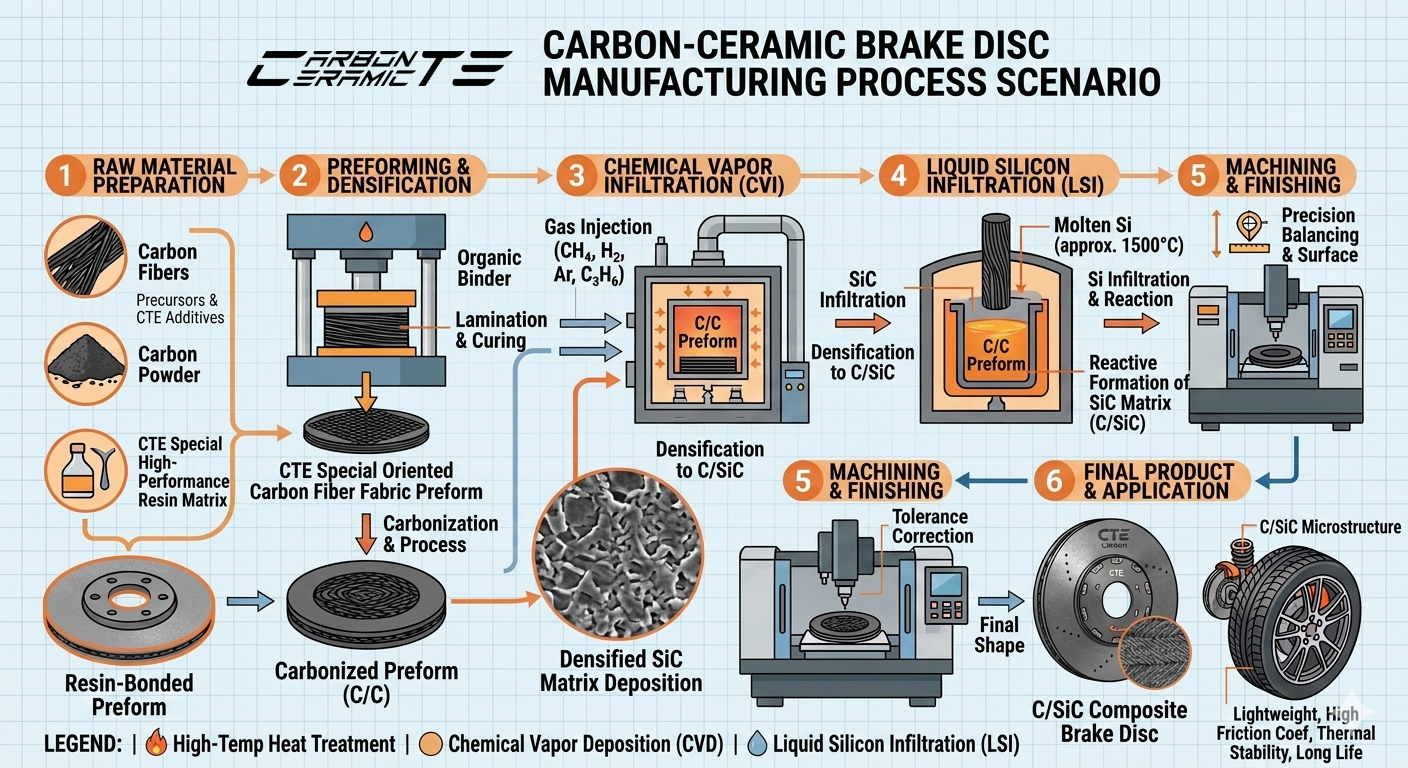
CTE's proprietary 5-step process transforms T700-grade continuous carbon fibers into high-performance Carbon/Silicon Carbide (C/SiC) ceramic brake discs — delivering 50% weight reduction and zero thermal fade at temperatures exceeding 1000°C.
Manufacturing process
Five stages, one continuous vertically-integrated line — no external sub-contractors at any point.
-
01T700 Continuous Fiber3D Needle-Punching
3D Fabric Preforming
T700-grade continuous carbon fibers are woven into a three-dimensional reinforcing matrix using patented needle-punching technology. Unlike discontinuous T300-grade fibers used in standard OEM discs, the continuous long-fiber architecture ensures isotropic strength and superior delamination resistance.

-
02Vacuum CarbonizationCVI Densification
Carbonization & Chemical Vapour Infiltration
The preform undergoes high-temperature vacuum carbonization to pyrolyze the fiber binder, followed by CVI in which hydrocarbon gases decompose and deposit a dense pyrolytic carbon (PyC) matrix, producing a Carbon/Carbon (C/C) composite intermediate.

-
031500°C Molten Silicon>2800 HV Hardness
Liquid Silicon Infiltration
The C/C preform is infiltrated with molten silicon at 1500°C in a vacuum furnace. Silicon reacts with free carbon to form Silicon Carbide (SiC) in-situ, converting the matrix into a C/SiC ceramic composite with hardness exceeding 2800 HV.

-
04±0.05mm ToleranceG2.5 Dynamic Balance
Precision Machining
CNC diamond grinding achieves final dimensional tolerances within ±0.05 mm, followed by ultrasonic drilling for ventilation channels. Dynamic balancing is verified to G2.5 standard.

-
0550% Weight ReductionZero Fade to 1000°C+
Quality Inspection & Application
Each disc passes dimensional, porosity, and dynamic balance inspection. The finished C/SiC disc delivers 50% weight reduction versus cast iron, stable friction from cold start to above 1000°C, and zero thermal fade under repeated race-condition stops.

Every disc is verified for dimensional accuracy, porosity, and dynamic balance before leaving the line.
Stable friction from cold start to above 1000°C, with zero thermal fade under repeated race-condition stops.
CTE Carbon: Engineering the future of braking
Aerospace-Derived Technology | Race-Proven Performance
More than an upgrade — a transformation
CTE Carbon Ceramic brake discs are crafted from next-generation Carbon Fibre Reinforced Ceramic (CFRC). Developed through years of intensive R&D for major European OEM manufacturers, our proprietary process transforms Carbon/Carbon (C/C) into Carbon/Silicon Carbide (C/SiC) — the same material class deployed in aerospace turbine components and Formula-class racing. If you have piloted a European Hypercar or a track-ready Porsche equipped with upgraded ceramics, you have likely already experienced the precision and quality of CTE.
The CTE advantage: continuous long-fiber technology
While most factory-standard carbon ceramic discs — such as the Brembo / SGL CCM — utilise T300-grade discontinuous (chopped) fibers, CTE utilises T700-grade continuous (long) fibers woven into a patented 3D matrix architecture. This distinction is fundamental: continuous fibers carry load along their full length, eliminating the micro-crack propagation pathways that limit chopped-fiber composites under repeated thermal cycling and mechanical stress.
| Feature | Standard OEM Discs (CCM) | CTE 3D Matrix (C/SiC) |
|---|---|---|
| Fiber Grade | T300 discontinuous (chopped) | T700 continuous (long fiber) |
| Fiber Architecture | 2D random mat | 3D needle-punched matrix |
| Matrix | Carbon/Carbon (C/C) or basic C/SiC | Proprietary C/SiC via LSI at 1500°C |
| Surface Hardness | ~1500–2000 HV | >2800 HV |
| Weight vs Cast Iron | ~40% reduction | ~50% reduction |
| Thermal Fade | Possible above 800°C | Zero fade to 1000°C+ |
| OEM Qualification | Standard OEM supply | European hypercar OEM qualified |