Calibrated for Public Road / Street Use — not the closed-track sequence
For Street Use Only
Standard CCM Bedding-In
A four-phase thermal transfer sequence for seating new pads onto Carbon Ceramic Matrix (CCM) rotors on public roads — building a stable friction layer without a closed circuit.
The bedding-in process (also known as burnishing or conditioning) for Carbon Ceramic Matrix (CCM) rotors is fundamentally different from traditional cast-iron rotors. While iron rotors are bedded to align the geometric surfaces, the primary goal for carbon ceramic rotors is "thermal transfer."
You must generate enough controlled heat to vaporize the binding resins within the brake pads and deposit a uniform transfer layer of friction material onto the ceramic rotor surface.
Without a proper bed-in, the system will lack stopping power, and you risk uneven pad deposition — which leads to premature pad wear, brake judder, or permanent rotor damage.
Street-use notice: this sequence is written for a safe, empty, wide-open public road — not a closed circuit. Only proceed where you can perform every deceleration legally and without endangering other road users. If a closed track is available, use the dedicated track-bedding procedure instead.
Bedding-In Sequence
Four phases, one continuous drive
Never come to a full stop between cycles — each phase builds directly on the heat carried from the last.
01
Phase 01
Initial Matting & Pre-Heating
80km/h→30km/h
Pedal Effort~30%
Light to moderate
REPEAT 5–10×
Execution
Apply light-to-moderate brake pressure (~30%) to slow the vehicle down from 80 km/h to 30 km/h.
Crucial
Do NOT come to a complete stop. Immediately accelerate back up to speed and repeat. This gradually brings the system up to initial operating temperature.
02
Phase 02
Thermal Transfer — Building the Layer
150km/h→50km/h
Pedal Effort~60–70%
Firm, heavy — just short of ABS
REPEAT 10–15×
Execution
Once the brakes are warm, increase speed. Apply firm, heavy pressure (~60–70%) from 150 km/h down to 50 km/h. Braking should be hard but just short of triggering the ABS.
Technique
Accelerate immediately after each cycle without letting the rotors cool down. By the 10th iteration, you should smell a strong odor of burning pad resin — this is completely normal and indicates the transfer layer is forming.
03
Phase 03
High-Temperature Hardening
180km/h→60km/h
Pedal EffortVery heavy
Maximum controlled braking
REPEAT 3–5×
Execution
If safety and track conditions permit, perform 3–5 very heavy braking cycles from 180 km/h down to 60 km/h to push the core temperature into its optimal performance window, finalizing the binding process.
04
Phase 04
Complete Cool-Down Drive
80km/h→100km/h
Pedal EffortZero
No braking whatsoever
DURATION 10–15 MIN
Most Critical
After the final heavy stop, keep the vehicle moving at a steady cruise (80–100 km/h) for 10–15 minutes without touching the brakes. Use ambient airflow to completely cool down the entire system.
Must Avoid
Critical rules
RULE 01
Never Come to a Complete Stop (0 km/h)
During the heating phases, never stop completely while holding the brake pedal down. The intense heat trapped between the stationary pad and the rotor will create an uneven patch of friction material (known as "pad imprinting"), causing permanent brake judder later on.
RULE 02
Avoid Triggering ABS / TCS
Bedding requires smooth, continuous, and high-load friction to generate heat. Avoid stomping the pedal so hard that the ABS engages — the pulsing action disrupts the uniform transfer layer creation.
RULE 03
Do Not Park or Engage the E-Brake Immediately
Parking a vehicle with blistering hot CCBs without a cool-down drive can cause the pad to weld to, or chemically damage, the rotor's silicon carbide surface structure.
Post-Bed Check
How to verify success
✓ Visual Check
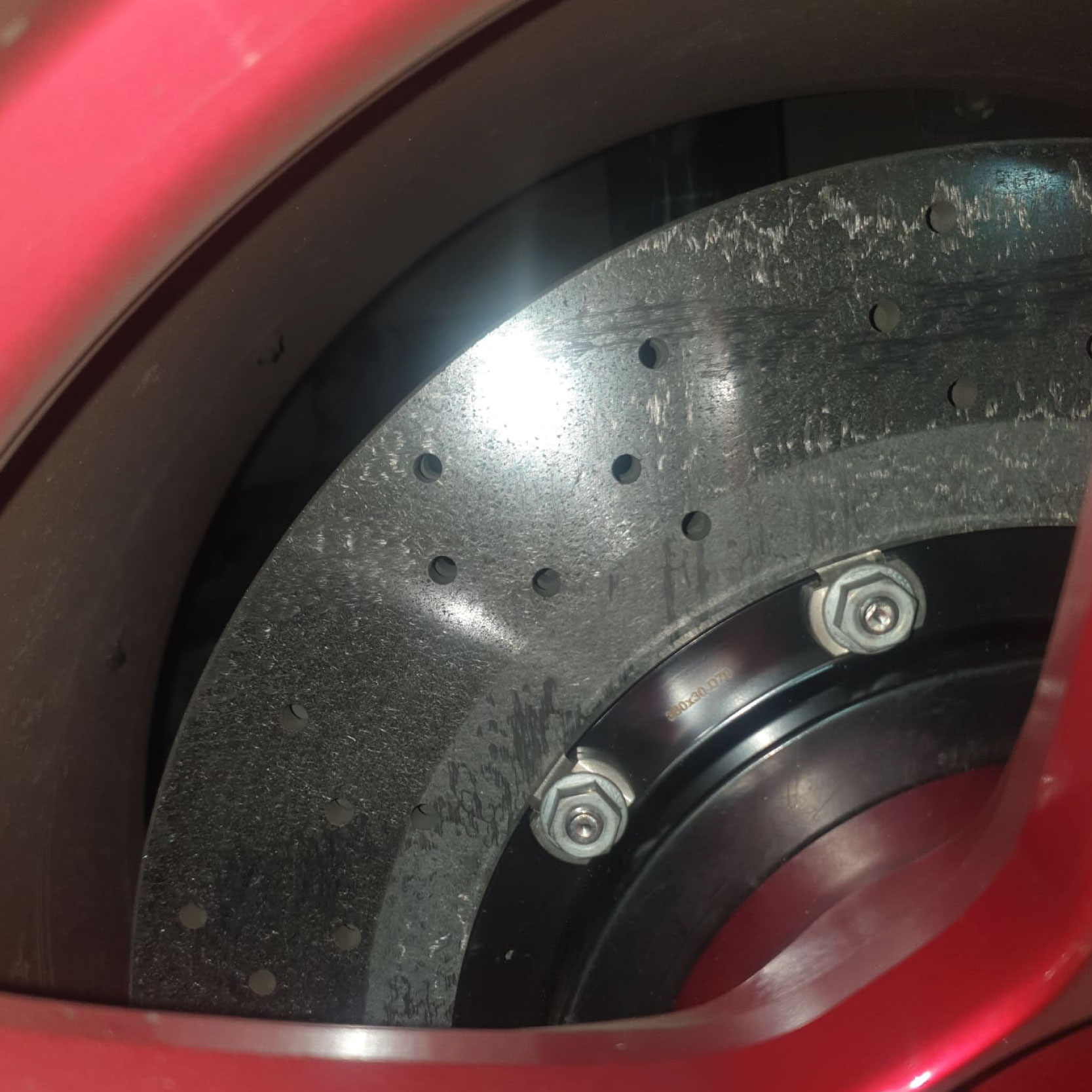
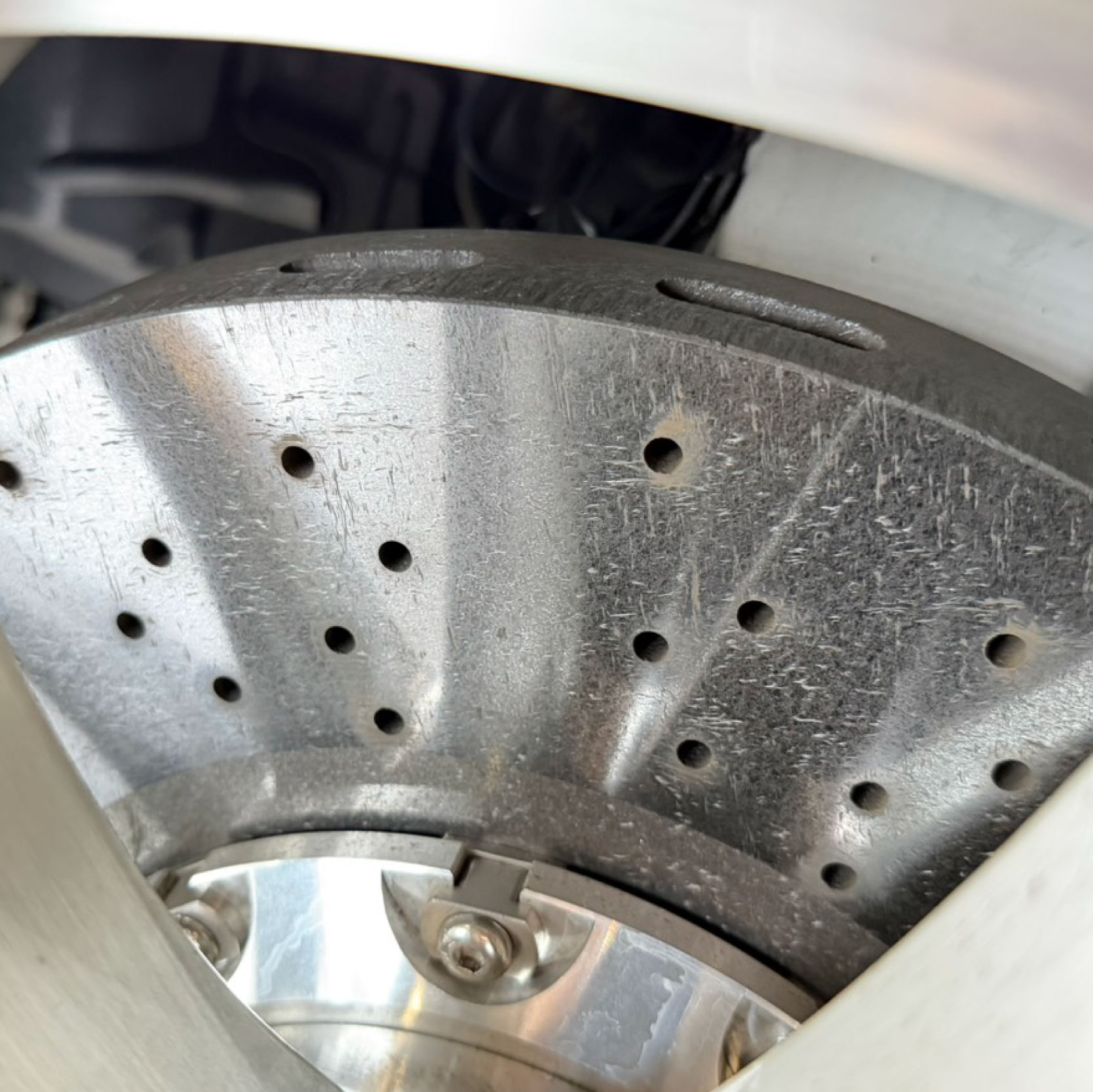
Once the brakes have completely cooled, inspect the rotor face. The fresh, shiny, or metallic sheen from the factory should be replaced by a consistent, dull, dark matte-gray finish across the entire swept area of the pad.
✓ Pedal Feel & Bite
Initially, fresh CCBs might feel woody, soft, or lack immediate bite. Once properly bedded, the pedal will feel incredibly firm, and you will experience that signature, massive "brick-wall" linear stopping power with minimal pedal effort.