Calibrated for Closed-Track / Racing Use — not the street sequence
For Track Use Only
CCM-R Motorsport
Bedding-In
A four-phase thermal build-up sequence for seating new pads onto CCM-R carbon ceramic discs on a closed circuit — from micro-geometric mating to full transfer-layer sintering.
Track-use notice: this sequence is written for a closed racing circuit (ideally during a dedicated free-practice session) or a fully secured private test track. Degrease and declutter the rotor faces with professional solvent brake cleaner before starting.
Bedding-In Sequence
Four phases, one continuous run
Never come to a full stop between cycles — each phase builds directly on the heat carried from the last.
01
Phase 01
Micro-Geometric Mating
100km/h→40km/h
Core Temp
~200°C
REPEAT 15–20×
Execution
Accelerate to 100 km/h on a straightaway. Apply light-to-moderate brake pressure (~25–30% pedal effort) to smoothly decelerate down to 40 km/h.
Technique
The moment you reach 40 km/h, do NOT stop. Immediately release the brake and accelerate back to 100 km/h. Keep intervals between cycles wide (at least 500 m) to let the brakes breathe.
Objective
Because the CCM-R rotor face is incredibly hard, this phase acts as a micro-file, shearing down manufacturing tolerances on the brand-new pads to ensure 100% surface contact before high heat is applied.
02
Phase 02
High-Density Thermal Stacking
160km/h→60km/h
Core Temp
450°C – 550°C
REPEAT 10–12×
Execution
Increase speed to 160 km/h. Initiate a sharp, assertive deceleration (~60–70% pedal effort) down to 60 km/h — threshold braking just short of ABS intervention.
Technique
Rapid, continuous bombardment. As soon as you hit 60 km/h, go wide-open throttle back to 160 km/h, then brake hard again. Shorten the distance between cycles to purposefully trap and stack heat within the rotor's core.
Objective
Drive the core system temperature into the 450°C–550°C window, where the active chemical compounds and bonding agents within the race pads begin to melt and liquefy — preparing for molecular transposition.
03
Phase 03
Motorsport-Grade Sintering
200km/h→60km/h
Core Temp
650°C – 750°C+
REPEAT 3–5×
Execution
On the main straightaway, reach 200 km/h (or the car's maximum safe track speed). Execute a race-intensity, violent deceleration (~80% pedal effort) down to 60 km/h.
Technique
Again, absolutely do not stop. Maintain the rhythm of immediate throttle application upon completing each deceleration.
What to Expect
A pungent, toxic chemical odor of burning resins will engulf the cabin, and visible smoke may billow from the wheel wells. A transient, slight softening of the pedal (pad fade) is normal outgassing behaviour.
Objective
Under extreme localized heat and crushing shear forces, the pad's friction elements are sintered and forced into the micro-pores of the CCM-R's 3D carbon matrix, cementing the ultimate Transfer Layer.
04
Phase 04
Forced Ambient Cool-Down
80km/h→120km/h
Core Temp
< 100°C
DURATION 15 MIN
Execution
Immediately following the final heavy stop, settle into a steady cruise between 80–120 km/h. Perform a slow cool-down lap or exit to an open paddock/perimeter road.
Technique
For the next 15 minutes, unless a major safety issue arises, keep your feet off the brake pedal entirely. Let clean, oncoming airflow bring the rotors from a glowing-hot state down below 100°C.
Objective
This allows the freshly molten transfer layer to undergo "thermal curing" — crystallizing and hardening its molecular structure uniformly, while relieving internal thermal stresses between the carbon disc and the metal bell housing.
Zero Tolerance
Critical trackside rules
CCM-R discs are absolute top-tier motorsport components. Strictly enforce these guardrails.
RULE 01
Never Come to a Complete Stop While Hot
During Phases 2 and 3, brake temperatures sit well over 600°C. Bringing the vehicle to a dead stop — even for a single second — while holding pedal pressure will brand a thick, localized blob of friction material onto that exact spot.
Consequence: A microscopic Thickness Variation (DTV) forms once the disc cools. On subsequent sessions, every pad sweep over the hardened imprint triggers violent steering-wheel judder and pedal pulsation — damage that typically requires specialized diamond resurfacing to correct.
RULE 02
Banish the Emergency / Electronic Parking Brake
When the vehicle completes Phase 4 and pulls into the pit box:
Correct protocol: Shut down the engine, shift into "Park" (or 1st gear for manual gearboxes), and immediately slide heavy race wheel chocks under the tires.
Forbidden: Never pull the handbrake or activate the EPB. The rear calipers retain extreme residual heat — any mechanical clamping force will deform the hot disc or trigger an irregular chemical weld between the rear pads and the carbon track.
RULE 03
Do Not Blindly Rely on "Pre-Bedded" Discs
Premium CCM-R components are pre-conditioned via a factory high-inertia dynamometer, but this only establishes an initial baseline layer on the disc itself. Differences in caliper piston alignment, hub face runout, and clamping tolerances mean Phase 1 (Mechanical Mating) must still be fully executed on every install. Skipping it will cause immediate localized hot-spotting on your first hot lap.
RULE 04
Zero Liquid or Compressed Air Contact While Hot
If rotors are radiant or ticking with extreme heat upon entering the pits, never spray them with water, cooling mists, or brake cleaner, and never blast compressed air directly at a localized spot. While CCM-R resists thermal shock phenomenally well, extreme localized temperature deltas will cause micro-cracking within the 3D-woven matrix — instantly scrapping the rotor.
Diagnostic Telemetry
Success vs. failure
▲ Successful Burnish
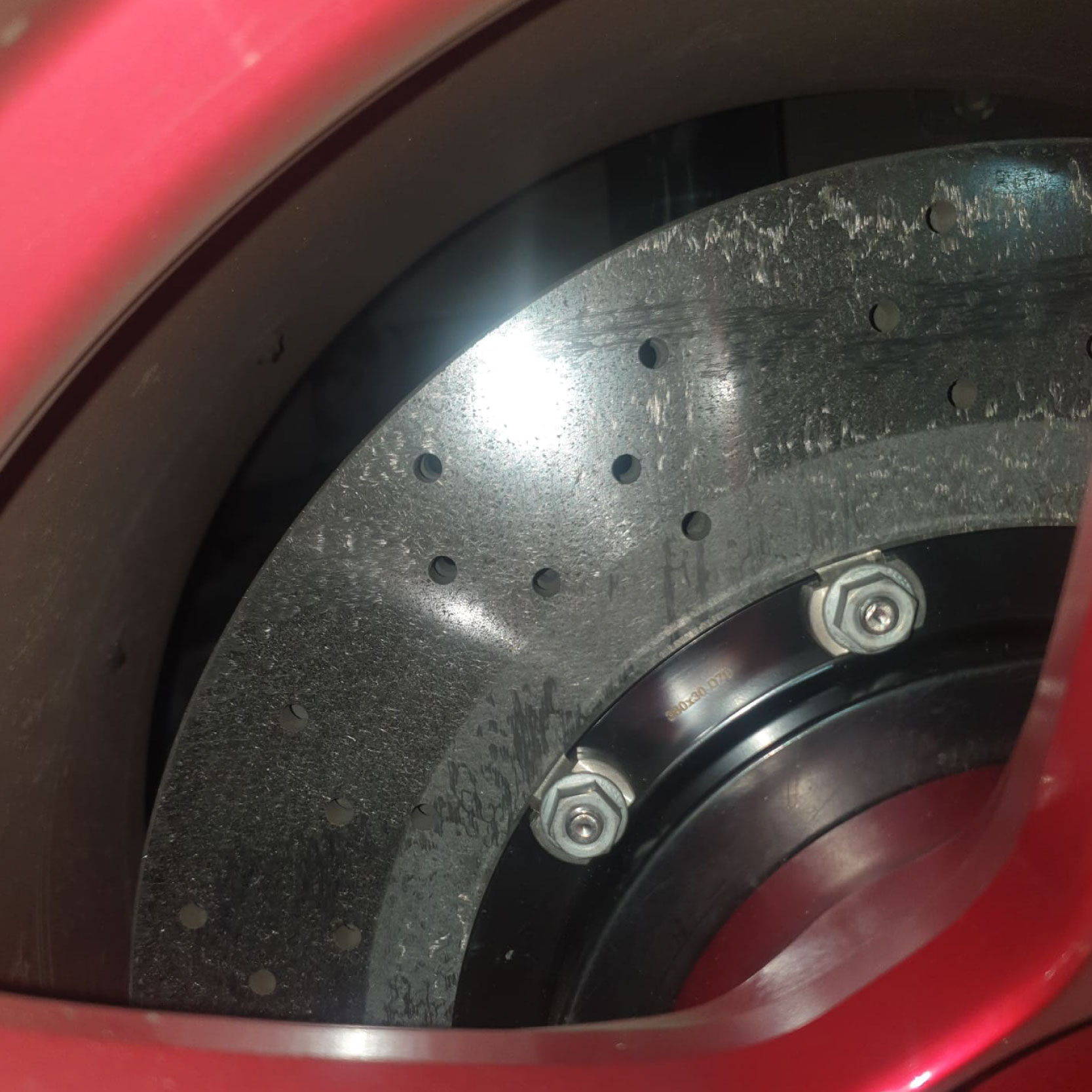
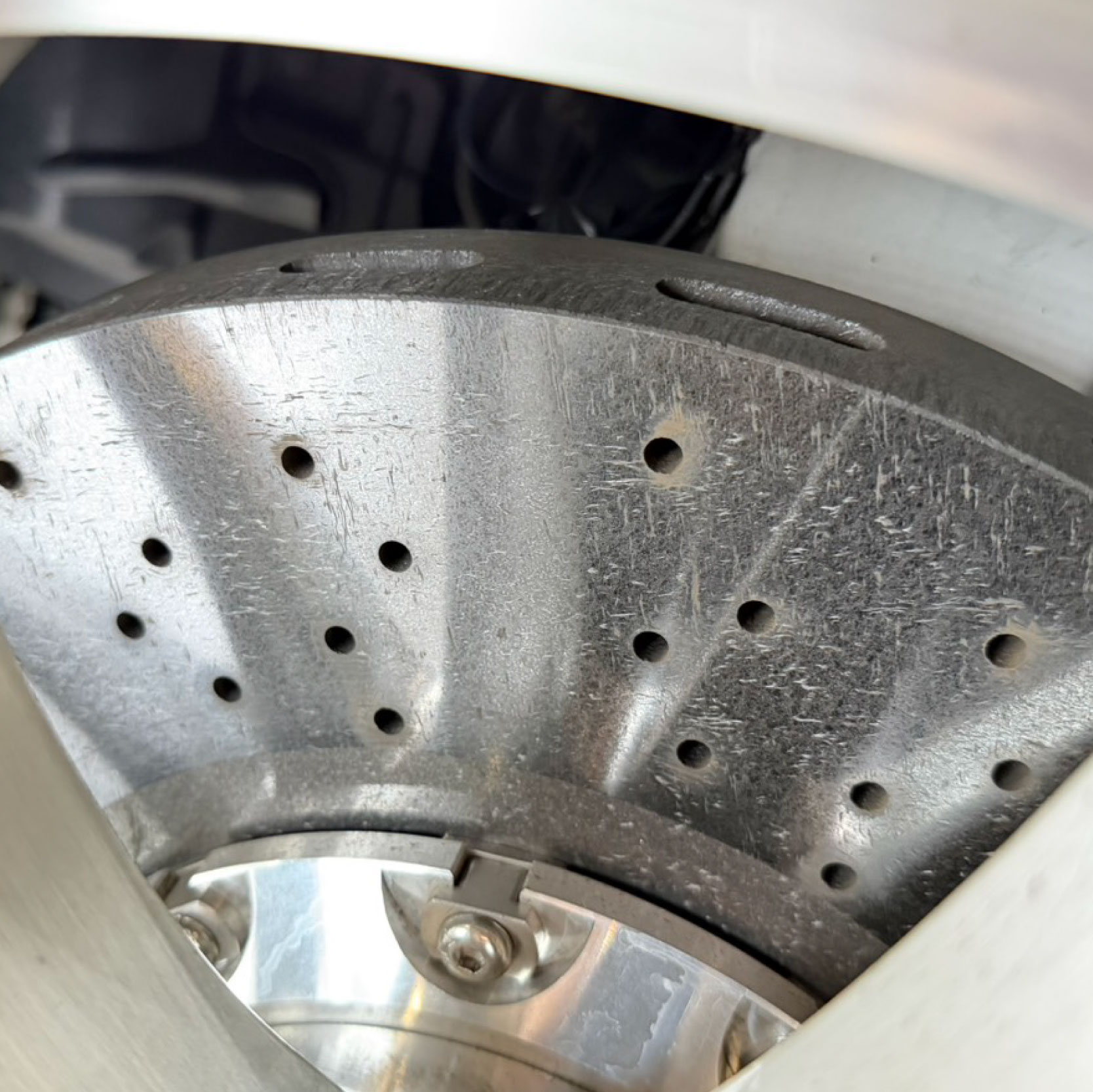
Once fully cooled to ambient, the glossy raw carbon finish is gone — replaced by a seamless, uniform, matte-gray or deep slate-blue transfer film across the swept track.
Pedal Feel
Initial "woody" numbness is replaced by an ultra-rigid, highly sensitive pedal with immediate, linear bite.
▼ Failed Bedding-In (Glazing)
Rushing into Phase 3 before completing Phase 1 flash-carbonizes the pad's bonding resins into an ultra-smooth, reflective glass-like crust.
Symptoms
Rock-hard pedal with near-zero actual stopping power, accompanied by a high-pitched metallic shriek.
Remedy
Pull the calipers, remove the pads, and use 80-grit sandpaper to grind off the glazed layer until fresh, porous compound is exposed. Reinstall and restart the sequence from Phase 1.