

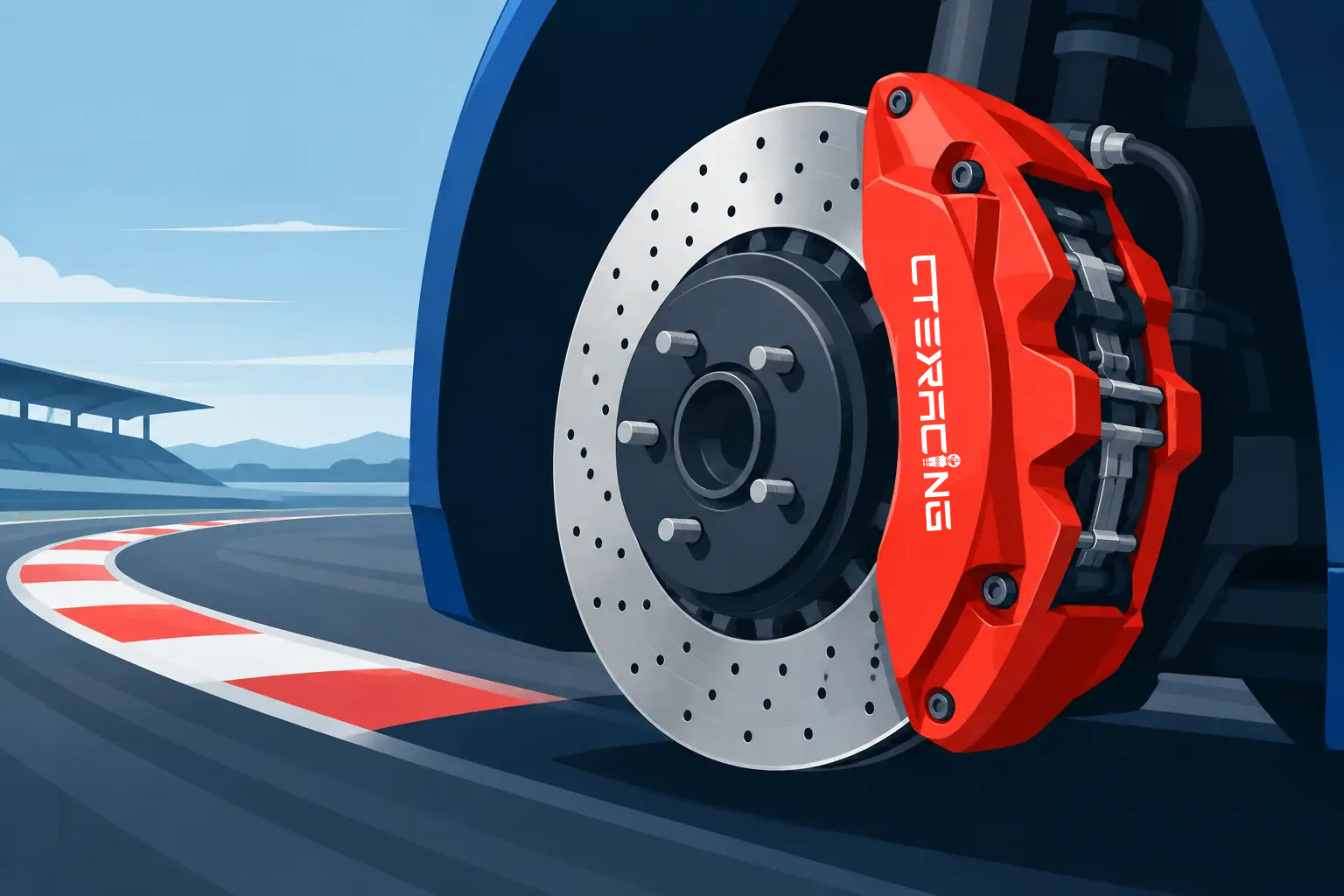
The brake pedal goes long at the end of a fast straight, and suddenly horsepower is irrelevant. Racing calipers are built for this moment: repeated high-energy stops where factory hardware can lose consistency, pads can overheat, and driver confidence can disappear. For performance shops, distributors, and serious vehicle owners, the right caliper is not a cosmetic upgrade. It is a structural part of a braking system designed to control heat, maintain clamp force, and deliver predictable response lap after lap.
What Racing Calipers Actually Do
A brake caliper converts hydraulic pressure from the master cylinder into clamping force at the brake pads. Those pads press against the rotor, creating the friction that slows the wheel. The principle is straightforward. The engineering challenge is keeping that force even, stable, and controllable when rotor temperatures rise and braking loads become extreme.
Compared with many original-equipment sliding calipers, fixed racing calipers use opposed pistons on both sides of the rotor. This layout applies pressure more directly and can support a larger, more evenly loaded pad. A rigid monobloc body limits flex under pressure, helping preserve pedal feel and pad contact across repeated heavy braking events.
More pistons do not automatically mean better brakes. Piston sizing, total piston area, master-cylinder compatibility, pad shape, rotor diameter, and vehicle weight must work together. An oversized caliper can create an unsuitable pedal ratio or disturb front-to-rear brake balance. Racing-grade hardware must be specified as a system, not selected by piston count alone.
Why Caliper Stiffness Changes Pedal Feel
Every caliper body deflects under hydraulic load. The question is how much. When a caliper flexes excessively, some pedal travel is used to deform the housing rather than pressing the pads firmly into the disc. Drivers experience this as a softer or less repeatable pedal, particularly once braking temperatures and pressures build.
A rigid forged or monobloc caliper helps keep hydraulic energy focused on pad clamping. That consistency matters when trail braking into a corner, managing a heavy SUV on a mountain road, or slowing a high-powered EV carrying substantial battery mass. The benefit is not simply a firmer pedal. It is a more reliable relationship between pedal input and vehicle deceleration.
Caliper construction also affects durability. Precision-machined bores, properly supported bridge sections, and controlled piston clearances reduce the chance of uneven pad movement or seal stress. For a workshop installing performance brakes on Porsche, BMW, Tesla, Nissan GT-R, Toyota Supra, Jaguar, Land Rover, Defender, or supercar platforms, these details are central to long-term customer satisfaction.
Piston Layout Is About Pressure Management
Opposed-piston calipers are often available in four-, six-, and eight-piston configurations. The proper choice depends on the rotor and pad package, axle load, tire grip, and intended use. A six-piston front caliper may be appropriate for a high-performance road car, while larger multi-piston arrangements can suit heavier vehicles or applications requiring more pad volume and thermal capacity.
Differential piston sizing is equally valuable. Pistons can be sized to account for the way a rotor moves through the pad, promoting more uniform pad wear and reducing taper. That may sound like a minor refinement, but even pad loading supports stable friction performance and allows the full pad surface to do its job.
Heat Control Starts at the Caliper
Brake fade is rarely caused by one component alone. It is the result of excessive thermal energy moving through pads, rotors, fluid, seals, and caliper bodies faster than the system can manage it. Racing calipers contribute by providing pad volume, controlled piston movement, and materials capable of operating near high-temperature brake components.
However, calipers cannot compensate for an undersized rotor or unsuitable pad compound. A vehicle that sees track use, repeated high-speed braking, towing, or steep descents needs enough rotor mass and airflow to absorb and reject heat. Carbon ceramic brake systems offer major advantages here, including reduced unsprung weight, strong resistance to thermal distortion, and stable performance across demanding temperature cycles. Their value is greatest when paired with calipers, pads, and mounting hardware engineered for the same application.
Thermal insulation between piston and pad can further reduce heat transfer toward the brake fluid and caliper seals. High-temperature seals and correctly selected fluid are also essential. If the fluid boils, even the best caliper cannot restore a firm pedal until the hydraulic system is serviced.
Racing Calipers Need Vehicle-Specific Fitment
A universal caliper is not a universal braking solution. The mounting position determines pad sweep over the rotor, caliper clearance governs wheel compatibility, and bracket geometry affects alignment under load. Small errors in these areas can lead to uneven pad wear, rotor interference, poor cooling, or contact with the wheel barrel.
A complete kit should account for caliper mounting brackets, rotor hat offset, rotor diameter and thickness, brake line routing, pad selection, wheel clearance, and the vehicle's parking-brake requirements. On modern platforms, the installation may also involve electronic parking brakes, brake wear sensors, ABS calibration considerations, and clearance around factory suspension components.
For distributors and installers, this is why documented fitment matters. A vehicle-specific system reduces installation uncertainty and prevents the costly cycle of modifying brackets, changing wheels, or troubleshooting poor pad contact after the vehicle is already on the lift.
Wheel Clearance Cannot Be Assumed
Large calipers and rotors often require larger wheels, but wheel diameter alone is not enough. Spoke profile and barrel shape determine whether a wheel clears the caliper face and bridge. Two 19-inch wheels can have very different internal clearance.
Before approving an order, verify the supplied fitment data against the actual wheel design whenever possible. This is especially important with aftermarket forged wheels, concave wheel faces, and vehicles that have been converted from factory brake packages. Correct clearance protects both the caliper finish and the wheel, while eliminating a preventable installation delay.
Choosing the Right Caliper for Road and Track Use
The best racing calipers are not always the largest or most aggressive-looking units. A road-driven performance car may prioritize cold response, low noise, dust management, corrosion resistance, and practical pad availability alongside high-temperature capability. A dedicated track car can accept more frequent inspections, faster pad wear, and a narrower operating window in exchange for maximum thermal capacity.
A useful specification process starts with the vehicle's real braking demand. Consider curb weight, power level, tire compound, typical speed, track duration, ambient temperature, and how often the brakes will see repeated threshold stops. Then match the caliper to a rotor and pad package that can handle that energy without compromising brake balance.
Do not overlook serviceability. Accessible pad retention hardware, available seal kits, accurate torque specifications, and technical support all matter to a professional workshop. A brake system that performs well but is difficult to inspect or service creates avoidable downtime for both installer and owner.
Manufacturing Control Is a Safety Requirement
Calipers are safety-critical components. Material selection, machining accuracy, anodizing or protective finishes, piston tolerances, hydraulic sealing, and pressure testing cannot be treated as separate concerns. Inconsistent production can create uneven performance between batches, which is unacceptable for braking hardware sold into demanding performance applications.
CCYS controls approximately 90% of production in-house, from R&D and precision machining through quality management. Backed by IATF 16949 and ISO 9001 quality systems, that manufacturing control supports consistency across complete carbon ceramic brake kits, monobloc calipers, rotors, pads, hubs, and supporting components. It also gives professional buyers a direct technical path when fitment or application requirements need clarification.
The right braking upgrade should make the driver more confident, not more cautious. Specify racing calipers around the vehicle, the rotor, the pad, and the intended duty cycle, then install and maintain the system with the same discipline used to build it. When the next braking zone arrives faster than expected, that engineering discipline is what remains between control and compromise.