

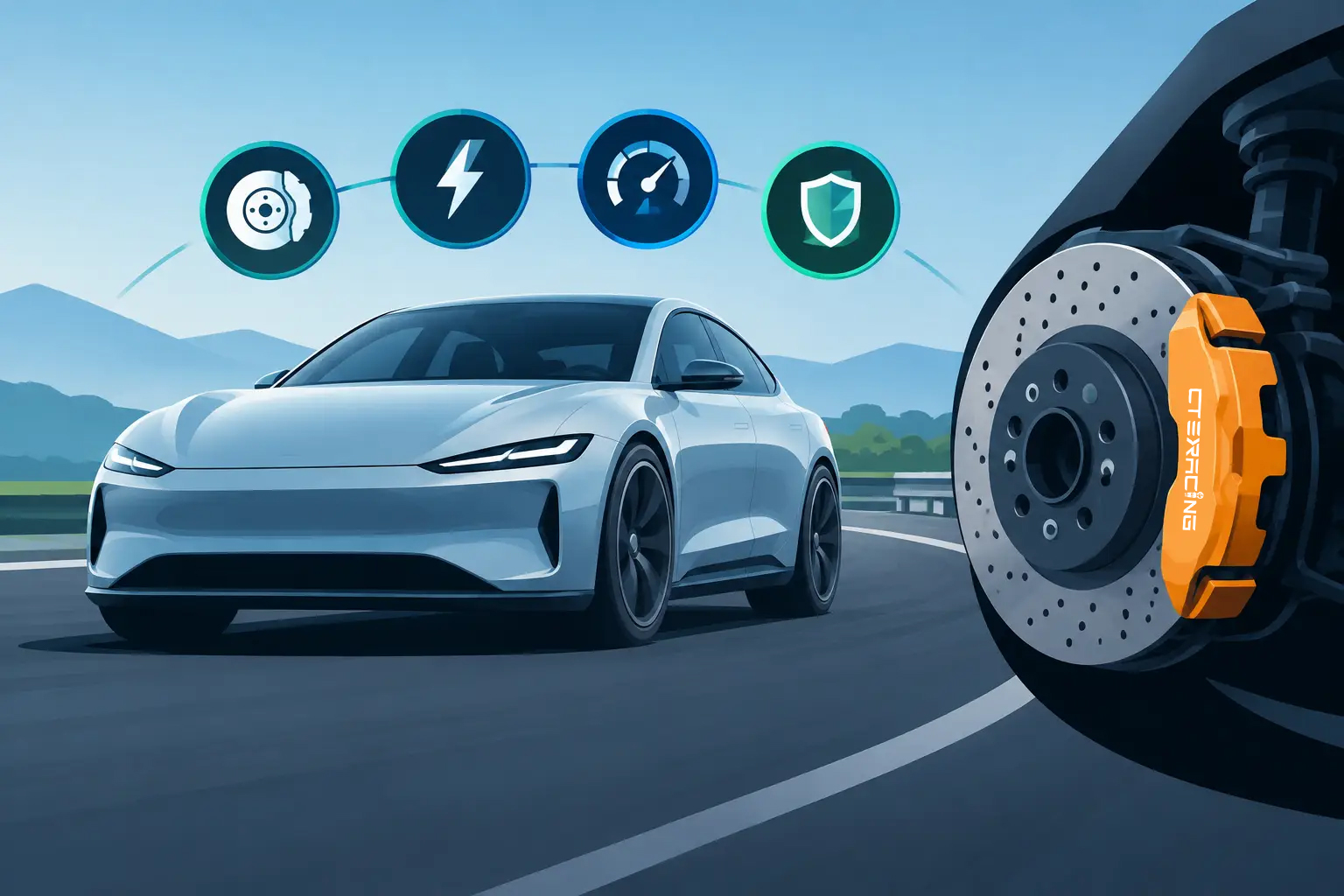
A heavy EV can reach highway speed with the urgency of a supercar, then ask its brakes to erase that momentum repeatedly. That is where weak component selection becomes more than an inconvenience. A soft pedal, inconsistent response, overheated friction surfaces, or poor brake balance can quickly turn impressive acceleration into a serious confidence problem.
The most consequential EV braking trends are not simply about installing bigger rotors. They involve managing vehicle mass, regenerative braking behavior, repeated thermal load, corrosion during low friction-brake use, and the calibration realities of electronically controlled brake systems. For performance workshops and distributors, the opportunity is clear: EV braking upgrades must be engineered as vehicle-specific systems, not sold as cosmetic hardware.
EV Braking Trends: More Mass, More Heat, Higher Expectations
Battery packs add substantial vehicle mass, even when the platform is built around a low center of gravity. A high-performance EV may also deliver full torque immediately, allowing drivers to reach braking zones faster and more often than they would in a comparable combustion vehicle. The energy the brake system must manage rises sharply with speed and vehicle weight.
Regenerative braking changes the picture, but it does not eliminate the need for serious friction brakes. During moderate deceleration, the electric motor can recover energy and reduce demand on the pads and rotors. During hard stops, repeated mountain descents, track laps, low-battery conditions, or situations where regeneration is limited, friction brakes still carry a major share of the work.
This is why larger disc diameters, higher-capacity calipers, improved airflow, and materials with stronger thermal stability are gaining attention across premium EV applications. The goal is not merely a higher peak stopping number. The goal is consistent pedal feel and controlled deceleration after the first hard stop, the fifth hard stop, and the next session.
Thermal capacity matters more than peak claims
A brake package can appear powerful in a single-stop test and still struggle under repeated use. Heat is the real test. Once temperatures exceed the effective range of a pad compound, friction can fall, pedal travel can change, and rotor surfaces can develop uneven transfer layers or thermal damage.
Performance EVs need braking systems that account for rotor mass, ventilation design, pad volume, caliper stiffness, and the heat path through the complete assembly. A racing-grade system should maintain structural integrity and predictable response rather than relying on aggressive initial bite alone. For a heavy SUV, luxury sedan, or modified Tesla, that distinction is critical.
Regenerative Braking Is Changing Friction-Brake Service Needs
One of the less obvious EV braking trends is that friction brakes may be used less frequently in normal driving. That sounds beneficial, but reduced use creates its own maintenance and performance concerns. Rotors can corrode, pads can glaze, slide mechanisms can bind, and surface contamination can affect the first meaningful hard stop.
This is especially relevant in wet, coastal, or winter climates. An EV driven primarily with strong one-pedal regeneration may not apply enough friction braking to keep conventional iron rotor surfaces clean. The result can be noise, roughness, uneven response, or premature replacement despite low apparent pad wear.
For workshops, the correct approach is to inspect the full system rather than judge condition by pad thickness alone. Rotor condition, hardware movement, caliper operation, brake-fluid health, and electronic fault data all matter. Owners should also understand that occasional firm, safe friction-brake application can help maintain rotor and pad surfaces when vehicle operating conditions allow.
Carbon ceramic systems can offer a meaningful advantage where low weight, corrosion resistance, and high-temperature durability are priorities. However, material selection must fit the use case. A premium street EV that sees occasional spirited driving has different requirements from a track-focused build running repeated high-energy sessions. Carbon ceramic hardware is not a universal answer if the pad compound, caliper specification, and vehicle integration are wrong.
Brake-by-Wire Requires Complete-System Thinking
Many EVs use blended braking strategies controlled by software. The vehicle continuously determines how much deceleration comes from regeneration and how much comes from hydraulic friction braking. Pedal feel may be created or adjusted electronically rather than following the direct mechanical relationship familiar from older vehicles.
That makes aftermarket brake selection more technical. Changing rotor dimensions, caliper piston area, pad friction characteristics, or hydraulic volume without understanding the original system can affect pedal travel, front-to-rear balance, ABS behavior, and stability-control intervention. Bigger is not automatically better.
A properly engineered kit needs vehicle-specific mounting geometry, correct disc offset, appropriate piston sizing, and clearance confirmation for the wheel design. It must also preserve the operating range expected by the vehicle's electronic control systems. On platforms with advanced driver-assistance functions, careless modifications can introduce problems that may not be obvious during a short road test.
For distributors and performance shops, this supports a move away from universal component sales toward complete application-based packages. The strongest solutions pair rotors, calipers, brackets, pads, lines, hardware, and fitment documentation. Technical support is part of the product because EV brake upgrades demand accurate installation and verification.
Lower Unsprung Weight Is Now a Performance Advantage
EV performance conversations often focus on battery capacity and motor output, but unsprung weight remains fundamental. Heavy wheels, rotors, and calipers affect how quickly the suspension can control tire contact over uneven surfaces. Reducing mass at the wheel can improve steering response, ride control, and suspension reaction while also lowering rotational inertia.
This is one reason carbon ceramic discs remain relevant in high-end EV and hybrid builds. Their potential weight savings can be substantial compared with large iron discs, particularly when a vehicle needs greater rotor diameter to handle added mass. Less unsprung mass does not replace correct damping, tire selection, or suspension geometry, but it can improve the quality of the entire chassis response.
The trade-off is commercial as well as technical. Carbon ceramic systems carry a higher initial cost, and replacement planning must be discussed honestly with the customer. For daily-driven vehicles that never face high thermal demand, a well-designed iron rotor and performance pad package may be the more rational choice. For premium vehicles, repeated high-speed use, or customers seeking corrosion resistance and a lighter wheel-end assembly, carbon ceramic can justify its position.
Pad Compounds Are Becoming More Application-Specific
The pad is where braking torque is created, and it must work across a broader range of real-world conditions than many buyers expect. EVs require compounds that deliver stable friction under high load but remain controlled during low-temperature city driving. Noise, dust, rotor compatibility, cold bite, and fade resistance must all be balanced.
An aggressive track compound may tolerate extreme temperature but produce unacceptable noise or poor cold response on a luxury street vehicle. A quiet low-dust pad may suit commuter use but lose consistency during repeated hard stops. The correct recommendation depends on vehicle weight, tire grip, power output, regenerative-braking setting, climate, and driving purpose.
This is also why caliper stiffness and piston design matter. A rigid monobloc caliper can support more consistent pad loading and pedal response under high pressure. Yet it must be matched to the master cylinder, brake bias, and rotor dimensions. The system is only as capable as its least compatible component.
What Performance Buyers Should Ask Before Upgrading
A credible EV brake proposal should answer practical questions before hardware is ordered. Is the vehicle used for daily commuting, canyon driving, towing, track events, or all of them? Does it run larger wheels and tires? Are clearance templates available? Is the upgrade designed around the factory electronic brake architecture? What is the expected maintenance path for pads, discs, and hardware?
Buyers should also ask how the manufacturer controls machining, materials, and quality verification. CCYS produces 90% of its braking systems in-house and works under IATF 16949 and ISO 9001 quality standards, providing the process control that performance applications require. That level of manufacturing ownership matters when component fitment, thermal behavior, and long-term consistency are on the line.
The Next EV Brake Upgrade Must Be Purpose-Built
The market is moving beyond the idea that EV brakes are either stock replacements or oversized show pieces. The next generation of upgrades will be lighter, more thermally capable, more application-specific, and more carefully matched to electronic brake control.
For performance professionals, the best recommendation starts with the vehicle's actual braking duty cycle, then builds a complete system around it. When the vehicle is heavy, fast, and driven hard, braking confidence should never depend on guesswork.