

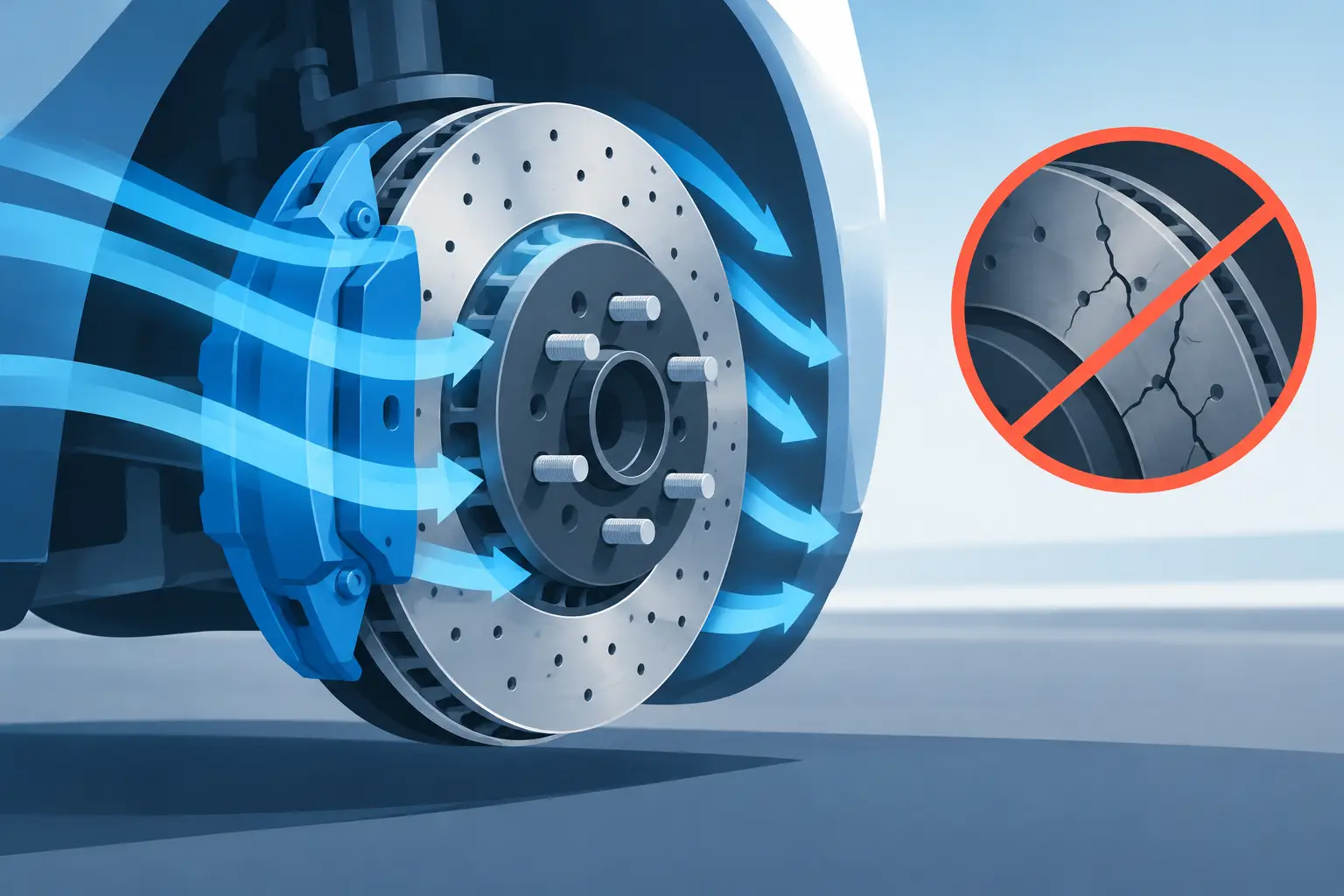
A crack across a brake rotor is not a cosmetic problem. Under repeated high-speed stops, it can signal that the disc has been pushed beyond its thermal limits, its cooling path has been compromised, or the entire brake system is mismatched for the vehicle’s duty cycle. So, can brake cooling prevent cracking? Often, yes - but cooling is only one part of a properly engineered solution.
For track-driven street cars, heavy luxury SUVs, modified EVs, and high-horsepower builds, brake temperatures can rise and fall violently within minutes. The objective is not simply to make the brakes run colder. It is to manage heat evenly, move it out of the rotor efficiently, and avoid the concentrated thermal stress that starts cracks.
Can Brake Cooling Prevent Cracking? It Can Reduce the Risk
Brake cooling can significantly reduce the chance of heat-related cracking by lowering peak rotor temperature and reducing the temperature difference between the disc’s friction surface, internal vane area, hat section, and outer edge. That difference matters. When one part of a rotor expands much faster than another, the material is placed under stress. Repeat that cycle hard enough and often enough, and small surface checks can develop into visible cracks.
A well-designed cooling system supplies controlled airflow to the rotor’s center or inlet face, where internal vanes can pull air through the disc. This is more effective than directing air randomly at the outside of the rotor. Cooling the friction ring unevenly can create its own localized thermal shock, particularly when a very hot disc is hit with excessive airflow or water.
Cooling cannot rescue a rotor that is undersized, poorly manufactured, incorrectly installed, or used beyond its intended operating range. Nor can it correct caliper drag, a sticking pad, poor brake balance, or a driver who stays on the pedal too long. It reduces thermal load. It does not erase the underlying cause of that load.
Why Brake Rotors Crack Under Severe Use
Rotor cracking is commonly blamed on “overheating,” but that description is incomplete. A rotor may survive very high temperatures when it heats and cools uniformly. Cracking becomes more likely when temperature is uneven, the cooling cycle is too abrupt, or the disc repeatedly exceeds the stress level its material and design can tolerate.
Thermal cycling creates fatigue
Every hard stop heats the rotor. Every straight, cooldown lap, or road section lets it shed heat. This expansion-and-contraction cycle is normal, but extreme cycles create fatigue over time. On a heavy vehicle or a car with major power increases, stock-size iron rotors may be asked to absorb energy they were never designed to manage.
Fine heat checking on a track rotor is not always an immediate safety failure. Small superficial checks can occur in demanding motorsport use. The concern rises when cracks extend toward cooling vanes, drilled holes, mounting areas, or the edge of the friction ring. Those conditions require inspection and, in many cases, rotor replacement.
Hot spots concentrate stress
Hot spots occur when pad material transfers unevenly or when the rotor sees inconsistent contact pressure and temperature. Drivers may feel this as vibration, pulsation, or a change in pedal feedback. The problem is often called a warped rotor, but many cases involve uneven friction deposits and disc thickness variation rather than a permanently bent disc.
A dragging caliper, seized slide hardware, incorrectly bedded pads, or a pad compound that is unsuitable for the rotor can all create hot spots. More cooling helps only after those mechanical and friction-related faults are corrected.
Rotor geometry and material matter
Rotor mass, friction-ring thickness, vane design, metallurgy, and machining accuracy determine how a disc handles heat. Larger-diameter rotors increase leverage and can provide more thermal capacity. Proper internal vanes draw air through the disc, while a carefully engineered two-piece configuration can separate the high-heat friction ring from the mounting hat more effectively.
Drilled rotors require particular attention. Holes may support gas evacuation and reduce mass, but they also create stress concentrations. On a high-heat application, drilled patterns must be engineered with the rotor material, thickness, and intended service conditions in mind. A decorative drilling pattern is not a substitute for thermal engineering.
Effective Brake Cooling Starts at the Rotor Center
The best brake ducting delivers air where the rotor can use it. Ideally, a duct captures relatively high-pressure air from the front of the vehicle and feeds it through heat-resistant hose toward a backing plate or deflector behind the rotor. The backing plate directs air into the rotor vane inlet, allowing the disc to act like a centrifugal pump as it turns.
This approach cools the rotor from the inside out. It supports more consistent temperatures across the friction ring and reduces the chance of repeatedly cooking the inner disc area while the outer face receives most of the airflow.
Duct placement needs to respect suspension movement, steering angle, tire clearance, wheel travel, and road debris. A hose that collapses, rubs through, or directs air into the wrong location will not deliver reliable results. For performance workshops, this is why vehicle-specific brake and cooling solutions are preferable to universal components fitted by guesswork.
Airflow also depends on the wheel. Tight-spoke wheels, enclosed wheel designs, and poorly positioned dust shields can retain heat around the caliper and rotor. Conversely, an open wheel is not automatically a cooling solution if air cannot enter the rotor’s internal vane path.
Cooling Is Only One Part of Crack Prevention
A complete braking system manages energy from pedal input to tire contact patch. The rotor is central to that process, but it does not work alone. The right combination of caliper stiffness, piston sizing, pad compound, rotor size, brake fluid, lines, wheel fitment, and cooling capacity determines whether the system remains controlled when braking demand rises.
Pad selection deserves special attention. An aggressive track pad can deliver strong bite, but it may operate at temperatures that overwhelm an OEM rotor or create excessive heat transfer into the disc. A street-oriented pad may feel refined during normal driving but fade during repeated high-energy stops, causing the driver to apply more pressure and extend braking zones. The correct pad is the one matched to vehicle weight, tire grip, speed, and real operating temperature.
Brake bias matters as well. If one axle is consistently overloaded, its rotors will run hotter and wear faster. Upgrading only the front brakes can be appropriate, but the final system must maintain predictable balance and work with the vehicle’s ABS and stability-control strategy.
Carbon ceramic systems offer a different approach to repeated heat exposure. A quality carbon ceramic disc provides high thermal resistance, major weight reduction, and strong durability when engineered as a complete vehicle-specific system. However, carbon ceramic is not a universal answer. Pad compatibility, warm-up characteristics, driving environment, and replacement cost must all be considered. A performance brake upgrade should match the customer’s actual use, not just the vehicle’s badge.
Driving and Service Practices That Protect Rotors
Even the strongest hardware can be damaged by poor operation or neglected maintenance. After a hard session, use a controlled cooldown period rather than stopping immediately and holding the brake pedal at maximum pressure. Parking with hot pads clamped against a glowing rotor can transfer material unevenly and create a localized hot spot.
Avoid spraying cold water directly onto hot brakes. The rapid temperature change can shock the rotor surface and increase stress, especially after track use or mountain driving. Inspect rotors regularly for cracks, discoloration, uneven deposits, scoring, and changes around drill holes or vane openings. Measure disc thickness and compare it with the manufacturer’s minimum specification rather than judging condition by appearance alone.
For workshops, correct installation is equally critical. Torque wheel hardware to specification, clean hub faces, verify rotor runout, bed pads correctly, and inspect caliper movement. A premium rotor mounted on a corroded or uneven hub can develop runout and uneven pad contact from its first miles of service.
Build for the Heat Your Vehicle Actually Produces
Brake cooling is a valuable crack-prevention tool because it lowers and stabilizes rotor temperatures. But airflow works best when it supports a system with sufficient rotor capacity, correct vane direction, compatible pads, stable calipers, and accurate installation. Treat cooling ducts as part of the brake package, not an accessory added after repeated failures.
For demanding Porsche, Tesla, BMW, Nissan GT-R, Supra, Defender, and supercar applications, CCYS develops racing-grade carbon ceramic brake systems with vehicle-specific fitment, thermal-resistant materials, and factory-controlled quality. Before selecting any upgrade, define the vehicle’s weight, power, wheel package, driving environment, and braking duty cycle. That is where a brake system begins to earn confidence - before the next hard stop asks more of it than it can safely deliver.