

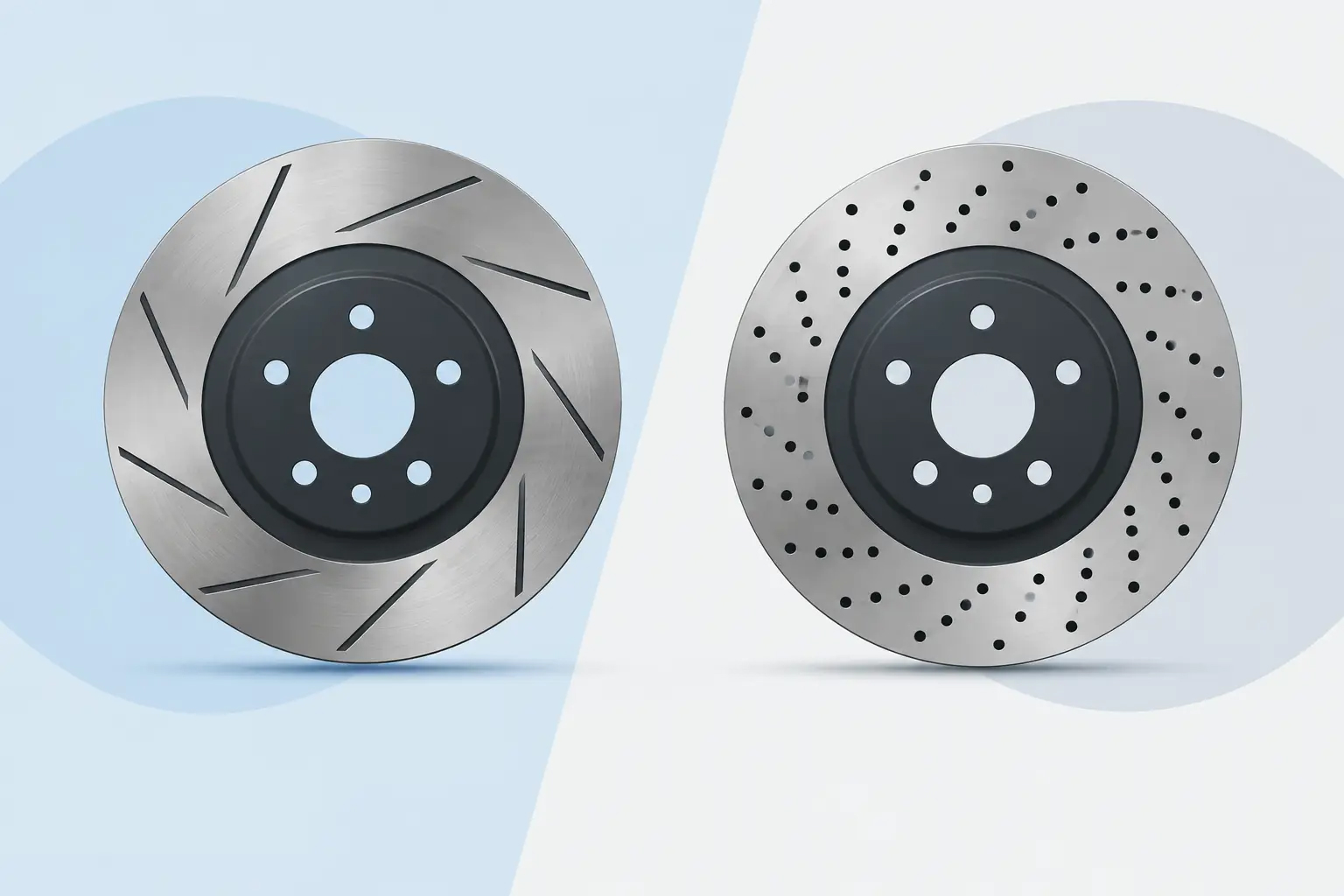
A hard stop should feel controlled, repeatable, and predictable. When a performance vehicle enters a braking zone at speed, the rotor cannot be treated as a cosmetic part behind the wheel. Its surface design affects pad behavior, heat management, noise, durability, and driver confidence. The slotted versus drilled rotors decision is therefore not about appearance alone. It is about matching a rotor design to the vehicle, brake material, pad compound, and the severity of the work it must perform.
For distributors, workshops, and serious drivers, the correct answer is rarely universal. A Porsche used for canyon driving and occasional track days has different priorities than a Tesla carrying substantial battery weight through repeated urban stops. A Nissan GT-R used in high-temperature track sessions requires another level of thermal discipline. The best choice begins with the braking duty cycle, not the visual preference.
Slotted Versus Drilled Rotors: The Functional Difference
A slotted rotor uses machined channels across the friction face. As the rotor turns, those slots help refresh the pad surface by sweeping away worn pad material, gases, water, and debris. The goal is a more consistent pad-to-rotor interface during demanding use. Slots can also provide a clearer visual indication of rotor condition as they gradually wear.
A drilled rotor uses holes through the friction surface. These holes can reduce mass and provide paths for water and gases to escape, which can improve wet-weather bite and give the brake system a distinctive performance appearance. On suitable applications, a properly engineered drilled pattern can be an effective part of a complete brake package.
The essential distinction is structural. Slots remove material from the surface without creating a full hole through the disc. Drilling creates stress concentration points that demand careful material selection, rotor thickness, hole geometry, thermal processing, and manufacturing control. That difference matters most when rotor temperatures climb rapidly.
When Slotted Rotors Are the Stronger Performance Choice
Slotted rotors are commonly favored for repeated high-energy braking because their friction surface is generally more resistant to cracking under severe thermal cycling than a conventionally drilled disc. During track use, heavy SUV braking, or spirited driving in a high-output vehicle, the rotor repeatedly expands and contracts. A slot design preserves more of the disc's continuous structure while helping maintain a clean contact patch.
This makes slotted designs especially relevant for vehicles that see frequent hard stops, aggressive pad compounds, or elevated vehicle mass. They are a practical choice for track-oriented BMW, Toyota Supra, GT-R, and supercar applications where consistent braking behavior matters more than a polished showroom look.
There is a trade-off. Because slots continually condition the pad surface, pad wear can be somewhat higher than with a plain rotor. Depending on the slot pattern and pad material, drivers may also hear a light sweeping sound during braking. For a performance-focused customer, that is usually a reasonable exchange for sharper response and stable braking under load. For a quiet luxury street vehicle, it may be less desirable.
Slot Design Matters More Than Slot Count
Not all slotted rotors perform the same way. Slot angle, depth, width, edge finish, and placement affect how the pad engages the disc. Excessive or poorly finished slotting can accelerate pad wear without delivering a meaningful benefit. The rotor must also retain enough thermal mass and structural integrity for the caliper, pad, wheel, and intended operating temperature.
For this reason, workshops should evaluate the rotor as part of a system. Pairing a slot pattern with the wrong pad compound, incorrect bedding procedure, or inadequate cooling can create noise, uneven deposits, and inconsistent pedal feel. A performance rotor is not a substitute for correct installation and brake-system setup.
Where Drilled Rotors Make Sense
Drilled rotors remain popular for street performance, premium vehicle upgrades, and applications where wet performance, reduced rotating mass, and visual appeal are valuable. They can work very well when they are engineered for the material and use case rather than added as an afterthought.
For many road-driven luxury and sports vehicles, a drilled rotor can offer confident initial bite and effective water evacuation in wet conditions. Drivers who want a clean OEM-plus appearance often prefer the drilled look behind open-spoke wheels. When paired with a compatible pad and used within its intended temperature range, this configuration can deliver a satisfying street braking experience.
The limitation appears during sustained high-temperature operation. Under repeated heavy braking, drilled holes can become locations where heat stress concentrates. This does not mean every drilled rotor will crack, nor does it mean drilling is automatically unsuitable for performance use. It means rotor construction and duty cycle must be considered honestly. A low-cost drilled rotor fitted to a high-mass, high-horsepower vehicle and then subjected to track abuse is a poor engineering match.
Cast-In Holes Versus Post-Drilled Holes
The manufacturing method deserves close attention. Holes integrated during casting or formed through a controlled production process may behave differently from holes drilled into an already finished conventional rotor. The exact outcome depends on the rotor material, heat treatment, design, and quality control.
For professional buyers, the practical lesson is straightforward: do not evaluate drilled rotors only by hole count or appearance. Ask how the disc is engineered, what temperatures it is designed to handle, and whether the brake kit has been validated for the specific vehicle platform. Fitment, caliper piston sizing, pad shape, disc thickness, and mounting hardware all influence real braking performance.
Carbon Ceramic Changes the Conversation
Carbon ceramic brake discs operate differently from conventional iron rotors. Their material properties, heat behavior, friction characteristics, and manufacturing requirements call for a purpose-designed brake system. Applying assumptions from low-cost iron rotor upgrades to carbon ceramic systems can lead to the wrong selection.
In a high-quality carbon ceramic system, drilled or patterned surfaces may be engineered into the disc design to manage water, debris, and interface behavior while protecting the structural integrity required for high-temperature use. The pattern is not merely decorative. It is part of a larger design that includes the carbon ceramic disc, friction layer, pad compound, caliper stiffness, mounting bell, and thermal expansion strategy.
Carbon ceramic systems also offer a major unsprung-weight advantage, which can improve steering response, suspension control, and overall vehicle behavior. Yet the benefits depend on correct fitment and compatible components. A premium brake conversion should be supplied as a complete, vehicle-specific system, not assembled from unrelated parts.
CCYS applies this system-level approach through in-house control of core production processes, with 90% of manufacturing completed internally and quality management supported by IATF 16949 and ISO 9001 standards. For distributors and workshops, that production control is more meaningful than surface styling alone. Consistency in disc manufacture, hardware, machining, and application engineering is what supports repeatable braking performance.
Choose by Duty Cycle, Not by Trend
The most reliable selection starts with how the vehicle is actually driven. A street-focused premium sedan that encounters rain, traffic, and occasional spirited use may be well served by an engineered drilled rotor package. A track-driven coupe, high-power street car, or heavy performance SUV that repeatedly converts speed into heat will often benefit from a slotted rotor configuration designed for sustained load.
Consider four connected factors before specifying either design: vehicle mass, peak speed, braking frequency, and pad compound. Heavier vehicles create more kinetic energy to control. Higher speeds multiply the thermal demand. Consecutive braking events reduce recovery time. More aggressive pads can raise friction performance while increasing the demand placed on the rotor surface.
Also consider the customer's tolerance for noise and wear. The driver seeking quiet, refined daily operation may accept a different compromise than the customer preparing for track sessions. Neither preference is wrong. The error is fitting a rotor style that conflicts with the intended use.
Installation and Bedding Protect the Investment
Even the best rotor design can underperform if installed incorrectly. Rotor faces and hub mounting surfaces must be clean and measured for runout. Fasteners must be tightened to the correct specification. Pad selection must match the disc material and vehicle use. Brake fluid condition, cooling airflow, caliper operation, and tire grip all affect the result at the pedal.
Bedding is equally critical. Proper bedding gradually transfers an even friction layer from the pad to the rotor. Skipping this process can create uneven deposits that feel like rotor vibration, even when the disc itself remains structurally sound. Workshops should provide customers with clear bedding instructions and explain that the first miles after installation influence long-term brake behavior.
A rotor should earn its place on the vehicle through engineering, not visual trend. Specify slots when repeated thermal load and stable friction response are the priority. Specify drilled discs when the system is designed for their use and street performance, wet behavior, or appearance is the better fit. For demanding applications, choose the complete brake system that gives the driver the same confidence at the end of the session as it did at the first braking point.