

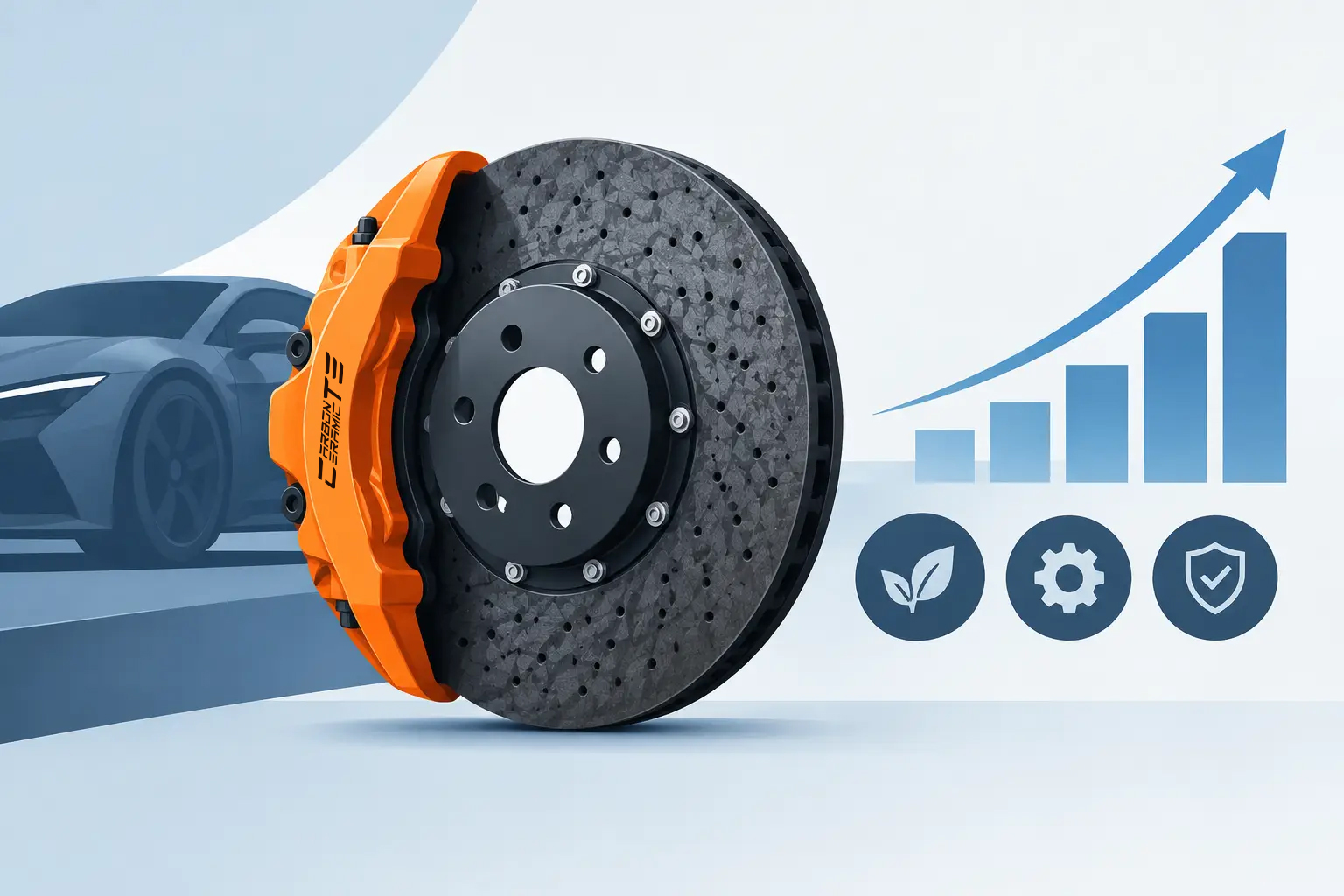
A brake pedal that goes long after repeated hard stops is not a minor inconvenience. On a fast road, a track session, or a heavily loaded premium SUV, it is the moment when confidence disappears. Carbon ceramic aftermarket trends are gaining momentum because performance buyers and professional workshops are no longer satisfied with simply fitting larger hardware. They want lighter, thermal-resistant, vehicle-specific brake systems engineered to perform consistently when conventional setups reach their limits.
The shift is not about copying factory carbon ceramic options for appearance alone. It is about making racing-grade brake technology more accessible to the aftermarket while demanding better fitment, clearer technical documentation, and accountable manufacturing. For distributors and workshops, that changes what a credible carbon ceramic product program must deliver.
Carbon Ceramic Aftermarket Trends Are Moving Beyond Big Rotors
For years, the aftermarket brake conversation centered on rotor diameter and caliper piston count. Those specifications still matter, but they do not tell the complete story. The strongest current demand is for a balanced system: carbon ceramic rotors, correctly matched pads, rigid calipers, mounting hardware, brake lines, and vehicle-specific brackets designed to work as one assembly.
This matters because braking performance is a system result. A large rotor paired with an unsuitable pad compound can deliver inconsistent cold response or excessive noise. A powerful caliper without the correct piston sizing can alter pedal feel and brake balance. An improperly engineered bracket can create alignment problems that no amount of marketing will solve. As the market becomes more educated, buyers are asking not only, “How big is it?” but also, “Was it engineered for my vehicle?”
Complete kits are therefore becoming the preferred route for Porsche, Tesla, BMW, Jaguar, Land Rover, Toyota Supra, Nissan GT-R, Defender, and supercar applications. Workshops can reduce installation uncertainty, distributors can carry a more coherent product offering, and drivers receive components intended to operate together rather than a collection of upgrades from unrelated sources.
Weight Reduction Is Becoming a Practical Performance Metric
Carbon ceramic brakes are valued for more than stopping power. Their lower mass can reduce unsprung and rotating weight compared with many conventional iron brake assemblies. That distinction has practical consequences for steering response, suspension control, acceleration, and how a vehicle reacts over uneven pavement.
For track-focused coupes, reduced unsprung weight supports sharper chassis behavior during rapid direction changes. For high-performance SUVs and electric vehicles, where vehicle mass is substantial, it can help offset the weight penalty created by larger wheels, batteries, and luxury equipment. The benefit is not identical on every platform, and it does not replace correct suspension tuning. Still, it is one reason carbon ceramic systems are increasingly considered a vehicle-dynamics upgrade rather than only a brake upgrade.
This trend also creates demand for supporting chassis components. Control arms, stabilizer links, ball joints, tie-rod ends, rack ends, and rubber bushings all influence how accurately the vehicle responds once braking loads rise. A brake system can generate tremendous force, but the surrounding chassis must maintain geometry and control under that load. Performance workshops are increasingly planning braking and chassis upgrades as connected work rather than separate sales categories.
Thermal Stability Is Driving Demand in Heavy-Duty Use Cases
Repeated high-energy stops generate extreme heat. Iron discs can perform exceptionally well in many applications, but sustained thermal load can contribute to fade, cracking, distortion, and accelerated wear when the system is pushed beyond its intended duty cycle. Carbon ceramic materials are attractive because of their heat resistance, stable performance characteristics, and ability to withstand demanding use without the corrosion concerns associated with exposed iron rotors.
The strongest growth is not limited to dedicated race cars. Premium road vehicles see increasingly demanding conditions: mountain descents, high-speed driving, towing, heavy urban traffic, track-day use, and repeated braking from the added mass of electrified platforms. Tesla and other EV owners, for example, may rely heavily on regenerative braking in daily driving, yet still require dependable friction braking when speed, battery state, traction conditions, or emergency stops call for it.
There is a trade-off. Carbon ceramic systems must be engineered around realistic operating conditions, including pad selection and expected temperature range. A road-driven vehicle needs predictable behavior during ordinary cold starts as well as sustained high-temperature capability. The most aggressive track-oriented configuration is not automatically the best choice for a quiet luxury vehicle. Proper application matching remains more valuable than an extreme specification sheet.
Fitment Accuracy Is Now a Purchase Requirement
The carbon ceramic aftermarket is moving away from universal-style solutions. Professional buyers expect application-specific engineering that accounts for wheel clearance, hub dimensions, caliper location, rotor offset, parking brake integration where required, ABS and stability-control behavior, and service access.
Wheel clearance deserves particular attention. A caliper may fit within one 19-inch wheel and interfere with another wheel of the same nominal diameter because spoke design, barrel profile, and offset differ. Responsible suppliers provide fitment guidance rather than leaving this decision to visual estimation. For distributors and installers, this protects both the customer experience and the reputation of the brake brand.
Vehicle-specific fitment also improves the quality of the final installation. Correctly designed hats, brackets, and mounting points help maintain rotor centering and caliper alignment. That supports even pad contact, consistent wear, and predictable pedal behavior. On premium vehicles, where customers expect factory-level execution, fitment precision is not optional.
Manufacturing Control Is Becoming a Competitive Divider
As carbon ceramic demand expands, product availability alone is no longer a sufficient differentiator. Buyers want to know who controls the machining, inspection, material selection, and final assembly. This is especially relevant in a category where a braking component is a safety-critical part, not a cosmetic accessory.
Manufacturers with substantial in-house capability can manage tolerances more directly, respond to technical issues faster, and keep product development connected to quality control. Certifications such as IATF 16949 and ISO 9001 further indicate that quality management is built into the production process rather than added after the fact. They do not eliminate the need for application testing, but they give distributors and workshops meaningful evidence when evaluating a supplier.
CCYS reflects this direction with 90% of production controlled in-house across R&D, precision machining, and quality management. For channel partners, that level of control supports a more consistent supply of carbon ceramic brake kits, rotors, calipers, pads, wheel hubs, and supporting components, with manufacturer warranty coverage behind the system.
Carbon Ceramic Aftermarket Trends Favor Serviceable Systems
Durability has always been part of the carbon ceramic value proposition, but the aftermarket is placing more attention on long-term serviceability. Buyers want clear replacement pathways for pads, rotor hardware, caliper seals, and related accessories. Workshops want practical technical support when a vehicle has nonstandard wheels, modified suspension, or prior brake changes.
This is where the lowest initial purchase price can become misleading. A brake package without documented replacement parts, application data, or technical assistance may create expensive downtime later. A well-supported system can be a better commercial decision even when its upfront price is higher, particularly for performance shops responsible for the installation and for distributors serving repeat customers.
Serviceability also means using the right maintenance practices. Carbon ceramic rotors and compatible pads should be inspected for wear condition, surface damage, mounting security, and correct bedding. Installers should follow torque procedures, verify clearances, and avoid contaminating braking surfaces. These fundamentals protect performance and help prevent avoidable warranty disputes.
The Market Will Reward Engineering, Not Hype
Carbon ceramic brakes will continue to move into more aftermarket segments, from track-ready sports cars to premium EVs and performance SUVs. But the winning products will not be the ones that make the broadest claims. They will be the systems that combine thermal resistance, lower weight, precise fitment, verified manufacturing, and real technical support.
For distributors and workshops, the opportunity is to sell confidence backed by engineering, not just an impressive-looking caliper behind a wheel. For drivers, the right carbon ceramic conversion should feel composed under pressure, predictable at the pedal, and properly matched to how the vehicle is actually used. That is the standard worth demanding before the next hard stop.