

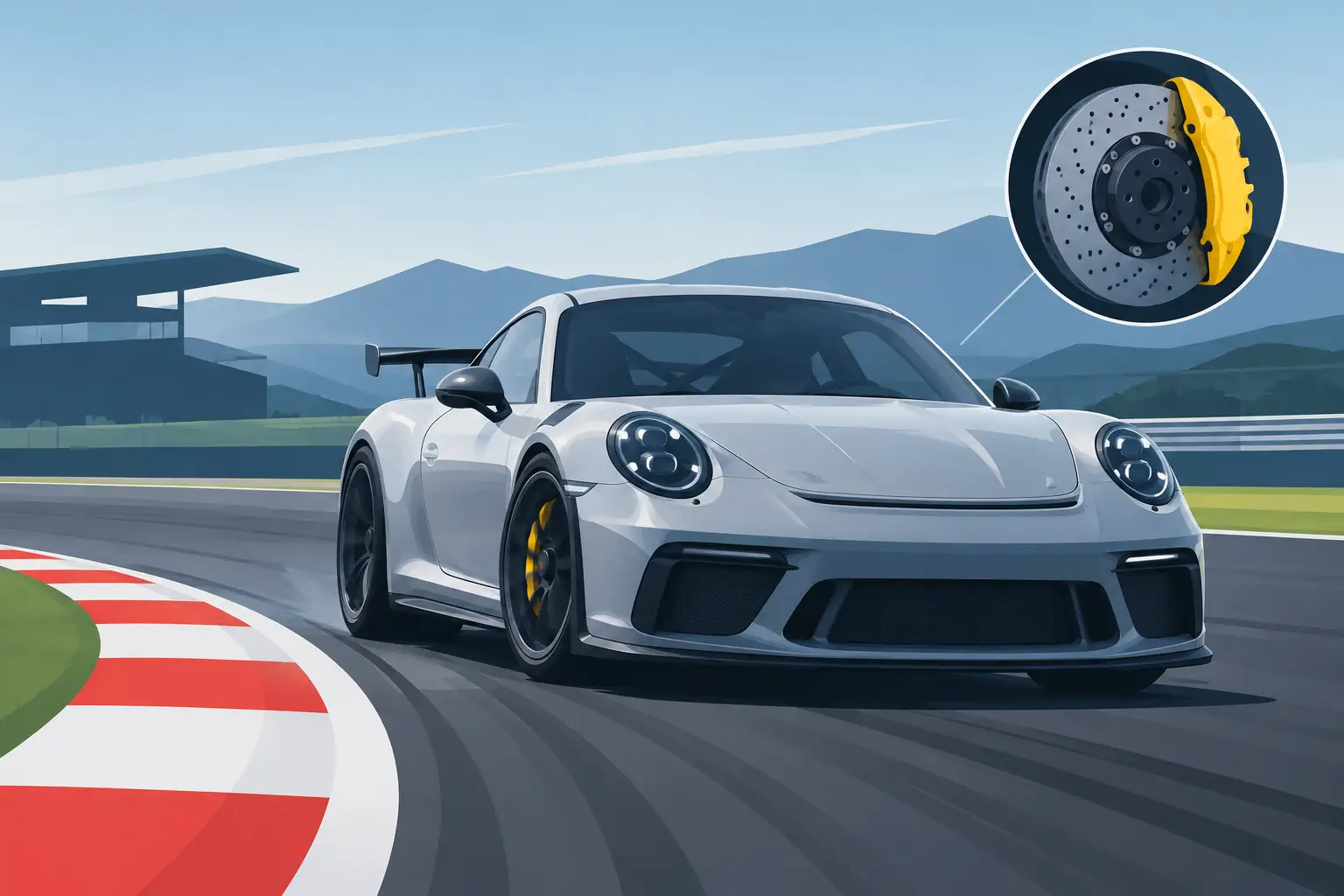
A Porsche that feels composed at highway speed can become unpredictable after six hard laps. The brake pedal grows longer, initial bite falls away, and the driver starts braking earlier to protect the car and finish the session. This Porsche track braking case study examines why that loss of confidence happens and how a complete, vehicle-specific brake system changes the result.
The subject is a track-driven Porsche 911 used for weekend events and spirited road miles. Its owner did not report one dramatic brake failure. The problem was more familiar and more dangerous: performance changed as heat accumulated. Early laps felt strong. Later laps required more pedal pressure, braking points moved forward, and the driver could no longer trust the same response at the end of a fast straight.
That pattern is not solved by chasing a single oversized component. Track braking is a system problem involving thermal capacity, rotor and pad behavior, caliper stiffness, hydraulic condition, wheel clearance, and the way every part fits the vehicle.
The Track Problem Was Heat, Not Just Stopping Distance
On the first cold stop, many factory performance brake systems can feel excellent. A track session asks a different question: can the system repeatedly convert speed into heat without a major change in pedal feel or torque output?
Each high-speed braking event loads the front axle heavily. The rotors absorb a large share of that energy, while pads must maintain a stable friction relationship against a surface that is becoming dramatically hotter. If the rotor cannot manage repeated heat cycles, the pad compound exceeds its effective temperature range, or the fluid begins to boil, braking consistency deteriorates.
In this case, the owner initially described the issue as fade. That word is useful, but it can hide several separate conditions. A firm pedal with reduced deceleration points toward pad friction loss or a rotor surface issue. A pedal that travels farther or feels soft raises concern about fluid temperature, trapped air, hose expansion, or caliper seal condition. Steering-wheel vibration under braking may suggest uneven pad deposits, disc thickness variation, or a hub and mounting issue rather than a warped rotor in the casual sense.
The diagnostic process began with the symptoms, but it did not end there. The workshop inspected pad thickness and wear shape, disc surface condition, hardware, fluid age, caliper operation, and the existing system's suitability for the car's tire grip and track use. This matters because replacing components without identifying the failure mode can produce an expensive upgrade with the same weak point still in place.
Porsche Track Braking Case Study: The Engineering Response
The selected direction was a complete carbon ceramic brake package matched to the Porsche application, rather than an improvised combination of discs, brackets, pads, and calipers from unrelated systems. The objective was not simply more aggressive initial bite. It was stable braking under repeated high-energy use, with lower unsprung weight and controlled fitment at the wheel.
A carbon ceramic rotor brings two important advantages in this environment. First, it provides strong thermal resistance during repeated severe braking. Second, it reduces rotating and unsprung mass compared with a conventional iron assembly of similar capacity. That reduction can benefit steering response and suspension control, particularly on a Porsche where chassis feedback is central to the driving experience.
Those benefits do not make carbon ceramic brakes a universal answer. They require the correct rotor design, caliper piston sizing, pad compound, mounting solution, and bedding procedure. A poorly matched pad can compromise feel, create excessive noise, or leave unstable transfer layers. A package that does not account for wheel spoke clearance, offset, brake-line routing, and electronic brake-system behavior can introduce fitment problems before the car reaches pit lane.
For this reason, the case focused on component compatibility rather than headline specifications. The caliper needed the stiffness and thermal management to apply force consistently. The rotor needed a design appropriate for repeated heat loading. The pad needed a predictable operating range for track work while remaining usable in the owner's road-driving conditions. The mounting hardware and hubs needed precise machining so the rotor ran true and the caliper sat correctly over the friction surface.
Why Complete-System Fitment Matters
Porsche platforms vary significantly by generation, trim, wheel size, factory brake package, and intended use. A brake kit should never be treated as a generic performance part. Even when a larger rotor physically fits behind a wheel, the full installation must preserve caliper alignment, clearance through suspension travel, secure line routing, and correct hardware engagement.
The workshop also considered the car's actual operating profile. A 911 driven in short sprint sessions on street tires has different demands from one running extended sessions on high-grip track tires. More grip increases braking force and heat generation. More power and higher terminal speed do the same. A driver who repeatedly attacks the final braking zone with late, high-pressure inputs will create a different thermal load from a driver managing pace over a long session.
That is why the correct question is not, “What is the biggest brake kit available?” It is, “What brake system has the thermal capacity, pedal character, and fitment accuracy for this Porsche and this use case?” Larger hardware can add capacity, but it may also affect wheel choice, replacement cost, pad selection, and street behavior. Engineering excellence means choosing the right margin, not the largest catalog number.
Installation Was Treated as a Safety-Critical Process
A racing-grade brake kit can only perform as designed when installation is controlled. The workshop confirmed the application before fitting components, checked wheel clearance, cleaned all mounting faces, used correct torque procedures, and inspected lines and fluid condition. Any contamination at the rotor or pad surface can distort the first impressions of a new system.
The bedding process received equal attention. Bedding is not a ceremonial series of stops. It establishes the working relationship between pad and rotor by bringing components through controlled heat cycles. Skipping it, overheating the system immediately, or holding the pedal while stationary with hot brakes can create uneven deposits and confuse later diagnosis.
Before the car returned to the circuit, the technician also verified pedal firmness and inspected for leaks, fastener movement, abnormal interference, and correct pad retention. Brake fluid was selected and maintained for the expected temperature range. Carbon ceramic hardware improves thermal resilience at the friction interface, but no rotor material excuses neglected fluid, damaged lines, or poor bleeding practice.
What Changed on Track
The meaningful improvement was not a single spectacular stop. It was repeatability. The driver reported a more consistent pedal through the session, stronger confidence when approaching heavy braking zones, and less need to protect the brakes after several fast laps. The vehicle could be driven closer to a consistent braking reference because the response did not change as sharply with temperature.
Lower unsprung mass was also relevant. On uneven braking surfaces and curbing transitions, reducing mass at the wheel can help the suspension follow the surface more effectively. That does not replace suspension setup, tire management, or driver technique, but it supports the chassis behavior performance Porsche owners expect.
The case also demonstrated a commercial reality relevant to distributors and performance workshops: brake-system results are easier to support when the supplier controls the engineering relationship among the major components. CCYS manufactures 90% of its products in-house, from development and precision machining to quality management. That level of production control supports application consistency, technical troubleshooting, and complete-system accountability rather than a collection of unrelated parts.
IATF 16949 and ISO 9001 certifications further matter here because track customers do not need vague promises after a difficult session. They need documented manufacturing discipline, vehicle-specific solutions, and a supplier prepared to stand behind the product with technical support and warranty coverage.
Lessons for Porsche Workshops and Parts Distributors
The strongest lesson from this Porsche track braking case study is that brake confidence is built before the car arrives at the circuit. Specify the system around vehicle weight, speed, tire grip, session length, wheel package, and customer expectations. Ask whether the customer needs a track-focused setup, a road-and-track balance, or a system for repeated high-load competition use.
Avoid treating carbon ceramic conversion as a cosmetic upgrade. It is a performance and safety decision that deserves the same installation discipline as any critical chassis or braking work. Verify fitment, select suitable pads and fluid, follow bedding requirements, and inspect the system between events. A well-engineered kit still requires a well-maintained vehicle.
When braking points stay consistent late in the session, the driver can focus on the line, the tires, and the next corner instead of wondering whether the pedal will feel the same. That is the standard a Porsche track brake system should be built to meet.