

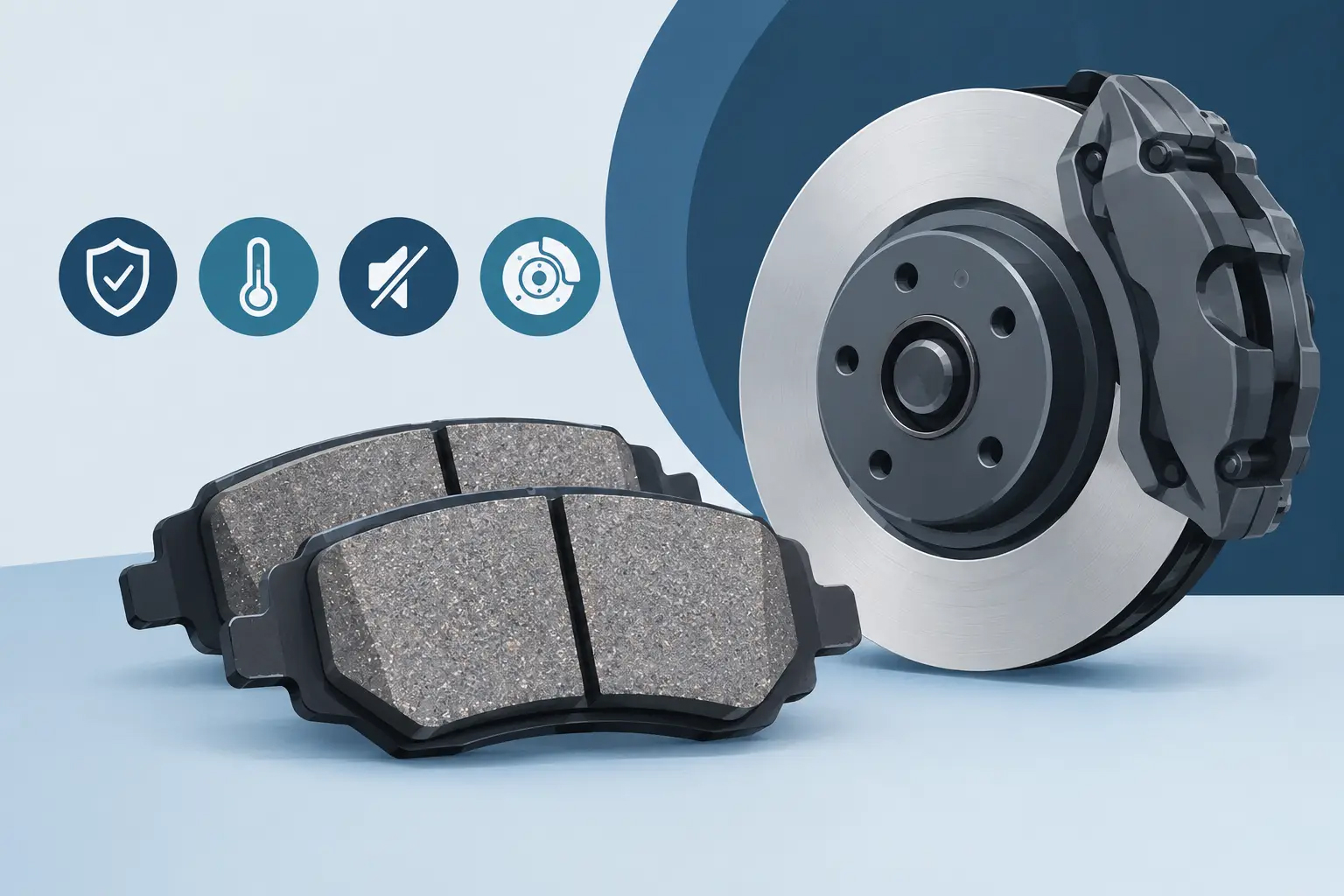
A brake pedal that goes long after several hard stops is not a minor inconvenience. On a fast road, a heavy SUV descent, or a track session, it is the point where speed becomes a liability. Ceramic metallic pads are often presented as a simple performance upgrade, but the correct compound is not chosen by label alone. It must work with the rotor material, caliper design, vehicle weight, tire grip, and the temperatures the brake system will actually see.
For performance workshops and parts distributors, that distinction matters. A pad that feels sharp on a short street test can create noise, uneven transfer layers, excessive wear, or inconsistent response when installed on the wrong rotor or used outside its operating range.
What Are Ceramic Metallic Pads?
The term ceramic metallic pads is used broadly in the aftermarket. In some cases, it describes a ceramic-based friction compound containing metallic fibers or particles. In others, it is simply a sales label for pads positioned between low-dust ceramic street pads and conventional semi-metallic performance pads.
The friction material may combine ceramic fibers, abrasives, binders, lubricants, and controlled amounts of metal. Each ingredient influences the coefficient of friction, initial bite, heat behavior, pedal feel, noise characteristics, and wear rate. The exact formula is proprietary, which is why two pads carrying similar descriptions can perform very differently.
A true pad decision starts with compound behavior, not packaging language. Ask what temperature range the compound is designed to handle, how it behaves from cold, whether it is intended for iron or carbon ceramic rotors, and what bedding procedure it requires. A reputable supplier should be able to answer those questions clearly for the specific vehicle application.
Ceramic Pad Material Is Not the Same as a Carbon Ceramic Rotor
This is the fitment issue that cannot be overlooked. A ceramic friction pad and a carbon ceramic brake rotor are different components made for different jobs. Carbon ceramic rotors use a carbon fiber-reinforced ceramic structure that delivers major thermal resistance, corrosion resistance, and lower unsprung weight compared with many iron rotor systems. Their surface and thermal behavior require a pad engineered specifically for that rotor family.
Installing a generic ceramic or semi-metallic pad on a carbon ceramic disc is not automatically acceptable. An incompatible compound can fail to build a stable transfer layer, produce unpredictable cold response, accelerate surface damage, or compromise the braking characteristics the complete system was engineered to deliver.
For carbon ceramic brake systems, treat the rotor and pad as a matched friction pair. The caliper piston design, pad backing plate, shim configuration, disc sweep, and compound must work together. This is particularly important on Porsche, Tesla, BMW, Jaguar, Land Rover, Toyota Supra, Nissan GT-R, Defender, and supercar platforms, where braking loads, electronic brake control, and OE packaging can vary substantially.
The Performance Trade-Off: Bite, Heat, Noise, and Wear
There is no single best brake pad compound. Every performance pad makes a set of trade-offs, and the right balance depends on the use case.
A street-focused ceramic metallic compound may provide quieter operation, reduced visible dust, and confident cold response. Those qualities suit premium daily-driven vehicles and road-focused upgrades. But if the vehicle sees repeated high-speed braking, towing, mountain descents, or frequent circuit use, that compound may reach its thermal limit. As temperature climbs beyond its intended range, friction can become inconsistent and fade resistance can decline.
A more aggressive metallic-content compound can deliver stronger initial bite and better resistance to sustained heat. The cost may be greater noise, more dust, increased rotor wear, and less refinement at low temperatures. Race-oriented pads can also require heat before they provide their intended friction level, making them a poor choice for many street vehicles.
The strongest brake system is not the one with the most aggressive pad on paper. It is the system that delivers repeatable pedal response at the temperatures and speeds the vehicle will encounter.
Cold Performance Still Matters
Track capability gets attention, but cold performance is a safety requirement for road cars. A vehicle leaving a garage on a cold morning needs predictable deceleration at the first stop, not only after several heavy applications.
For a dual-purpose build, choose a compound with a broad usable temperature window rather than one optimized only for peak circuit temperatures. If the owner runs dedicated track wheels and tires, a separate track pad set can be the more disciplined solution. It allows the street setup to remain quiet, controllable, and suitable for everyday driving while preserving a properly matched high-temperature option for the circuit.
Dust and Noise Are Diagnostic Clues, Not Just Comfort Issues
Brake dust and noise do not automatically indicate a poor pad. Aggressive compounds often generate both because of the materials required to produce friction under severe heat. However, sudden squeal, grinding, vibration, or abnormal dust patterns can signal an installation, bedding, rotor-surface, or caliper issue.
A performance workshop should inspect pad wear across the full surface, rotor condition, guide hardware, piston movement, brake fluid condition, and wheel-bearing play before blaming the pad compound. Brake performance is always a system result.
How to Match the Pad to the Vehicle
Start with the vehicle's actual duty cycle. A 700-horsepower coupe driven on weekends needs a different friction strategy than a tuned luxury SUV used for highway travel, spirited canyon runs, and occasional towing. Weight, tire compound, aero load, power level, and driver behavior all change brake temperature.
For a street-performance vehicle, prioritize stable cold friction, controlled noise, predictable modulation, and compatibility with the installed rotor. For an occasional track car, look for a compound that withstands repeated temperature cycles without excessive fade while remaining manageable on the road. For dedicated competition use, focus on sustained thermal capacity, high-temperature friction stability, and a compound proven for the exact disc material.
Fitment must be equally precise. Pad shape alone is not enough. Confirm backing plate thickness, retention hardware, sensor provisions, chamfers, shim design, caliper clearance, and axle application. Front and rear compounds should also be selected with brake balance in mind. Increasing front bite without considering the rear axle can change vehicle behavior under threshold braking and interfere with the balance the chassis was designed to maintain.
Bedding Creates the Working Surface
Even a correctly selected pad can disappoint if it is installed on a contaminated or poorly prepared rotor. Bedding is not a ceremonial sequence of hard stops. It establishes an even transfer layer of pad material on the rotor surface, stabilizing friction and helping prevent judder, hot spotting, and inconsistent pedal feel.
The exact procedure depends on the pad and rotor manufacturer. Generally, the process involves controlled brake applications that gradually bring the system to temperature, followed by a cooling period without holding the pedal when the brakes are extremely hot. Avoid panic-style repeated stops unless the specified procedure calls for them. Parking with hot pads clamped against a rotor can leave uneven material deposits that later feel like warped discs.
New pads should also be installed with clean contact surfaces and correctly lubricated hardware where specified. Brake lubricant belongs on approved metal contact points, never on the friction face, rotor surface, or pad material.
Why Complete-System Engineering Matters
A pad upgrade cannot compensate for undersized discs, tired fluid, seized caliper components, incorrect brake bias, or a braking system that was never designed for the vehicle's current performance level. When output, vehicle mass, or duty cycle rises, the correct response may be a complete brake-system upgrade rather than a more aggressive pad alone.
This is where carbon ceramic systems deliver a meaningful engineering advantage. Lower rotating and unsprung mass can improve suspension response, while high thermal resistance supports repeated demanding use. But those benefits depend on matched calipers, rotors, pads, mounting hardware, and vehicle-specific engineering.
CCYS develops carbon ceramic brake systems and supporting components with this complete-system view, backed by 90% in-house manufacturing control, IATF 16949 and ISO 9001 quality standards, and application-focused technical support. For distributors and workshops, that level of manufacturing control helps reduce the uncertainty that comes with assembling critical brake components from unrelated sources.
When to Replace Performance Pads
Do not wait for metal-on-metal contact. Replace pads when friction material approaches the manufacturer’s minimum thickness, when wear is uneven, when the backing plate or sensor indicates service is due, or when the compound has heat-cracked, glazed, or contaminated.
Also inspect the disc at every pad change. Carbon ceramic rotors should be assessed using the correct manufacturer criteria, not judged by iron-rotor habits. Surface appearance alone does not determine serviceability. Proper measurement, crack evaluation, hardware inspection, and documented limits protect both the vehicle owner and the workshop.
Choose ceramic metallic pads only after confirming the friction pair, temperature demand, and vehicle fitment. The right compound turns brake force into controlled, repeatable confidence. The wrong one can make an expensive braking system unpredictable exactly when the driver needs it most.