

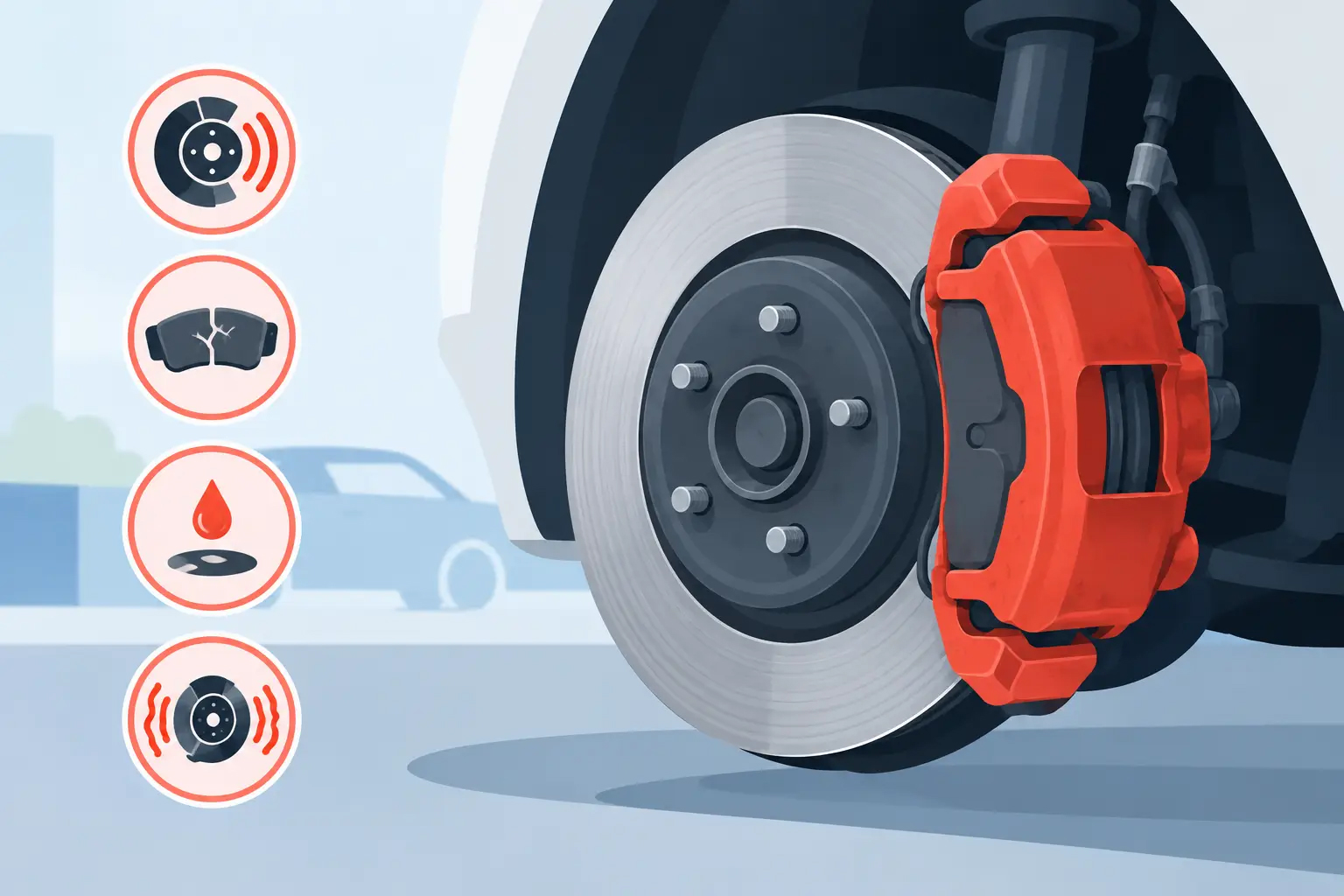
A brake caliper does not need to fail completely to put a high-performance vehicle at risk. One dragging piston, seized slide pin, leaking seal, or damaged hydraulic passage can turn a controlled hard stop into a pull toward one lane, a smoking wheel, or a brake pedal that no longer inspires confidence. The top signs of caliper failure often begin subtly, but repeated heat cycles and aggressive braking can make them escalate quickly.
For performance workshops, distributors, and owners of vehicles such as Porsche, BMW, Tesla, Nissan GT-R, Toyota Supra, and supercars, caliper diagnosis should never be reduced to a quick visual check. The caliper is the component that converts hydraulic pressure into clamping force. If it cannot apply and release that force evenly, brake pads, rotors, wheel bearings, tires, and suspension components can all be affected.
Top Signs of Caliper Failure During Driving
The most urgent warning is a vehicle that pulls or drifts to one side when the brakes are applied. A sticking caliper on one side may create excess braking force and pull the vehicle toward that wheel. Conversely, a caliper with a seized piston, internal fluid restriction, or loss of hydraulic pressure may contribute too little clamping force, causing the vehicle to pull toward the opposite side.
Do not confuse every pull with a caliper problem. Alignment settings, tire condition, road crown, worn control-arm bushings, and uneven tire pressures can also change straight-line behavior. The difference is consistency: a caliper-related pull is commonly most noticeable under braking, especially after the brakes have reached operating temperature.
A burning smell after normal road driving is another serious signal. If one caliper does not release fully, the pad remains in contact with the rotor. Friction builds heat continuously, even when the driver is off the pedal. On a performance car with large wheels and open spoke designs, you may notice one wheel radiating far more heat than the others. In severe cases, smoke may come from the wheel area.
Never touch a wheel, rotor, or caliper to compare temperatures. These components can cause serious burns. Use an infrared thermometer after a controlled drive, comparing equivalent wheel positions where practical. A major temperature difference deserves inspection before the vehicle returns to spirited driving or track use.
A soft pedal can also point to caliper trouble, particularly when it is paired with a visible fluid leak. Brake fluid around the caliper body, piston seal, bleeder screw, or hose connection is not cosmetic. Hydraulic pressure is the system’s operating force. Any loss of fluid can reduce pedal firmness and braking response, while fluid contamination can damage pads and reduce friction consistency.
Uneven Pad Wear Is a Caliper Diagnostic Clue
Brake pads tell a detailed story about caliper operation. When inspecting a brake system, compare the inner and outer pad on each corner, then compare left to right across the axle. Large differences should not be ignored simply because the pads have not reached their minimum thickness.
If the inner pad is much thinner than the outer pad on a floating-caliper setup, the piston may be sticking or the caliper may not be sliding correctly on its guide pins. If the outer pad is worn more heavily, corroded or seized slide pins are often a likely cause. On fixed multi-piston calipers, uneven wear can indicate a piston that is not moving freely, uneven hydraulic loading, pad fitment issues, or hardware that has been overheated or contaminated.
Pad taper matters as well. A pad that is noticeably thicker at one end may suggest caliper misalignment, worn mounting hardware, a distorted bracket, excessive rotor runout, or movement elsewhere in the suspension. Replacing pads alone may silence a noise temporarily, but it will not correct the source of uneven loading.
For track-oriented vehicles, pad wear must be read in the context of the entire brake package. Compound selection, cooling airflow, rotor design, driver technique, and vehicle weight all influence wear. Yet a dramatic difference from one pad to another is not a normal byproduct of performance driving. It is a reason to inspect the caliper, mounting points, brake lines, and rotor condition before the next high-load session.
Noise, Vibration, and Rotor Damage
Squealing does not automatically mean caliper failure. Performance pad compounds can make noise at low temperature, and surface corrosion after rain can create temporary sound. Persistent grinding, scraping, or a metallic dragging noise is different. It can indicate a pad worn to its backing plate, a loose pad retainer, hardware contact, or a caliper that is holding the pad against the rotor.
A dragging caliper can also leave visible evidence on the rotor. Look for abnormal blue or purple heat marks, cracking, heavy scoring, localized discoloration, or a noticeably rough friction surface. Excessive heat can alter rotor material behavior and accelerate pad breakdown. In extreme cases, it may damage seals, boots, wheel bearings, and nearby sensors.
Brake vibration during a stop is another symptom that requires proper diagnosis. Drivers often call this “warped rotors,” but the cause may be uneven friction deposits, rotor thickness variation, hub runout, loose hardware, or heat damage from a caliper that has been dragging. Measure rather than guess. Rotor thickness, runout, pad condition, hub surface cleanliness, and caliper movement should all be verified to identify the real fault.
Why Performance Vehicles Need Faster Caliper Checks
A daily-driven commuter may mask early caliper issues for weeks. A performance vehicle can expose them in one mountain descent, one high-speed road session, or several heavy braking events on track. Higher vehicle speeds increase braking energy sharply, while larger wheels and wider tires can make a directional pull more abrupt and harder to control.
Carbon ceramic systems bring meaningful advantages in weight reduction, thermal resistance, and repeated braking stability, but they still depend on correct caliper operation, pad compatibility, hydraulic integrity, and vehicle-specific installation. A premium rotor does not compensate for a seized piston. Likewise, a racing-grade caliper cannot perform as engineered if its seals are compromised, its hardware is improperly torqued, or its pads are not bedded and maintained correctly.
This is why complete-system engineering matters. Caliper stiffness, piston sizing, pad shape, rotor diameter, disc thickness, brake line routing, mounting brackets, and wheel clearance must work together. Mixing components without validating fitment can create uneven pad contact, clearance problems, inconsistent pedal behavior, or thermal imbalance.
What to Inspect Before Replacing a Caliper
Before condemning the caliper, verify the fault with a disciplined inspection. Check for external fluid leaks, damaged dust boots, corrosion around pistons, binding guide pins, restricted flexible brake hoses, and pad movement within the bracket. A collapsed brake hose can act like a one-way valve, allowing pressure to apply the brakes but preventing fluid from returning quickly enough to release them.
Inspect the rotor and pads at the same time. If a caliper has dragged long enough to overheat the rotor, replacing only the caliper may leave behind damaged friction surfaces and compromised pads. The correct repair may require a caliper rebuild or replacement, fresh pads, rotor replacement or measurement-based approval, new hardware, fluid service, and a full system bleed.
For fixed multi-piston performance calipers, rebuilding can be appropriate when the manufacturer supports it and the caliper body remains serviceable. The work must be carried out with the correct seals, torque procedures, cleaning standards, and brake-fluid handling. If the body is cracked, heavily corroded, or heat-damaged, replacement is the safer decision.
Preventing Repeat Caliper Problems
Caliper failures are often accelerated by neglected brake fluid, torn piston boots, improper wash chemicals, road-salt corrosion, and track heat beyond the system’s intended operating range. Brake fluid should be serviced on a schedule that reflects how the vehicle is used, not only its mileage. Moisture-contaminated fluid has a lower boiling point and can promote internal corrosion.
After track events or repeated heavy braking, inspect pads, rotors, caliper hardware, brake lines, and fluid condition before the vehicle returns to road use. Confirm wheel fastener torque and look for evidence of heat transfer at the wheel, hub, and suspension components. Small issues are far less expensive to correct before they damage a complete brake corner.
CCYS applies this system-level mindset to performance braking, combining vehicle-specific carbon ceramic solutions with controlled manufacturing, technical support, and quality processes backed by IATF 16949 and ISO 9001 standards. For workshops and distributors, documented fitment and complete-kit compatibility are not optional details - they are part of dependable braking performance.
If one wheel runs hot, the car pulls under braking, or pad wear no longer looks balanced, take the vehicle out of high-load use and inspect it before the next drive. Braking confidence is built at the caliper, one controlled and even application at a time.