

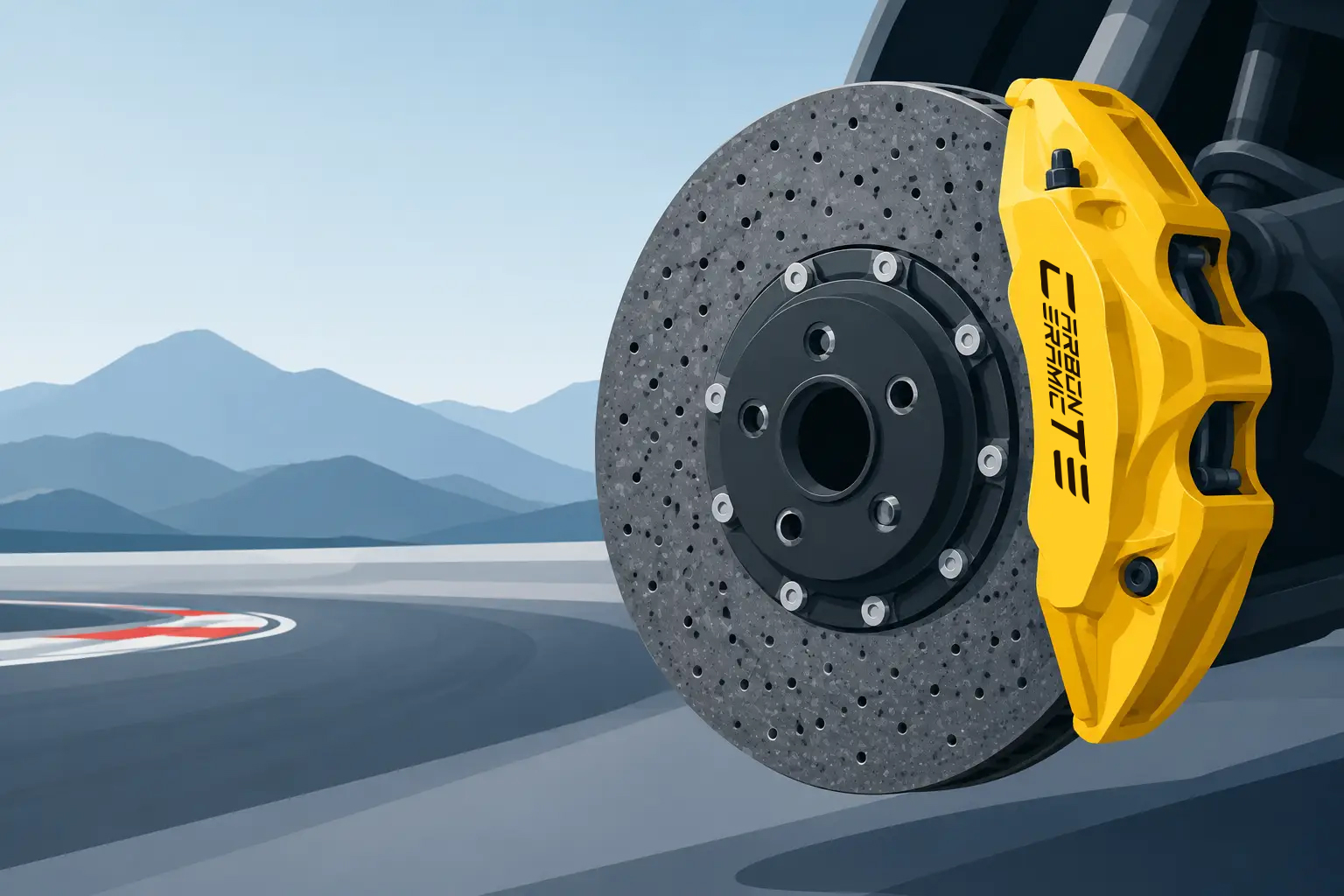
The moment a brake pedal goes soft after repeated hard stops, performance stops being a specification and becomes a safety problem. At highway speed, on a mountain descent, or at the end of a fast straight, the driver needs the same decisive response from the first stop to the next. A carbon ceramic brake system is engineered for that demand: high thermal resistance, lower rotating mass, and dependable braking force when conventional hardware is being pushed beyond its comfort zone.
For performance workshops, distributors, and owners of premium vehicles, carbon ceramic is not simply an expensive visual upgrade behind a large wheel. It is a material and system choice that affects vehicle balance, heat control, pedal consistency, fitment, and long-term service planning. The right solution must be engineered as a complete package, not assembled from unrelated parts.
What Makes Carbon Ceramic Brakes Different
Carbon ceramic brake discs are commonly produced from carbon fiber-reinforced material that is processed with silicon to form a silicon-carbide ceramic structure. The result is a disc designed to tolerate temperatures that would quickly challenge conventional iron rotors during repeated heavy braking.
Heat is the central issue. Every braking event converts vehicle speed into thermal energy. On a high-output Porsche, Tesla, BMW, Nissan GT-R, Toyota Supra, or supercar platform, that energy builds rapidly. A heavy vehicle, higher speeds, increased power, aggressive tires, or track use all place greater demand on the disc, pad, caliper, brake fluid, and surrounding components.
A carbon ceramic disc manages this environment differently from a standard cast-iron rotor. It is substantially lighter, highly resistant to corrosion, and built to maintain structural stability under extreme heat. That does not mean it is immune to wear or misuse. It means the braking system has a much larger performance window when components are correctly specified and installed.
Lower Unsprung Weight Changes More Than Acceleration
The weight savings of carbon ceramic braking are often discussed in terms of lightweight performance. That is true, but the more meaningful benefit is where the weight is removed. Brake discs and calipers are part of the unsprung mass - the components moving with the wheel rather than supported by the suspension.
Reducing unsprung and rotating mass can help the suspension react more effectively over uneven surfaces. The vehicle may feel more controlled through turn-in, under braking, and across imperfect pavement. Steering response can become sharper because the wheel assembly has less mass to accelerate and decelerate.
The result depends on the vehicle and the full chassis setup. A carbon ceramic kit will not correct weak dampers, worn ball joints, damaged control arm bushings, or poor alignment. On a properly maintained performance vehicle, however, reduced wheel-end mass supports the work of the suspension rather than fighting it.
This is why brake upgrades should be considered alongside the chassis. A vehicle expected to brake later and corner harder must have the supporting components to maintain geometry and control under load.
Thermal Resistance Is the Real Performance Advantage
Brake fade is not one single failure. It can involve overheated pads losing friction, fluid approaching its boiling point, disc surface conditions changing, or calipers and hardware transferring excessive heat through the system. The driver experiences the outcome as longer stopping distances, inconsistent pedal feel, vibration, smoke, or a loss of confidence precisely when confidence is needed most.
Carbon ceramic discs are valued because they remain capable in punishing thermal cycles. Their heat resistance makes them particularly relevant for repeated high-speed stops, track-day sessions, armored or heavy premium SUVs, and performance vehicles carrying more power than their factory braking system was designed to manage.
But disc material alone does not create a racing-grade system. Pad compound is critical. A pad must deliver compatible friction characteristics across the intended temperature range while controlling noise, wear, and disc surface condition. Caliper stiffness, piston design, fluid capacity, brake line condition, cooling airflow, and rotor dimensions also determine whether a system delivers consistent results.
A complete kit is therefore the professional answer. Matching carbon ceramic rotors with application-specific monobloc calipers, correctly selected pads, mounting brackets, hardware, and vehicle-specific fitment removes much of the uncertainty that comes with piecemeal modifications.
Carbon Ceramic Is Not the Same for Every Vehicle
The best brake choice depends on use. A dedicated circuit car may prioritize maximum thermal capacity, aggressive pad response, and rapid component inspection. A premium road vehicle needs strong braking with acceptable noise, cold performance, and predictable behavior in rain, traffic, and changing temperatures.
For a Tesla, the calculation can include vehicle weight and regenerative braking behavior. For a Land Rover, Defender, or Jaguar SUV, the requirements may center on mass, wheel fitment, towing loads, and repeated downhill braking. For a Porsche, BMW M platform, or GT-R, the owner may be seeking the heat capacity and pedal stability needed for spirited road use and occasional track events.
Wheel clearance also matters. Larger calipers and discs require confirmed clearance not only for wheel diameter but also for spoke shape, offset, barrel profile, and balancing weights. A system that looks correct on a fitment chart can still require detailed verification on a modified vehicle.
This is why professional buyers should demand vehicle-specific engineering. The right carbon ceramic brake package accounts for hub dimensions, mounting points, brake bias, rotor offset, wheel clearance, and the intended operating environment. Performance without fitment discipline is not performance engineering.
What to Look for in a Carbon Ceramic Brake Supplier
For distributors and workshops, the supplier behind the components is as important as the material itself. Carbon ceramic systems require precision across disc manufacture, machining, caliper production, finishing, inspection, and final assembly. Inconsistent tolerances can create noise, uneven contact, poor pedal feel, premature wear, or installation delays that cost a workshop time and reputation.
Look for a manufacturer that controls the critical production process rather than relying entirely on fragmented sourcing. In-house engineering and machining support tighter consistency, faster technical feedback, and better control when a vehicle application requires a specific solution.
Quality systems also matter. IATF 16949 and ISO 9001 certification indicate that a manufacturer operates with defined process controls and quality-management discipline. Certifications are not a substitute for proper installation or maintenance, but they are meaningful evidence for buyers who need dependable supply and documented production standards.
CCYS maintains approximately 90% of its production in-house, combining carbon ceramic braking specialization with precision machining, quality control, complete kits, and supporting chassis components. For a reseller or performance shop, this kind of manufacturing control helps simplify sourcing while providing a clearer path to technical support and warranty accountability.
Installation and Service Considerations
Carbon ceramic systems should be installed by technicians familiar with high-performance brake work. Rotor direction, mounting torque, disc handling, pad bedding procedures, brake fluid condition, and caliper centering all influence the result. Ceramic discs should also be handled carefully to avoid impact damage, especially around edges and mounting areas.
Pads must be selected for the actual use case. A race-focused compound may produce more noise or require more temperature before reaching its intended friction level. A street-oriented compound may offer better cold response and daily refinement but reach its limits earlier during sustained circuit use. Neither is automatically better; the correct decision follows the vehicle's duty cycle.
Regular inspection remains necessary. Check pad thickness, disc condition, mounting hardware, brake fluid, lines, and wheel-bearing play. If vibration develops, diagnose the entire system rather than assuming the disc is at fault. Hub runout, improper installation, suspension wear, uneven pad deposits, and wheel issues can all affect braking feel.
The right carbon ceramic system gives a performance vehicle more than shorter, harder stops. It gives the driver and the workshop confidence that the braking hardware is prepared for the heat, speed, and repeated demand the vehicle was built to handle. Confirm the application, match the system to the real driving environment, and choose engineering that remains dependable when the pedal matters most.