

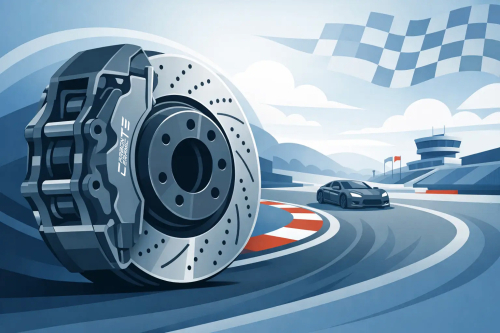
At the end of a long straight, weak braking is not an inconvenience. It is the moment a driver realizes the pedal has gone long, the car will not shed speed as expected, and the next corner is arriving too quickly. Monobloc brake calipers for track use are built to reduce that uncertainty through a stiffer caliper body, controlled piston movement, and repeatable clamping force under sustained heat.
For performance workshops, distributors, and serious drivers, the goal is not simply fitting a larger, more aggressive-looking caliper. The goal is a matched braking system that maintains predictable response lap after lap. That requires correct caliper stiffness, piston sizing, pad volume, rotor capacity, hydraulic balance, wheel clearance, and vehicle-specific mounting geometry.
Why Monobloc Brake Calipers for Track Use Are Different
A monobloc caliper is machined from a single forged or billet section rather than assembled from two separate halves bolted together. The one-piece architecture minimizes the joint movement that can occur when a split-body caliper is heavily loaded. Under hard braking, that increased structural rigidity helps the caliper apply pressure more consistently across the brake pad.
The driver feels the benefit as a more immediate, repeatable pedal. A stiff caliper does not create grip by itself, and it cannot overcome poor tires, incorrect pad selection, or inadequate rotor capacity. What it does is preserve hydraulic force instead of allowing more of it to be absorbed in caliper flex. On a track where braking zones are repeated dozens of times, that consistency is valuable.
Monobloc construction also supports tighter control of piston bores, fluid passages, bridge geometry, and pad support surfaces. When those details are engineered as a complete assembly, the caliper can manage high clamp loads without compromising piston stability or pad alignment.
Caliper Stiffness Is Only One Part of Brake Confidence
Track braking is a system problem. A large caliper with the wrong piston area can change hydraulic balance and create an undesirable pedal ratio or front-to-rear brake bias. A high-friction pad may deliver aggressive initial bite but become difficult to modulate or generate heat beyond what the rotor and fluid can manage. A rotor that lacks thermal mass may overheat regardless of the caliper fitted around it.
For this reason, a proper track brake upgrade begins with the vehicle and its duty cycle. A Porsche driven in open-pit track sessions has different requirements from a Tesla carrying substantial battery weight through repeated high-speed deceleration. A Nissan GT-R, Toyota Supra, BMW M platform, or supercar may require a different piston configuration, disc diameter, pad compound, and mounting bracket design to maintain correct brake balance.
The strongest result comes from a complete kit engineered around the platform. The caliper must work with the rotor, pad, braided hose, hardware, and master-cylinder characteristics already present on the vehicle. Piecing together unrelated components may appear economical at first, but it can introduce clearance issues, uneven pad wear, poor pedal behavior, and reduced confidence at speed.
Heat Management Determines Whether Performance Lasts
The first hard stop of a session rarely exposes a brake system's limitations. The fifth, tenth, or twentieth stop does. As rotor and pad temperatures climb, brake fluid can approach its operating limits, pad friction can change, and heat can transfer into caliper pistons and seals.
A racing-grade monobloc caliper helps by providing a rigid platform for piston seals, pad backing plates, and heat-management features. Its design can also accommodate larger pads, which distribute braking work over more surface area and can improve wear life in demanding use. However, caliper design must be paired with the appropriate rotor and pad package. There is no universal "track pad" or universal caliper size that works for every vehicle.
Carbon ceramic systems offer a meaningful advantage for applications where reduced unsprung weight, thermal resistance, and long-term rotor durability are priorities. They also require careful matching. Rotor construction, pad compound, bedding procedure, and operating temperature range must be designed to work together. A carbon ceramic disc should not be treated as a cosmetic upgrade or combined casually with an incompatible pad formulation.
For heavy vehicles and repeated high-energy braking, cooling airflow remains essential. Proper brake ducting, correctly installed backing plates, and clean air paths can make the difference between stable performance and a session cut short by heat. Even the best caliper cannot compensate for a brake system that is trapped in hot, stagnant air.
Piston Layout and Pad Shape Affect Real Track Behavior
The number of pistons in a monobloc caliper is not a scoreboard. Four-, six-, and eight-piston designs can all perform exceptionally when matched to the platform. Piston count should serve a defined engineering purpose: distributing pressure across the pad, accommodating pad shape, clearing the wheel, and controlling taper wear across the rotor face.
Staggered piston sizes are often used to help manage uneven pad wear as the disc rotates through the caliper. The caliper bridge must remain stiff across the pad opening, especially with large pads and wide rotors. A well-designed bridge resists spreading under load, maintaining a more even pressure distribution as temperatures rise.
Pad selection deserves the same attention. Street-oriented compounds can be quiet and low-dust but may lose friction when pushed beyond their temperature range. Full race compounds can withstand higher temperatures, yet may require heat before delivering their intended response and can be unsuitable for cold, wet, or daily driving conditions. Workshops should discuss the customer's actual use before specifying a compound.
Fitment Is a Safety Requirement, Not a Final Check
A caliper can be precisely engineered and still be wrong for a specific installation. Wheel spoke shape, barrel diameter, offset, hub condition, brake-line routing, rotor hat offset, and suspension travel all affect whether a big brake kit fits and performs correctly.
Wheel clearance should be confirmed with a vehicle-specific template or verified dimensional data before installation. The issue is not only whether the wheel rotates freely in the workshop. A minimal static gap can become a contact point when components deflect under cornering load or when stones and debris are present on track.
Mounting hardware also deserves disciplined attention. Brackets must be designed for the correct knuckle geometry and installed to the specified torque. Rotor hats require accurate centering. Brake lines must be routed so they cannot stretch, rub, or contact hot moving parts through the full range of steering and suspension movement. After installation, the system should be pressure-tested, bled thoroughly, bedded correctly, and inspected again after initial track use.
What to Ask Before Specifying a Track Caliper Kit
Before selecting a kit, establish the vehicle's weight, power level, tire package, track frequency, typical session length, and intended street use. Ask whether the customer is experiencing fade, excessive pad wear, cracked rotors, a soft pedal, poor modulation, or simple dissatisfaction with factory response. Each symptom points toward a different solution.
A driver who attends a few track days each year may need a performance-focused street and track package with manageable noise and cold performance. A vehicle used for sprint racing may prioritize pad volume, cooling, fast pad changes, and high-temperature fluid capacity. An endurance application places even more emphasis on thermal stability, wear consistency, service access, and spare-part availability.
CCYS develops braking systems with this full-system view, supported by in-house control over key manufacturing processes, IATF 16949 and ISO 9001 quality standards, and vehicle-specific performance applications. For distributors and workshops, that manufacturing control matters because repeatable machining, documented fitment, and reliable component supply are as critical as peak braking figures.
The Trade-Offs Are Worth Understanding
Monobloc calipers are not automatically the best answer for every build. Their precision construction can cost more than conventional split-body designs. In certain motorsport programs, a multi-piece caliper may offer practical service advantages or allow a specialized configuration. Larger calipers and rotors also add wheel-clearance demands, while an overly aggressive system can make cold street driving less refined.
The correct question is not whether a monobloc caliper is better in isolation. It is whether the complete system gives the driver more consistent control at the temperatures, speeds, and loads the vehicle will actually see.
When the braking zone is the place where confidence disappears first, start with engineering rather than appearance. Specify the caliper, rotor, pad, and fitment package as one system, then validate it with careful installation and inspection. That approach gives drivers something more useful than a dramatic first stop: the confidence to brake accurately every lap.