

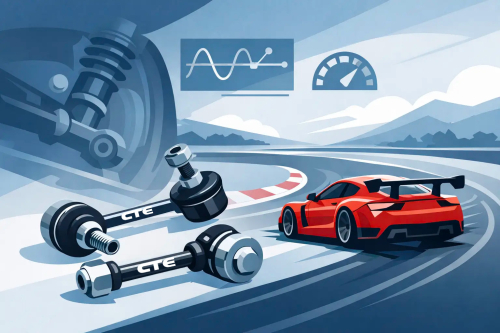
A braking zone is no place to discover that the car has started moving sideways before you turn the wheel. When repeated hard braking, curb strikes, and high lateral loads expose play in the suspension, track car stabilizer links can make the difference between a controlled chassis and a car that feels vague, delayed, or inconsistent from one corner to the next.
They are small components with a direct job: transfer force between the anti-roll bar and the suspension. But their influence reaches far beyond their size. A link that flexes, binds, wears prematurely, or is installed at the wrong length can compromise roll control, steering response, suspension travel, and driver confidence. For track-focused builds, stabilizer links should be specified as part of the full chassis and braking system, not treated as an afterthought.
What Track Car Stabilizer Links Actually Do
The stabilizer bar, often called the sway bar or anti-roll bar, resists the difference in suspension movement from one side of the vehicle to the other. As the car corners, the outside suspension compresses while the inside suspension extends. The bar twists to oppose that difference and reduce body roll.
Stabilizer links connect that bar to the control arm, strut, or another vehicle-specific mounting point. They are the force path. If the link has compliance or clearance where it should not, the bar cannot respond with the precision the chassis setup demands. The driver may feel extra roll, a pause during turn-in, unpredictable balance over curbs, or steering that loses its clean connection to the front tires.
That matters even more when braking hardware has been upgraded. Carbon ceramic systems reduce rotating and unsprung mass while maintaining braking performance under repeated heat cycles. A chassis with worn or poorly matched links can still undermine the confidence created by stronger, more thermal-resistant brakes. The vehicle needs to stay composed as load transfers forward and the driver turns in at speed.
Why Stock Links Often Reach Their Limit on Track
An OEM stabilizer link is engineered around the original vehicle’s broader mission: daily refinement, noise control, cost targets, warranty expectations, and normal-road durability. That does not make it inadequate. It means the original component may not be optimized for a lowered ride height, firmer springs, aggressive alignment, stickier tires, and repeated track loading.
The usual failure is not always a dramatic break. More often, internal ball-joint wear creates small amounts of free play. Rubber-bushed links can deflect under load. Corrosion can damage the joint or threads. A link may also sit at an unfavorable operating angle after suspension changes, placing the joint close to its articulation limit before the car reaches full bump or rebound.
On track, those small compromises become more noticeable because the inputs are larger and more repeatable. A driver may chase the problem with damper clicks, alignment changes, or a stiffer anti-roll bar when the actual issue is a worn link or an installation that has preloaded the bar at static ride height.
The Right Link Depends on the Suspension Setup
There is no universal rule that a heavier link is automatically the better link. Correct geometry, joint articulation, mounting hardware, and vehicle-specific fitment all matter. A race-oriented link must transmit load accurately while allowing the suspension to move through its intended travel without binding.
Fixed-Length Links for Standard Geometry
A high-quality fixed-length link can be the right choice for a vehicle at factory ride height or a modestly lowered setup that retains the intended anti-roll-bar geometry. The key is precise manufacturing, durable joint construction, secure boots or sealing where applicable, and correct hardware engagement.
For a performance workshop, fixed-length links are often the cleanest solution when the vehicle’s geometry remains close to the original design. They remove unnecessary adjustment while restoring a firm, reliable connection between the bar and suspension.
Adjustable Links for Lowered or Tuned Cars
Adjustable stabilizer links are valuable when ride height, bar position, control arms, or strut geometry have changed. Their primary purpose is not to make the suspension arbitrarily stiffer. It is to set the bar without preload at the car’s actual static ride height and keep the joints in a usable operating range.
This is especially relevant on track cars with coilovers. Lowering the vehicle can change the angle of both the bar and link. If one side is effectively loaded at rest, the car may respond differently in left and right turns. An adjustable link gives the installer a way to correct that condition, provided the suspension is settled, the car is at running ride height, and the adjustment is performed carefully.
Adjustment also creates responsibility. Excessive length changes, insufficient thread engagement, mismatched side-to-side settings, or poorly secured lock nuts can introduce a new failure point. The best adjustment range is the amount needed for the application, not the greatest amount possible.
Joint Design, Materials, and Real-World Trade-Offs
Performance links commonly use either ball-joint assemblies or spherical bearings. Both can work well, but they serve different priorities.
Ball-joint links generally offer a more enclosed, street-friendly arrangement with controlled articulation and better protection from contamination. They can be an effective choice for premium road cars that see occasional track use, including performance BMW, Porsche, Tesla, Jaguar, Land Rover, Toyota Supra, Nissan GT-R, and Defender applications where refinement still matters.
Spherical-bearing links can provide very direct movement with minimal compliance. They are well suited to serious track environments where accurate response is the priority and regular inspection is expected. The trade-off is greater exposure to dirt, moisture, and wear, along with a higher potential for noise. A component that is appropriate for a dedicated track car may be too maintenance-intensive for a daily-driven luxury vehicle.
Material selection matters as well. The body must resist bending under load, the threads must maintain integrity, and the hardware must remain secure through thermal cycles and vibration. But oversized parts alone are not proof of engineering quality. Poor joint articulation or incorrect fitment can defeat the purpose of strong material. Racing-grade performance comes from the complete design: dimensions, load path, joint angle, machining accuracy, corrosion resistance, and controlled production.
Installation Details That Protect Handling Balance
A stabilizer link installation should be treated as suspension work, not as a quick accessory swap. Start by confirming vehicle-specific application, anti-roll-bar diameter where relevant, mount style, and any changes made to ride height, arms, dampers, or wheel-and-tire clearance.
The vehicle should be at its normal static ride height when adjustable links are set. Depending on the platform and workshop equipment, that may require ramps, a drive-on lift, or safely supporting the suspension at its loaded position. Setting link length with the suspension hanging can create bar preload once the vehicle returns to the ground.
Check that the link does not contact the damper body, axle, brake hose, wheel, or control arm through steering lock and suspension movement. Confirm that ball joints or spherical bearings are not at the end of their articulation range. Use the manufacturer’s specified torque procedure, secure all lock nuts, and recheck the assembly after initial track use.
For cars that run curbs hard or see frequent high-temperature braking, inspection should become part of the service routine. Look for torn boots, looseness, corrosion, bent link bodies, damaged threads, contact marks, and changing alignment of the bar. Any audible clunk or sudden loss of front-end precision deserves immediate attention.
Stabilizer Links and Brake Confidence Work Together
A car does not brake, turn, and accelerate as separate events. Under heavy deceleration, the front axle takes load, the chassis pitches, and the driver begins asking the tires to generate lateral force before the braking phase is fully over. That transition is where suspension consistency earns its value.
A carbon ceramic brake system can deliver lower unsprung mass, strong heat resistance, and repeatable stopping performance under demanding use. Properly engineered stabilizer links support the chassis side of that equation by helping the anti-roll bar respond as intended. They do not replace correct springs, dampers, alignment, tires, or driver technique. They help ensure those systems are working from a stable and predictable platform.
For distributors and workshops, the opportunity is to specify a complete solution rather than sell isolated parts. Verify the customer’s vehicle, intended use, ride height, brake package, and maintenance expectations. A track-day street car needs a different compromise than a dedicated time-attack build, even when both use the same basic platform.
CCYS applies the same engineering discipline to supporting chassis components as it does to performance braking: vehicle-focused design, precision manufacturing, and quality control backed by 90% in-house production and IATF 16949-certified processes. The right stabilizer link is not the most visible modification on the vehicle, but when the braking zone gets serious, it helps keep every major input honest.