

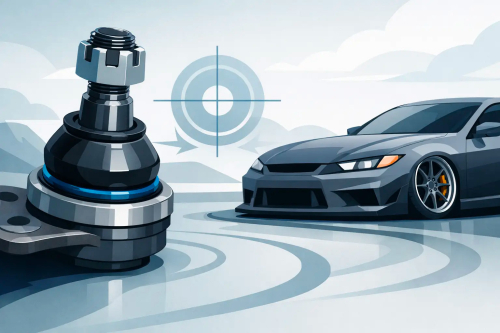
Lowering a performance car can sharpen its stance and reduce body movement, but it also changes the angles that keep the front suspension stable. The wrong ball joints for lowered cars can leave a premium build with wandering steering, accelerated tire wear, binding at full droop, or unpredictable behavior when braking hard into a corner.
That is not a cosmetic problem. On a Porsche, BMW, Tesla, Toyota Supra, Nissan GT-R, or other high-output platform, suspension geometry directly affects how the tire stays loaded during turn-in, braking, and acceleration. A lowered vehicle needs chassis components selected for its real operating angles, not simply the lowest-priced replacement part that fits the control arm.
Why Lowering Changes Ball Joint Loads
A ball joint is the articulated connection between a control arm and the steering knuckle or hub carrier. It must allow the suspension to move through bump and rebound while maintaining a precise location for the wheel. At factory ride height, the joint works within an intended angular range. Lowering the vehicle moves its normal operating position closer to one end of that range.
This matters because the control arm may no longer sit near its designed angle. On many front suspensions, a lowered arm can point upward toward the wheel, changing camber gain, roll-center position, and bump-steer behavior. The joint itself may operate at greater articulation even while the car is sitting still. Add a sharp road impact, curb transition, or track braking zone, and the joint can approach binding.
A component that binds does not merely wear faster. It can restrict suspension movement at the moment the tire needs to follow the road surface. That loss of compliance may reduce grip, disturb steering feedback, and make the car less consistent under load.
Ball Joints for Lowered Cars Need More Than a Lowered Stance
A proper solution begins with geometry. Some lowered applications need a ball joint with increased articulation. Others benefit from an extended or corrected-geometry design that helps return the control arm to a more favorable angle. Adjustable designs can also create useful camber correction, but adjustment alone does not guarantee correct kinematics.
The right choice depends on the suspension layout, actual ride height, wheel and tire package, intended alignment, and use case. A street-driven luxury SUV lowered modestly for appearance has different requirements than a track-focused coupe running stiff springs, sticky tires, and repeated heavy braking.
Correctly engineered ball joints should address several demands at once: secure taper engagement at the knuckle, sufficient articulation through full travel, controlled play under cornering load, and durable sealing against water and road contamination. Any one of these requirements can compromise the result if it is ignored.
Articulation Range Is a Safety Requirement
Do not judge articulation by looking at the car at ride height alone. The wheel must travel through full compression, full droop, steering lock, and the combined movements created during cornering. A ball joint may look acceptable on a lift but bind when the suspension compresses and the steering is near lock.
High-articulation designs can be valuable on aggressively lowered applications, especially where factory-style joints reach their angular limit. However, more movement is not automatically better. The joint must still have the correct stud dimensions, housing geometry, load capacity, and interface with the control arm. A generic high-angle joint is not a substitute for vehicle-specific engineering.
Geometry Correction Must Match the Vehicle
Extended ball joints are often used to alter the relationship between the control arm and knuckle. Depending on the platform, this may help restore roll-center height or improve camber behavior after lowering. It can also affect bump steer and wheel clearance.
That last point is often underestimated. A geometry-correcting joint may change the position of the hub carrier enough to influence brake rotor clearance, wheel spoke clearance, axle angle, or tie-rod relationship. On vehicles equipped with large carbon ceramic brake systems, every millimeter around the caliper, rotor, wheel barrel, and steering components must be verified as a complete assembly.
The best result comes from treating the suspension, steering, wheel fitment, and braking system as one package. A joint selected in isolation can create an expensive fitment problem later.
Construction Details That Separate Performance Parts From Replacements
Performance chassis components live in a harsh environment. Heat from brakes, vibration from rough pavement, high lateral tire loads, and repeated steering input all work against the joint. Materials and manufacturing control determine whether the component keeps its precision or develops unwanted movement over time.
Look for a precision-machined housing, accurately formed stud taper, high-strength stud material, and a durable bearing or liner design suited to the intended duty cycle. A quality dust boot and effective sealing are equally practical. Open or poorly sealed joints can quickly collect abrasive contamination, especially on cars that see rain, road grit, or frequent wheel cleaning.
Serviceability is another trade-off. Replaceable-bearing or rebuildable joints can make sense for dedicated track vehicles that receive regular inspection. For many street and premium daily-driven vehicles, a sealed, maintenance-free design may offer the more practical ownership experience. The correct decision is based on service schedule and operating environment, not marketing language.
Manufacturing consistency matters here. Stud taper inaccuracies, variable preload, or poor surface finish can lead to difficult installation, abnormal movement, or reduced component life. For distributors and workshops, those problems create comebacks that cost far more than the initial savings of an unverified part.
Installation Errors Can Defeat a Quality Ball Joint
Even a racing-grade ball joint cannot correct an installation performed without geometry checks. The tapered stud and knuckle bore must be clean and undamaged. The joint must seat fully before the retaining hardware is tightened to the vehicle-specific specification. Never rely on an impact gun to pull a questionable taper into place.
Control-arm bushing fasteners deserve equal attention. Rubber-bushed arms should generally be tightened at their intended ride position, not with the suspension hanging at full droop. Tightening them in the air can preload the bushing, limit available movement, and shorten bushing life after the vehicle is lowered.
After installation, perform a full alignment. Camber, caster, toe, steering-wheel center, and thrust angle should be checked against the vehicle's intended use. For a modified car, factory alignment numbers may be only a starting point. Excessive negative camber or toe-out may feel responsive initially while consuming expensive tires and reducing stability under braking.
A serious workshop should also cycle the suspension and steering before release. Check the joint at compression and droop, inspect tie-rod clearance, confirm wheel and brake clearance, and listen for contact points. This is especially relevant on cars with coilovers, wide wheels, low offsets, or oversized brake hardware.
Know When Replacement Is Not Enough
Clunking over sharp bumps, unstable braking, inconsistent steering return, or visible grease loss can indicate a worn ball joint. Yet a lowered car can show similar symptoms from worn control-arm bushings, loose stabilizer links, tired tie-rod ends, damaged wheel bearings, or incorrect alignment. Replacing one component without inspecting the surrounding system often masks the root cause.
For a performance restoration or handling upgrade, inspect the entire front-end load path. That includes control arms, bushings, ball joints, tie-rod ends, rack ends, hubs, stabilizer links, and brake mounting interfaces. A precise new joint connected to flexible, worn, or mismatched parts will not deliver the steering accuracy the customer expects.
CCYS supports complete performance braking and chassis solutions with vehicle-specific fitment discipline, factory-controlled production, and quality processes aligned with IATF 16949 and ISO 9001 standards. For performance workshops and distributors, that level of control helps turn a component sale into a dependable system outcome.
The right ball joint should disappear into the driving experience: no binding, no vague steering, no unwanted play, and no surprises when the driver reaches the brake pedal at speed. Specify the component around the vehicle's actual ride height, geometry, and duty cycle, then verify the complete suspension and brake package before the car returns to the road or track.