

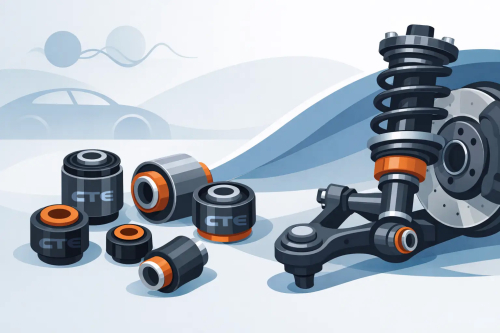
A brake system can have the rotor capacity, caliper stiffness, and pad compound to stop hard, yet still feel unsettled when the chassis moves unpredictably under load. Performance suspension rubber bushings address a less visible part of that problem: the controlled movement between suspension components, subframes, steering links, and mounting points. When those joints deflect too far, the driver may feel a delayed response at turn-in, instability under braking, tramlining, or a vehicle that seems to shift before it takes a set.
For performance workshops and serious vehicle owners, bushings should not be treated as minor service parts. They are chassis-control components. The correct rubber bushing helps maintain suspension geometry while filtering the vibration, noise, and harsh impact that make a road car difficult to live with. It is a measured upgrade, not a universal cure. The right specification depends on vehicle weight, suspension design, tire choice, power level, brake capability, and whether the vehicle spends its time on public roads, track days, or both.
What Performance Suspension Rubber Bushings Do
A suspension bushing is the engineered elastic joint between a mounting bracket and a moving component. Control arms, anti-roll bars, stabilizer links, subframes, and steering assemblies all rely on these joints to move through their intended range without metal-to-metal contact. Rubber allows that movement while managing vibration and isolating noise.
In an aging factory bushing, heat cycles, oil exposure, road salt, repeated load, and simple material fatigue can cause the rubber to crack, soften, separate from its sleeve, or lose its original shape. The suspension may still appear assembled correctly, but its geometry can change dynamically as the vehicle brakes, corners, or accelerates. That movement affects how consistently the tire maintains its contact patch.
A performance-oriented rubber compound is designed to reduce excessive deflection without turning the chassis into a harsh, noisy system. Better control at the bushing helps the suspension do its actual job: keeping the tire loaded predictably. This matters most when a heavy, high-grip vehicle is asked to brake repeatedly from speed or change direction aggressively.
The benefit is often felt as precision rather than drama. Steering inputs arrive with less delay. The front end settles more confidently under braking. Transitions become cleaner. On vehicles with upgraded brake systems, the chassis is better able to manage the forces that higher-grip tires and stronger deceleration place on every suspension joint.
Why Bushing Control Matters Under Hard Braking
During a serious braking event, weight transfers forward and suspension loads rise quickly. Control-arm bushings resist fore-and-aft movement, while subframe and steering-related bushings help keep the front axle positioned as intended. If these components are worn or too compliant for the application, toe and caster can shift under load. The driver may experience a wandering steering wheel, uneven response between left and right braking zones, or a vague initial bite even when the brake hardware is performing correctly.
Bushings do not increase rotor thermal capacity or create additional clamping force. They cannot compensate for incorrect pad selection, a compromised hydraulic system, or poor tire condition. Their role is different and equally practical: they help the vehicle use its suspension geometry consistently when braking forces are high.
That distinction is critical for professional diagnosis. A customer who complains of instability under heavy braking may need more than pads and rotors. Before assigning the problem to the brake system alone, inspect the control-arm bushings, ball joints, tie-rod ends, stabilizer links, wheel hubs, alignment settings, and tire condition. A complete chassis assessment prevents a premium brake upgrade from being judged through the behavior of worn supporting components.
The Tire Contact Patch Is the Real Priority
Every suspension decision eventually reaches the tire contact patch. Excessive bushing deflection can allow unwanted wheel movement that changes alignment angles at the exact moment the tire needs predictable loading. A firmer, properly engineered rubber bushing reduces that unwanted movement while retaining the progressive compliance needed on imperfect roads.
For platforms such as BMW, Porsche, Tesla, Toyota Supra, Nissan GT-R, Jaguar, Land Rover, and Defender models, the answer is never simply to install the hardest available part. Vehicle mass, factory suspension architecture, drivetrain layout, and intended use all matter. A heavy electric vehicle may place very different demands on its front-end components than a lightweight track-focused coupe. An SUV used for high-speed road travel must retain a different level of isolation than a dedicated circuit car.
Performance Rubber vs. Polyurethane vs. Solid Mounts
Rubber is sometimes dismissed as the soft option. That is an oversimplification. Modern performance rubber can be tuned through compound hardness, void design, bonded sleeve construction, and geometry. It can provide a substantial improvement over deteriorated original equipment while preserving the quiet, progressive response expected in premium road vehicles.
Polyurethane bushings can offer higher stiffness and often appeal to drivers pursuing a more immediate chassis feel. They may be appropriate for certain track-oriented applications, but they can introduce more noise, vibration, and harshness. Depending on design and lubrication, some polyurethane configurations may also require greater attention over time. The best choice is not determined by hardness alone.
Solid mounts and spherical bearings deliver the highest degree of location control, making them valuable in dedicated competition environments. They also transmit more impact and drivetrain noise, and they may reduce comfort or service life in daily-driven conditions. Installing race-level joints throughout a street car can create new problems without providing a proportional real-world gain.
Performance rubber sits in the useful middle ground for many builds. It is particularly well suited to premium street cars, fast-road applications, performance restorations, and track-capable vehicles that still need civilized road behavior. The goal is controlled compliance, not zero compliance.
Choosing the Right Bushing Specification
Start with the failed component and the vehicle’s actual duty cycle. A cracked bushing in one control arm does not automatically mean every mount should be replaced with a maximum-stiffness alternative. Identify the location, load direction, and relationship to braking, steering, and suspension geometry. Then select a vehicle-specific component that matches the use case.
Fitment accuracy matters because bushing dimensions, sleeve design, and mounting orientation directly affect installation and performance. A part that is close in size is not necessarily correct. Improperly seated bushings, incorrect sleeve lengths, or a design that does not match the original arm geometry can preload the suspension or create premature wear.
For distributors and workshops, sourcing from a manufacturer with direct control over machining, compound selection, and quality management reduces uncertainty. CCYS supports performance chassis and braking programs through factory-controlled engineering, with 90% of production completed in-house and quality processes aligned with IATF 16949 and ISO 9001 standards. That production discipline matters when a component must fit correctly, tolerate repeated load cycles, and support the behavior of a high-performance vehicle.
Installation Details That Determine Results
Even a well-designed bushing can underperform when installation discipline is poor. Suspension arms should generally be tightened at the manufacturer-specified ride-height position, not left hanging at full droop. Tightening bonded rubber bushings with the suspension unloaded can twist the rubber at rest, reducing its working range and accelerating fatigue.
After replacing bushings that influence control-arm position or steering geometry, perform a complete alignment. Do not assume factory alignment values are automatically ideal for a modified vehicle. Tire width, ride height, dampers, brake upgrades, and the intended driving environment can all affect the final alignment strategy.
Inspect adjacent parts before returning the vehicle to service. Replacing one worn bushing while leaving a loose ball joint or fatigued tie-rod end in place can mask the improvement and compromise safety. The same applies to stabilizer links, hub bearings, and control-arm hardware. Chassis performance is a system, and its weakest connection is often the one the driver feels first.
Signs It Is Time to Inspect Suspension Bushings
Bushings should be inspected during brake service, alignment work, tire replacement, and any suspension repair. Look closely when the vehicle shows four or more of these symptoms:
- A clunk, thud, or sharp knock over bumps or during brake application
- Steering delay, wandering, or a change in direction when braking hard
- Uneven or accelerated tire wear after alignment has been checked
- Visible rubber cracking, separation, distortion, or fluid leakage from hydraulic-style mounts
- Increased vibration, road noise, or instability during high-speed driving
Visual inspection is only one part of the process. Some bushings fail internally or deflect excessively only when loaded. Controlled leverage testing and a road evaluation can reveal movement that is not obvious on a lift.
Build Braking and Chassis Control as One System
A high-performance braking package deserves a chassis that can support it. Carbon ceramic rotors, monobloc calipers, and racing-grade pads manage heat and stopping force, but the vehicle still depends on predictable suspension geometry and tire loading to use that performance safely. Replacing degraded bushings is not cosmetic maintenance. It is part of restoring the accuracy and confidence engineered into the vehicle.
For a street-driven performance build, choose suspension rubber that matches the car’s real workload, install it with alignment and torque procedures taken seriously, and assess the complete front and rear chassis rather than one isolated part. The result should not be a vehicle that merely feels stiffer. It should be one that remains composed when braking hard, turns with authority, and gives the driver clear feedback when the road or track demands more.