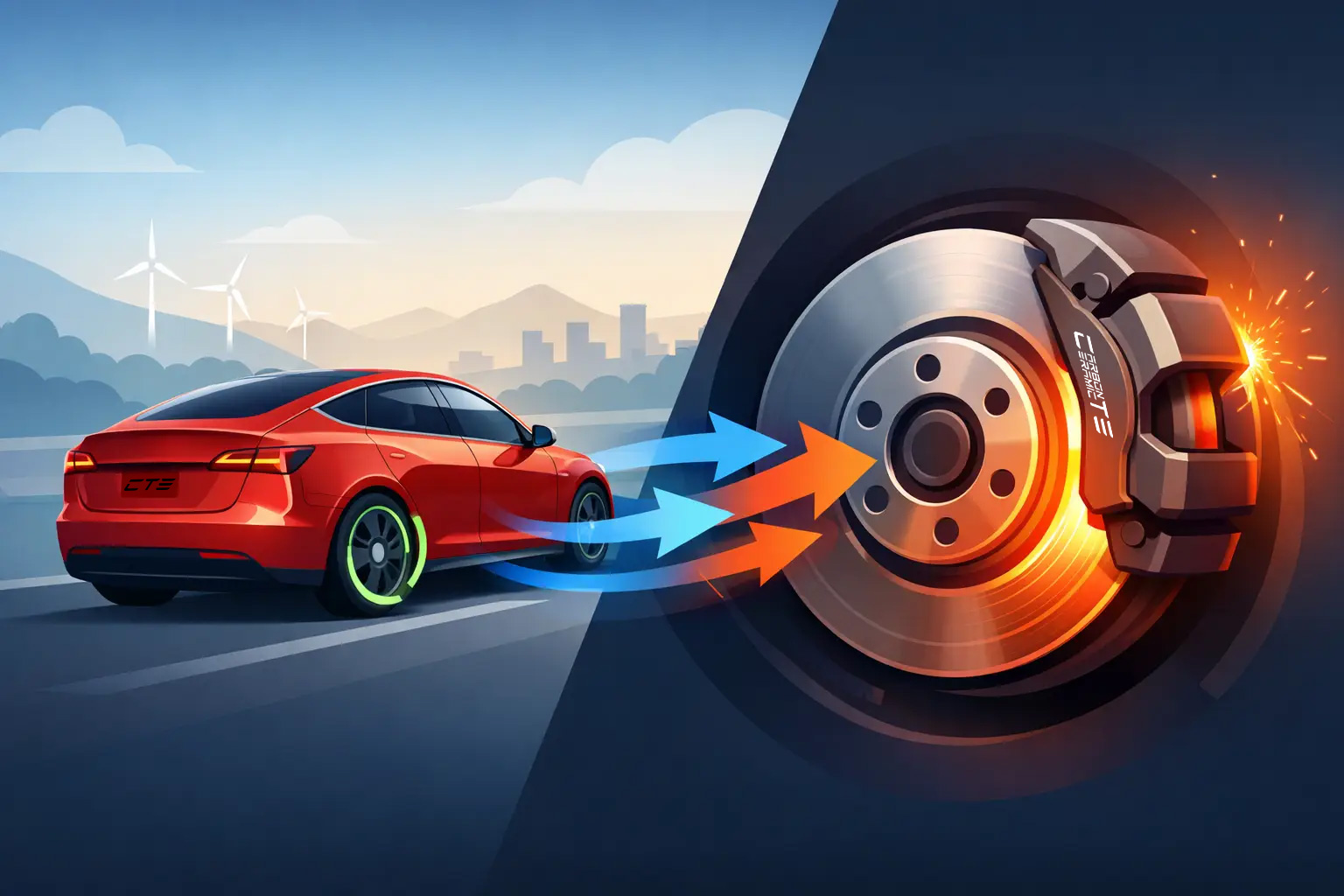
A Tesla can feel exceptionally controlled right up to the moment repeated hard braking asks more of the friction system than regeneration can provide. That is where Tesla brakes become a serious engineering question, not a cosmetic upgrade. A heavy EV carrying passengers, cargo, and instant torque can build speed quickly. When the road, track session, or emergency stop demands maximum deceleration, the rotor, pad, caliper, fluid, and mounting hardware must work as one.
For daily commuting, the factory system is usually designed around predictable road use, regenerative braking, durability, and cost control. For performance driving, mountain descents, loaded highway travel, or repeated high-speed stops, the priorities change. Heat capacity, pedal consistency, pad stability, unsprung weight, and vehicle-specific brake balance become decisive.
How Tesla Brakes Share the Work With Regeneration
Regenerative braking is one of the defining advantages of an electric vehicle. When the driver lifts off the accelerator or applies the brake pedal under suitable conditions, the drive motors can recover energy while slowing the vehicle. This reduces friction-brake use in normal driving and can extend the life of pads and rotors.
But regeneration is not a substitute for high-performance friction braking. Its available braking force varies with battery state of charge, battery temperature, vehicle speed, traction conditions, and system strategy. A fully charged or cold battery may accept less regenerative energy. At low speeds, regenerative effect also decreases. During an emergency stop, the friction brakes must immediately deliver the stopping force regeneration cannot provide.
That distinction matters for Tesla owners who drive beyond the daily commute. A Model 3 Performance, Model S Plaid, Model X, or Model Y can carry considerable mass and generate rapid acceleration. The braking system has to repeatedly convert kinetic energy into heat without fading, pulling, vibrating, or losing pedal confidence.
Why Factory Friction Brakes Can Become the Limiting Factor
A stock brake system is always a compromise. It must meet broad expectations for noise, comfort, durability, cost, and standard road use. That does not mean it is inadequate. It means the system may reach its thermal limit sooner when the vehicle is driven aggressively or repeatedly decelerated from high speed.
Brake fade is the most obvious warning. As pad and rotor temperatures climb, the pad friction coefficient can change, the pedal can feel less decisive, and stopping distances can become less repeatable. Brake fluid exposed to extreme temperatures can also contribute to a soft pedal feel. On a long descent or track session, this is not a minor inconvenience. It changes the driver’s margin of safety.
There is another Tesla-specific concern: low friction-brake use. Because regeneration performs much of the routine deceleration, rotors can develop surface corrosion, particularly in wet, salty, or coastal climates. Pads may also see less regular cleaning action. A driver may have plenty of pad material remaining yet still experience uneven braking, noise, rotor scoring, or reduced initial bite.
The right response depends on the vehicle’s actual use. A commuter with occasional spirited driving may benefit from proper inspection, brake servicing, and performance-oriented pads. A vehicle that sees repeated canyon runs, high-speed road use, heavy loads, or track days may need a complete thermal-capacity upgrade.
What a Performance Tesla Brake System Must Solve
More clamping force alone does not create a better brake system. A credible upgrade needs to manage heat, preserve front-to-rear balance, fit the wheel package, and maintain dependable operation with the vehicle’s electronic brake and stability systems.
Rotor material and thermal capacity
The rotor absorbs and releases enormous heat during deceleration. Larger rotor dimensions can increase leverage and thermal mass, while carefully engineered ventilation improves cooling. Carbon ceramic rotors offer a different performance path: substantially lower weight, high thermal resistance, and strong durability under demanding temperature cycles.
Reducing rotor mass also reduces unsprung and rotating weight. This can help suspension response, steering precision, and wheel control over uneven pavement. For a heavy, high-output EV, that benefit is meaningful, but it does not eliminate the need for the right pads, calipers, and system calibration.
Carbon ceramic systems involve real trade-offs. They cost more than conventional iron systems and require pads engineered for the rotor material and intended temperature range. Fitment, bedding procedures, wheel clearance, and replacement planning should be addressed before installation. The best choice is not always the most expensive one. It is the system matched to the vehicle, tire grip, wheel size, and duty cycle.
Caliper stiffness and controlled clamping
A racing-grade monobloc caliper is designed to resist flex under pressure. Greater stiffness helps produce a more consistent pedal response and distributes clamping force evenly across the pad. Multi-piston caliper design also allows pad shape and pressure distribution to be engineered around the rotor’s usable surface.
The critical point is balance. Oversizing the front brakes without considering the rear axle, tire compound, suspension setup, and electronic intervention can create an unbalanced vehicle. A complete kit should be engineered around the specific Tesla platform, not assembled from unrelated parts chosen only because they look aggressive behind a wheel.
Pad compound, fluid, and hardware
Pads determine much of the brake system’s character. A street-focused compound may offer quiet operation and strong cold response, while a track-oriented compound can tolerate greater temperatures but may create more noise, dust, or wear. Neither is universally better.
High-temperature brake fluid, correctly specified hoses where applicable, precision brackets, mounting hardware, and clear installation instructions matter just as much. Braking confidence is often lost through overlooked details: an incompatible pad, poor rotor bedding, incorrect torque, trapped air, or a caliper bracket that does not maintain exact alignment.
Choosing the Right Upgrade for the Tesla Application
Start with duty cycle, not appearance. A Model Y used for family transportation and occasional fast road driving has different requirements from a Model 3 Performance used for track days. A Model S Plaid requires a system that respects its speed and mass, while a Model X used for towing or mountain travel demands stable braking under load.
Before selecting components, confirm the exact model year, trim, wheel diameter, wheel-spoke clearance, factory brake package, and intended use. Brake packages can vary by production year and market. Even when a rotor diameter appears compatible, caliper clearance, hub dimensions, parking-brake configuration, and electronic-system integration may differ.
For distributors and performance workshops, complete-kit support is especially valuable. It reduces the risk of mixing incompatible components and gives the installer a defined package: rotors, calipers, pads, brackets, lines where required, hardware, and technical specifications. That is a stronger commercial proposition than selling stopping performance as a collection of separate parts.
Installation and Service Are Part of Brake Performance
No premium brake kit can overcome poor installation. Mating surfaces must be clean, rotor runout checked, fasteners torqued to specification, and fluid properly bled. Pads and rotors need a controlled bedding process to establish an even transfer layer. Skipping this work can cause vibration, inconsistent bite, noise, and premature wear that are wrongly blamed on the hardware.
Tesla owners should also continue routine brake maintenance even when regenerative braking minimizes pad use. Inspect pad movement, caliper slides or pistons as applicable, rotor condition, brake-fluid age, and corrosion exposure. In winter climates, periodic friction-brake use and proper service can help keep the system operating freely.
For high-performance applications, choose a manufacturer that can provide vehicle-specific fitment data, material specifications, quality documentation, warranty support, and technical assistance. CCYS applies 90% in-house production control, IATF 16949 and ISO 9001 quality standards, and complete carbon ceramic system engineering to serve this level of requirement.
A Tesla’s acceleration may get the attention, but braking capacity determines how confidently that performance can be used again and again. Specify the system around real driving conditions, verify every fitment detail, and treat installation as safety-critical work. That is how a brake upgrade becomes dependable vehicle control rather than an expensive visual modification.