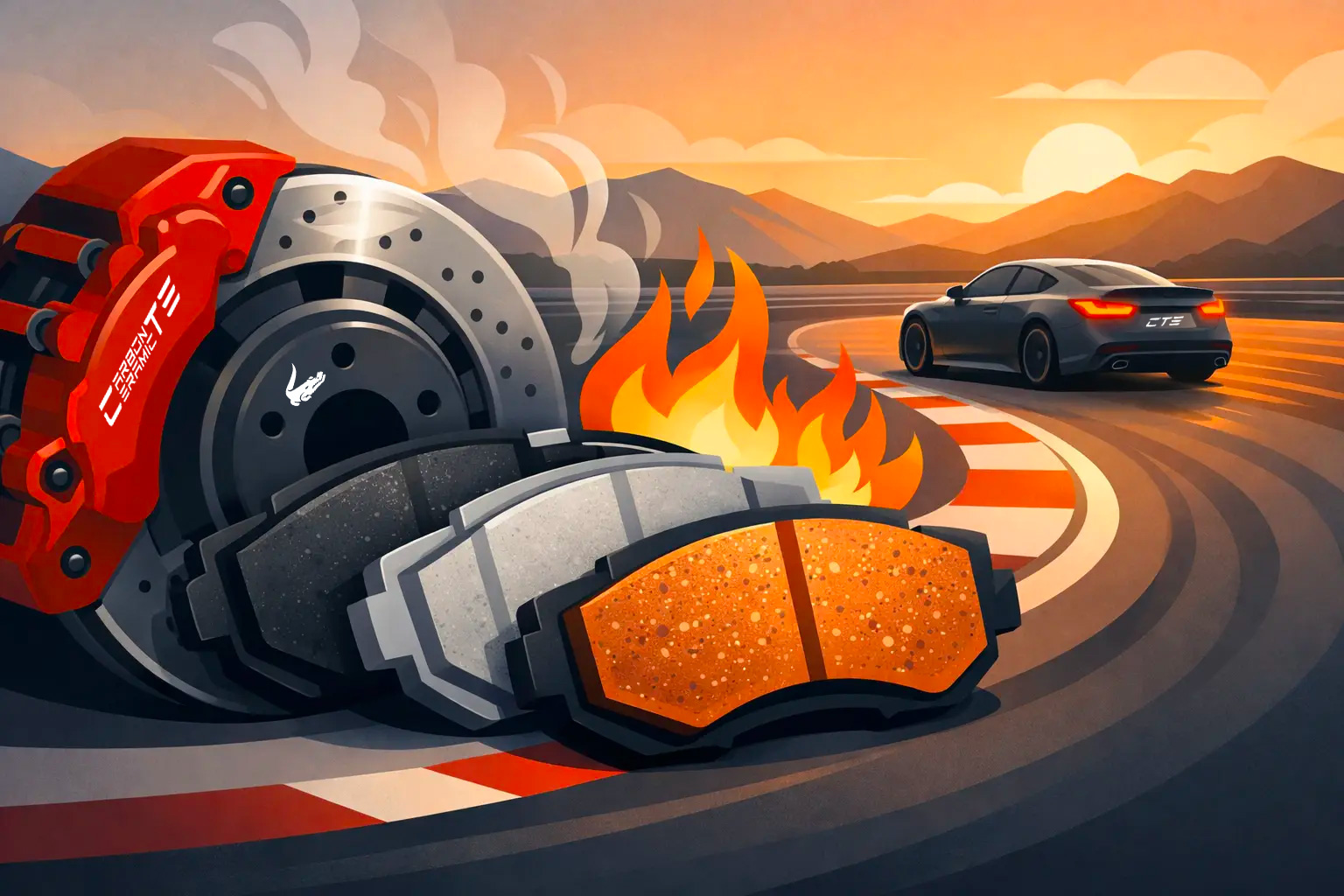
A brake pedal that goes long after several hard stops changes the entire character of a performance vehicle. The engine may have the power, the tires may have the grip, and the chassis may be prepared, but inadequate brake pad compounds can leave the driver without the repeatable response needed to use any of it safely. For premium street cars, track-focused builds, and high-output SUVs, pad selection is not a minor consumable decision. It is a core part of the braking system’s thermal and mechanical balance.
The right compound delivers predictable friction at the temperatures your vehicle actually reaches. The wrong one may feel aggressive during a cold morning commute, then fade when the brakes are asked to manage repeated high-speed stops. It may also generate excess noise, accelerate rotor wear, or compromise pedal consistency. Selecting pads by a single claim such as “race” or “ceramic” is not enough. The friction material, rotor material, caliper design, vehicle weight, tire grip, and intended use must work together.
What Brake Pad Compounds Actually Control
A brake pad converts hydraulic clamping force into friction and heat. Its compound is the engineered blend of friction materials, binders, fibers, lubricants, abrasives, and fillers that determines how that conversion behaves. A pad’s coefficient of friction matters, but the stability of that friction across a broad temperature range matters just as much.
For a driver, compound behavior shows up in four direct ways: initial bite, pedal modulation, fade resistance, and wear. Initial bite is the immediate response when the pad contacts the rotor. Modulation is the ability to add or reduce braking force with precision rather than feeling like the brakes are either on or off. Fade resistance measures how consistently the pad performs as heat builds. Wear includes both pad life and the effect the material has on the rotor surface.
A high-friction pad is not automatically the best pad. On a light track car with proper cooling and racing tires, an aggressive compound can offer the confidence needed for late braking. On a heavy luxury SUV used mainly on the road, that same material may be noisy, dusty, and difficult to control at low speeds. Brake performance is application-specific engineering.
Main Types of Brake Pad Compounds
Organic and low-metallic materials
Organic pads typically use nonmetallic fibers and resin-based binders. They tend to be quiet and rotor-friendly, making them suitable for standard daily driving, but they are generally limited when temperatures rise repeatedly. They are not the preferred choice for a vehicle that sees mountain descents, high-speed road driving, towing, or track sessions.
Low-metallic organic pads add metal content to improve heat transfer and friction performance. They can provide stronger bite than basic organic materials, but may create more dust and noise. For moderate street performance, they can be a reasonable middle ground. Their limits become apparent in heavier vehicles or sustained high-energy braking.
Semi-metallic compounds
Semi-metallic pads contain a substantial percentage of metallic material, commonly steel, iron, copper-free alternatives, or other engineered fibers. They are widely used because they offer dependable cold response, good durability, and stronger heat capability than organic designs.
For many fast street applications, semi-metallic material remains practical. It can handle more heat than a comfort-focused pad while retaining usable behavior on cold rotors. The trade-off is greater rotor wear potential, more dust, and the possibility of audible braking under light pedal pressure. Quality formulation makes a major difference here. Two pads described as semi-metallic can behave very differently under load.
Ceramic friction materials
Ceramic pads use ceramic fibers and fine material blends designed to manage heat while reducing noise and visible dust in many street applications. They are often associated with refined pedal feel and cleaner wheels, but “ceramic” alone does not define performance level. A comfort-oriented ceramic replacement pad and a high-temperature carbon ceramic brake pad are not interchangeable concepts.
When matched correctly to a carbon ceramic rotor system, a purpose-engineered pad must maintain stable friction without damaging the rotor’s specialized surface. The material needs to operate through demanding heat cycles while supporting the low unsprung weight, thermal resistance, and long service potential that make carbon ceramic systems valuable. This is a system decision, not a generic pad upgrade.
Track and racing-grade compounds
Track-focused pads are formulated for high thermal capacity, stable friction at elevated temperatures, and repeatable braking after lap after lap. Many require heat before reaching their best operating range. That makes them effective in a controlled performance environment but less appealing for daily driving, where cold response, noise, and frequent low-speed braking matter.
A racing-grade compound may also transfer material to the rotor differently than a street pad. Proper bedding is essential, and mixing incompatible pad materials on the same rotor can lead to uneven deposits, vibration, or inconsistent pedal feel. For dedicated track use, a separate rotor and pad set is often the more disciplined approach.
Match the Compound to Heat, Weight, and Use
The vehicle’s mass is often underestimated. A Tesla, Land Rover Defender, or high-performance luxury SUV carries significantly more kinetic energy into a braking event than a lighter coupe at the same speed. Add larger wheels, high-grip tires, passengers, cargo, or downhill terrain, and the brake system’s heat load increases quickly.
A Porsche, BMW M model, Toyota Supra, or Nissan GT-R used for spirited road driving may need a pad with stronger initial bite and greater fade resistance than an OE comfort compound. However, an owner who drives the same vehicle in urban traffic every day may still prioritize quiet operation and cold performance. The best selection is frequently a high-performance street compound, not the most aggressive track material available.
For track-day vehicles, be honest about session length, braking zones, tire level, cooling ducts, and driver pace. A novice driver on street tires may never reach the temperatures that justify an endurance-focused pad. An experienced driver on 200-treadwear tires can overwhelm a street-oriented compound in a few laps. Data from rotor temperature paint, pedal behavior, pad wear, and lap-to-lap consistency provides a better answer than marketing labels.
Rotor Compatibility Is Not Optional
Every pad leaves a transfer layer on the rotor. Properly managed, that layer supports stable friction. When pad and rotor materials are poorly matched, the result can be judder, hot spotting, accelerated wear, or a loss of predictable braking response.
Iron rotors tolerate a broad range of compounds, but they still need pads selected for the intended temperature range and rotor finish. Carbon ceramic rotors require more specific material control. A pad that is too abrasive can undermine rotor longevity. A pad that does not generate the required transfer behavior can feel inconsistent, particularly through repeated thermal cycles.
This is why complete brake-system engineering matters. The caliper’s piston arrangement, pad backing plate, anti-rattle hardware, rotor dimensions, airflow, and friction material all contribute to real-world performance. CCYS develops carbon ceramic brake systems with this complete-system view, supported by in-house manufacturing control across critical production processes and quality management aligned with IATF 16949 and ISO 9001 standards.
Do Not Ignore Bedding and Daily Behavior
Even the correct compound can disappoint if it is installed or bedded incorrectly. Bedding gradually brings the pads and rotors to temperature, establishes a controlled transfer layer, and stabilizes the contact surfaces. The precise procedure varies by pad and rotor system, so technicians should follow the supplied guidance rather than using a one-size-fits-all routine.
Noise is also not a simple quality verdict. High-friction materials can produce sound at low speeds, especially when cold or lightly applied. Slotting, chamfers, shims, caliper condition, and bedding quality all influence the result. A performance customer should understand the trade-off before installation: greater thermal resistance and stronger bite can come with more audible operation or dust.
Pad inspection should look beyond remaining thickness. Check for taper wear, glazing, cracking, uneven deposits, damaged backing plates, and changes in pedal feel. These signs can reveal caliper movement issues, insufficient cooling, incorrect compound choice, or rotor condition before they develop into a safety concern.
Choose for Repeatability, Not Just First Bite
The strongest brake setup is the one that responds the same way at the end of a demanding drive as it did at the first corner. Select brake pad compounds around the real thermal load, the rotor material, and the vehicle’s daily role, then support that choice with correct fitment, installation, and bedding. For distributors, workshops, and drivers building serious performance vehicles, that disciplined approach produces braking confidence that can be felt every time the pedal is pressed.