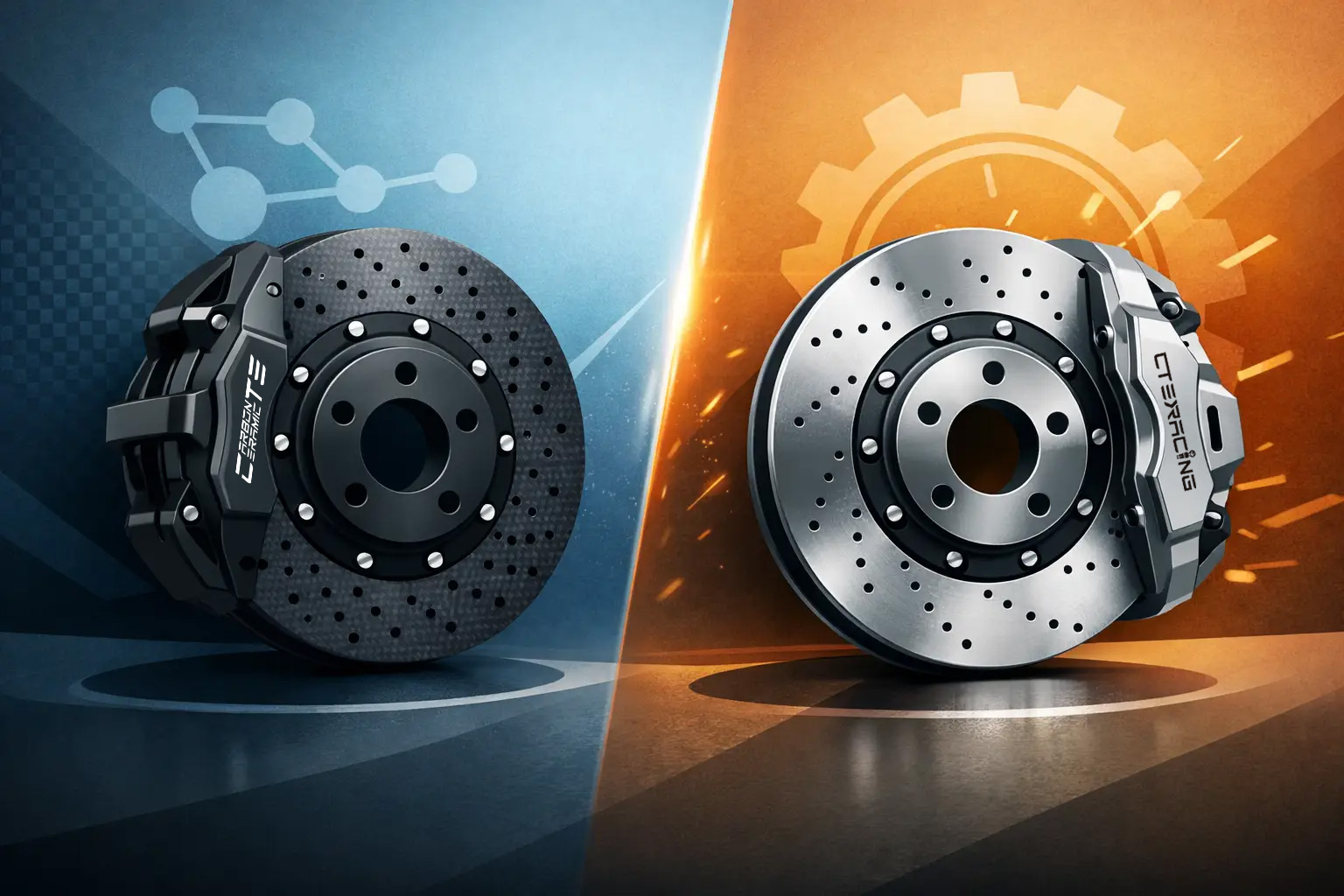
A brake pedal that goes long after a few hard stops changes the entire drive. Carbon ceramic versus iron rotors is not simply a premium-versus-budget decision. It is a system-level choice that affects unsprung weight, heat capacity, pedal consistency, service cost, and how confidently a vehicle performs when braking demand rises.
For performance workshops, distributors, and drivers building Porsche, Tesla, BMW, Nissan GT-R, Toyota Supra, Jaguar, Land Rover, Defender, and supercar platforms, the right answer depends on the vehicle's actual duty cycle. A rotor that excels on repeated high-speed stops may not be the most rational option for a commuter vehicle. Likewise, a low-cost iron setup can become expensive when heat, vibration, and repeated replacement enter the equation.
Carbon Ceramic Versus Iron Rotors: The Core Difference
Iron rotors, commonly made from cast gray iron, have earned their place because they are durable, affordable, easy to machine, and highly predictable. They generate strong friction with a wide range of pad compounds and deliver consistent braking behavior in everyday temperatures. For most street vehicles and many track cars, a properly sized iron rotor with quality pads, fluid, cooling, and calipers remains a capable solution.
Carbon ceramic rotors use a carbon-fiber-reinforced ceramic matrix, typically silicon carbide-based. Their purpose is not to create a dramatic first-stop advantage in every condition. Their engineering advantage is maintaining control under heat while reducing rotor mass substantially. In a properly matched brake system, that lower mass and high thermal resistance can support repeated heavy braking with less fade, reduced rotor wear, and less stress transferred to adjacent components.
The distinction matters because a rotor never works alone. Caliper stiffness, piston sizing, pad compound, brake fluid, cooling airflow, wheel fitment, and master-cylinder calibration all influence the result. Replacing rotors without matching the system can compromise the benefit of the material.
Weight: The Performance Benefit Drivers Feel
The most immediate physical advantage of carbon ceramic is lower weight. Compared with a similar-sized iron rotor, a carbon ceramic disc can remove significant mass at each corner. That reduction is not just a catalog number. Rotors are rotating, unsprung components, so their weight affects suspension response, steering precision, acceleration, and how quickly the tire maintains contact over imperfect pavement.
On a performance vehicle, lower unsprung weight can help the suspension react more cleanly over bumps and transitions. On heavier EVs and luxury SUVs, where vehicle mass and wheel mass are substantial, reducing brake-system weight can be particularly valuable. The improvement is not magic, and it will not transform a poorly damped chassis. But it is a meaningful engineering gain when combined with correctly selected wheels, tires, and suspension components.
Iron remains heavier, but weight is not the only measure of braking performance. A large iron rotor can offer excellent thermal capacity, and many dedicated race programs continue to use iron because it is economical, easy to inspect, and readily replaced between events. The question is whether the vehicle benefits more from low weight and long-term thermal resilience or from the lower consumable cost of iron.
Heat Resistance and Brake Fade
Hard braking converts speed into heat. When the rotor, pad, fluid, or caliper is pushed beyond its effective operating range, braking confidence disappears quickly. The pedal may feel soft, friction may fall away, or the vehicle may require greater pedal effort at the exact moment the driver needs precision.
Carbon ceramic rotors are engineered for elevated temperatures and repeated braking cycles. Their thermal-resistant structure helps them maintain integrity under severe use, while their low thermal expansion helps reduce the distortion issues associated with overheated conventional rotors. They also resist corrosion, an advantage for vehicles exposed to moisture, stored for extended periods, or driven in coastal environments.
That does not mean carbon ceramic systems are immune to fade. Pads can still overheat. Fluid can still boil. Inadequate cooling can still overwhelm the system. A carbon ceramic rotor must be paired with a pad compound designed for its operating temperatures and friction characteristics. The caliper and mounting hardware must also control the disc correctly under load.
Iron rotors absorb and dissipate heat effectively, especially when properly vented and paired with brake cooling. However, sustained thermal cycling can lead to surface cracking, judder, heat checking, and rotor distortion. For a street car that sees occasional spirited use, this may be manageable. For a heavy, high-horsepower vehicle making repeated high-speed stops, it becomes a service and safety concern.
Pedal Feel and Initial Bite Are System Decisions
A common assumption is that carbon ceramic automatically stops a car in a shorter distance. That is not always true. Maximum stopping distance is often limited by tire grip, ABS calibration, road surface, and vehicle balance before it is limited by rotor material.
What a well-engineered carbon ceramic system can deliver is more consistent response as temperature rises. With rigid monobloc calipers, correctly matched pads, and a vehicle-specific mounting solution, the driver can experience a firmer, more stable pedal during repeated braking. That consistency matters on track, during mountain driving, and in high-speed road use where the braking zone must remain predictable.
Iron rotors can provide excellent cold response and modulation, particularly with street-focused pads. Some drivers also prefer iron for dedicated track use because pad options are broad and behavior is familiar across changing conditions. Carbon ceramic systems may require a short warm-up period depending on the pad selection, and certain combinations can produce noise at low speed. Neither factor is a defect by itself. It is part of selecting components for the intended operating environment.
Cost, Service Life, and the Real Ownership Equation
Upfront cost is the clearest advantage for iron. Replacement iron discs and compatible pads are widely available, and regular service is straightforward. For fleet applications, moderate-output vehicles, and track drivers who consume rotors and pads frequently, iron can be the practical choice.
Carbon ceramic requires a larger initial investment. The rotor manufacturing process is specialized, and replacement parts must meet strict dimensional, material, and balance requirements. A carbon ceramic disc should never be treated as a generic upgrade item or matched casually with unverified pads and hardware.
The longer view is more nuanced. Carbon ceramic rotors can offer extended service life when used within their designed parameters, especially in demanding street and performance applications. Their corrosion resistance and wear characteristics can reduce rotor replacement frequency. However, damage from impact, improper installation, incorrect pad materials, or extreme misuse can be costly. Inspection procedures must be followed, and wear should be measured using the manufacturer's specified limits rather than assumptions borrowed from iron brakes.
For distributors and workshops, the strongest commercial offering is usually a complete, vehicle-specific system: rotors, calipers, pads, brackets, brake lines where applicable, hardware, and technical guidance. This approach reduces fitment risk and protects the performance the customer paid for.
When Iron Rotors Are the Better Choice
Iron is still the right answer for many builds. A daily-driven performance sedan that sees normal road use, a budget-conscious track project, or a vehicle where inexpensive consumables are a priority may be better served by a high-quality iron big-brake kit. The system should still include adequate rotor diameter and thickness, rigid calipers, suitable pads, and cooling appropriate to the vehicle's weight and speed.
Iron is also logical when a driver wants broad access to pad compounds for different events. Endurance, sprint racing, autocross, wet-weather driving, and street use can require different friction behavior. The lower replacement cost makes experimentation and frequent maintenance easier.
When Carbon Ceramic Is Worth It
Carbon ceramic becomes compelling when the vehicle is heavy, fast, repeatedly loaded, or built around premium performance. It is especially relevant for high-output road cars, EVs carrying substantial battery mass, luxury SUVs, supercars, and track-capable builds where reduced unsprung weight and stable high-temperature performance justify the investment.
The correct application is not a rotor-only swap. It is a matched brake package engineered around caliper geometry, rotor dimensions, mounting stiffness, pad selection, wheel clearance, and vehicle-specific fitment. CCYS applies this approach through carbon ceramic brake systems built with controlled manufacturing, racing-grade materials, and quality processes supported by IATF 16949 and ISO 9001 standards.
Before specifying either material, define the vehicle's weight, horsepower, tire grip, intended use, wheel clearance, and expected braking temperatures. Then choose the complete system that can deliver repeatable braking force without compromise. When the road tightens or the braking zone arrives sooner than expected, confidence comes from engineering that is already working at the limit.