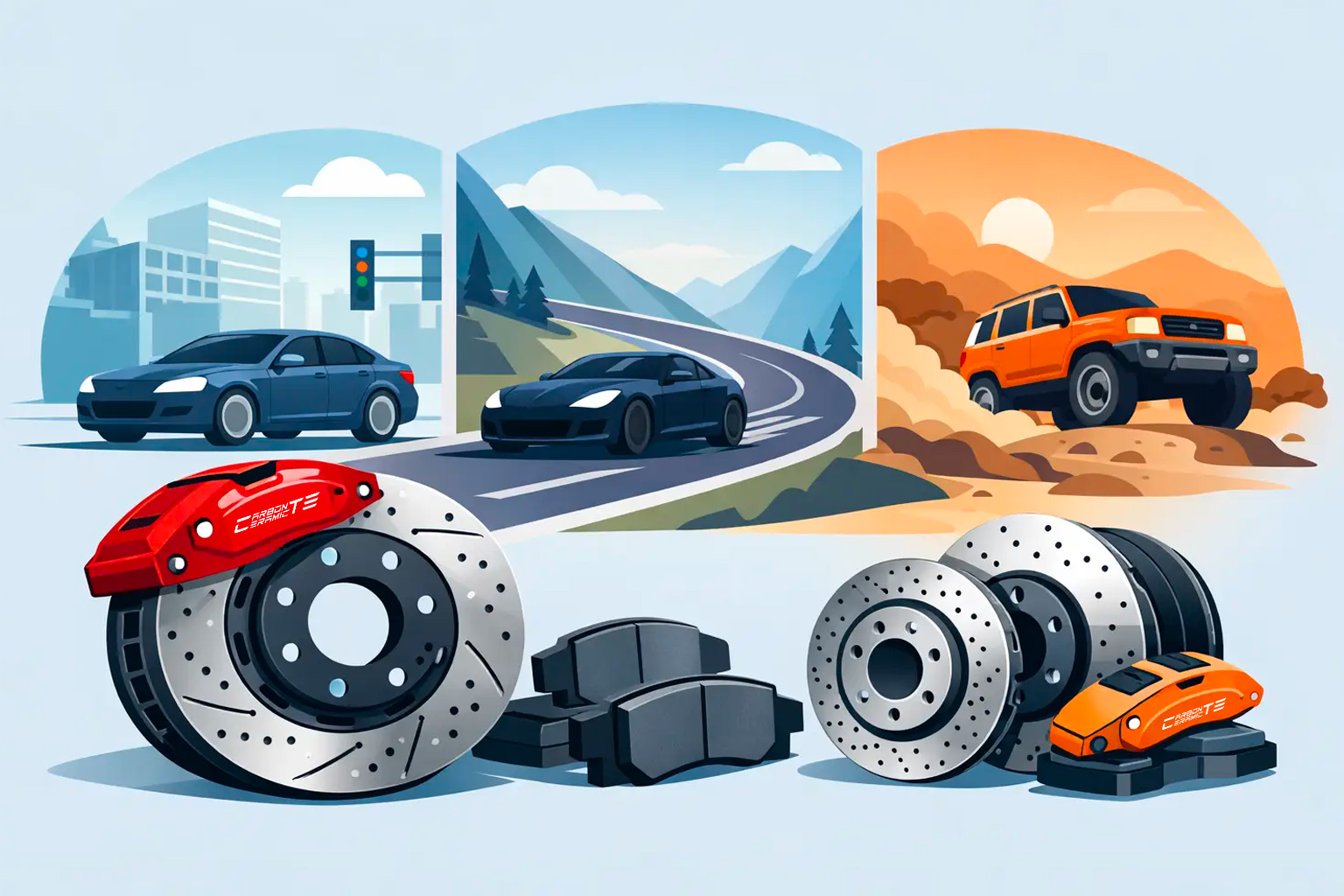
A hard brake pedal with no real deceleration is more than an inconvenience. When a heavy vehicle, high-speed road, mountain descent, or late braking zone exposes the limits of the factory system, the driver needs predictable stopping force immediately. Quality brake kits are built to address that moment with matched components engineered to work as one system, not as a collection of unrelated upgrades.
For performance workshops, distributors, and owners of premium vehicles, the right kit is not simply the one with the largest rotor or the most aggressive-looking caliper. It is the system that fits the platform, manages heat under repeated load, clears the intended wheel, maintains correct brake balance, and delivers reliable pedal feel over time.
What Complete Brake Kits Should Include
A complete brake upgrade is engineered around the relationship between rotor, caliper, pad compound, mounting bracket, brake line, and hardware. Each part influences the next. A larger rotor changes leverage and thermal capacity. A multi-piston caliper changes clamp-force distribution. Pad shape and compound affect friction, initial bite, noise, temperature range, and rotor wear.
This is why a vehicle-specific complete kit offers a stronger foundation than piecing together components from different suppliers. Properly designed brake kits commonly include carbon ceramic rotors or discs, monobloc calipers, performance brake pads, caliper brackets, mounting hardware, brake lines where applicable, and fitment-specific accessories. The objective is controlled, repeatable performance rather than a cosmetic change behind the wheel.
The bracket deserves particular attention. It must position the caliper accurately over the rotor and withstand braking loads without flexing or shifting. A kit may look impressive on a parts list, but poor bracket design, inconsistent machining, or incomplete hardware can compromise alignment and reduce the benefit of premium calipers and rotors.
Start With the Vehicle and Its Real Duty Cycle
The correct specification depends on how the vehicle is used. A Porsche used for spirited weekend driving has different priorities from a Tesla that regularly carries substantial weight, a BMW built for track days, or a Nissan GT-R subjected to repeated high-speed braking. Even within the same vehicle platform, wheel size, tire selection, power output, curb weight, and driver expectations affect the right choice.
For fast road use, the goal is usually sharper pedal response, better resistance to fade, reduced unsprung weight, and durable performance in changing weather and traffic conditions. Track-oriented use raises the thermal requirement dramatically. Repeated deceleration from high speed can push brake temperatures beyond the operating range of conventional components, leading to pad fade, fluid boil, rotor cracking, vibration, or a long pedal.
Carbon ceramic systems are especially relevant where heat capacity and weight reduction matter. Compared with traditional iron assemblies, carbon ceramic rotors can significantly reduce rotating and unsprung mass. That reduction can support steering response, suspension control, and ride quality, while the material's thermal resistance helps preserve braking consistency during demanding use. The trade-off is that carbon ceramic brakes are a premium investment and require correct pad selection, careful installation, and vehicle-specific engineering. They are not a universal answer for every daily driver or budget build.
Rotor Size Is Not the Whole Story
A larger rotor can improve mechanical leverage and provide more surface area for heat management, but size alone does not guarantee better brakes. Rotor construction, disc thickness, cooling vane design, friction ring material, caliper piston configuration, pad volume, and airflow through the wheel all matter.
An oversized rotor paired with an unsuitable pad compound may still produce poor cold response or excessive noise. A powerful caliper installed without proper hydraulic consideration can alter pedal travel and brake balance. Engineering means evaluating the complete system, including how the front and rear axles work together under weight transfer.
Caliper Design Influences Feel and Control
Monobloc calipers are valued in high-performance applications because a one-piece body can provide high stiffness and precise piston control. Caliper stiffness helps reduce flex under load, which supports a firm, consistent pedal. Multi-piston layouts can also distribute pressure more evenly across a large pad surface, improving wear characteristics and supporting stable friction during hard use.
However, more pistons do not automatically mean better performance. The piston sizes, seal design, bridge stiffness, pad geometry, and master-cylinder relationship must be engineered for the vehicle. A well-matched six-piston system may outperform an improperly specified eight-piston conversion every day of the week.
Fitment Is a Safety Requirement, Not a Final Detail
Vehicle-specific fitment should be confirmed before a kit is ordered, installed, or offered to a customer. The model year, drivetrain, factory brake package, wheel diameter, wheel barrel profile, offset, and suspension modifications can all affect compatibility. A kit that fits one trim level may not fit another, even when both carry the same model name.
Wheel clearance is one of the most common sources of preventable problems. Caliper-to-spoke clearance and rotor diameter must be verified against the exact wheel design, not just its advertised diameter. Many performance brake conversions require a wheel template check. This is standard professional practice, especially on Porsche, Tesla, BMW, Jaguar, Land Rover, Toyota Supra, Defender, and supercar applications where wheel architecture varies widely.
Installation also requires discipline. Rotor faces and hubs must be clean and measured for runout. Fasteners must be tightened to the specified torque. Brake fluid must match the vehicle's operating demands. The system must be bled correctly, then inspected for line routing, clearance, leaks, and pedal response before road testing. A premium kit cannot compensate for careless installation.
Choose Materials for the Temperature You Actually Reach
Brake fade is often described as a single problem, but it can come from several different failures. Pad fade occurs when friction material exceeds its useful temperature range. Fluid fade happens when brake fluid overheats and creates vapor, producing a soft pedal. Rotor and pad deposits can create vibration or inconsistent bite. Heat can also damage seals, dust boots, wheel bearings, and nearby suspension components.
The right kit manages these risks through material selection and thermal design. Carbon ceramic discs are engineered for demanding temperatures and can offer long service life when paired with the correct pads. Performance pads should be selected for the intended operating range rather than the highest advertised friction number. An aggressive race compound may offer exceptional hot bite but create noise, dust, and poor low-temperature behavior on a street-driven vehicle.
This is where professional guidance matters. A distributor or workshop should ask how the vehicle is driven, whether it sees track use, what tires are installed, and whether the driver values quiet operation, maximum bite, low dust, or endurance. Those answers shape the brake package far more effectively than choosing parts by appearance.
Manufacturing Control Protects System Performance
High-performance braking places extreme demands on materials, machining accuracy, and quality control. Small inconsistencies in rotor dimensions, caliper bores, sealing surfaces, or bracket geometry can become major issues once heat and load increase. For channel partners, component consistency also affects installation time, warranty exposure, and customer confidence.
CCYS controls 90% of production in-house, from research and development through precision machining and quality management. That level of manufacturing control supports consistent execution across carbon ceramic brake systems, rotors, calipers, pads, wheel hubs, and supporting chassis components. IATF 16949 and ISO 9001 certifications add documented quality-management discipline, while manufacturer warranty coverage provides further assurance for professional buyers and end users.
The practical value is straightforward: a complete system should arrive with components designed to work together, reliable technical specifications, and support when a fitment or installation question arises. That is especially important for workshops working under schedule pressure and distributors responsible for supplying dependable solutions across multiple vehicle applications.
Do Not Ignore the Supporting Hardware
Braking performance is connected to more than the caliper and rotor. Wheel hubs affect rotor mounting accuracy. Control arms, stabilizer links, ball joints, tie-rod ends, rack ends, and rubber bushings influence how consistently the tire stays loaded and pointed during braking. A vehicle with worn chassis components may still dive, wander, or feel unstable even after receiving an advanced brake system.
For a complete performance build, inspect the surrounding suspension and steering hardware before blaming the brakes for every symptom. Pedal pulsation may be related to hub runout. Instability under braking may point to bushings or ball joints. Uneven pad wear can indicate caliper issues, alignment problems, or a sticking slide mechanism elsewhere in the system.
The best brake upgrade creates confidence because it is engineered around the whole vehicle, installed with precision, and selected for the conditions the driver will actually face. When the next braking zone arrives faster than expected, that confidence is the performance that matters.