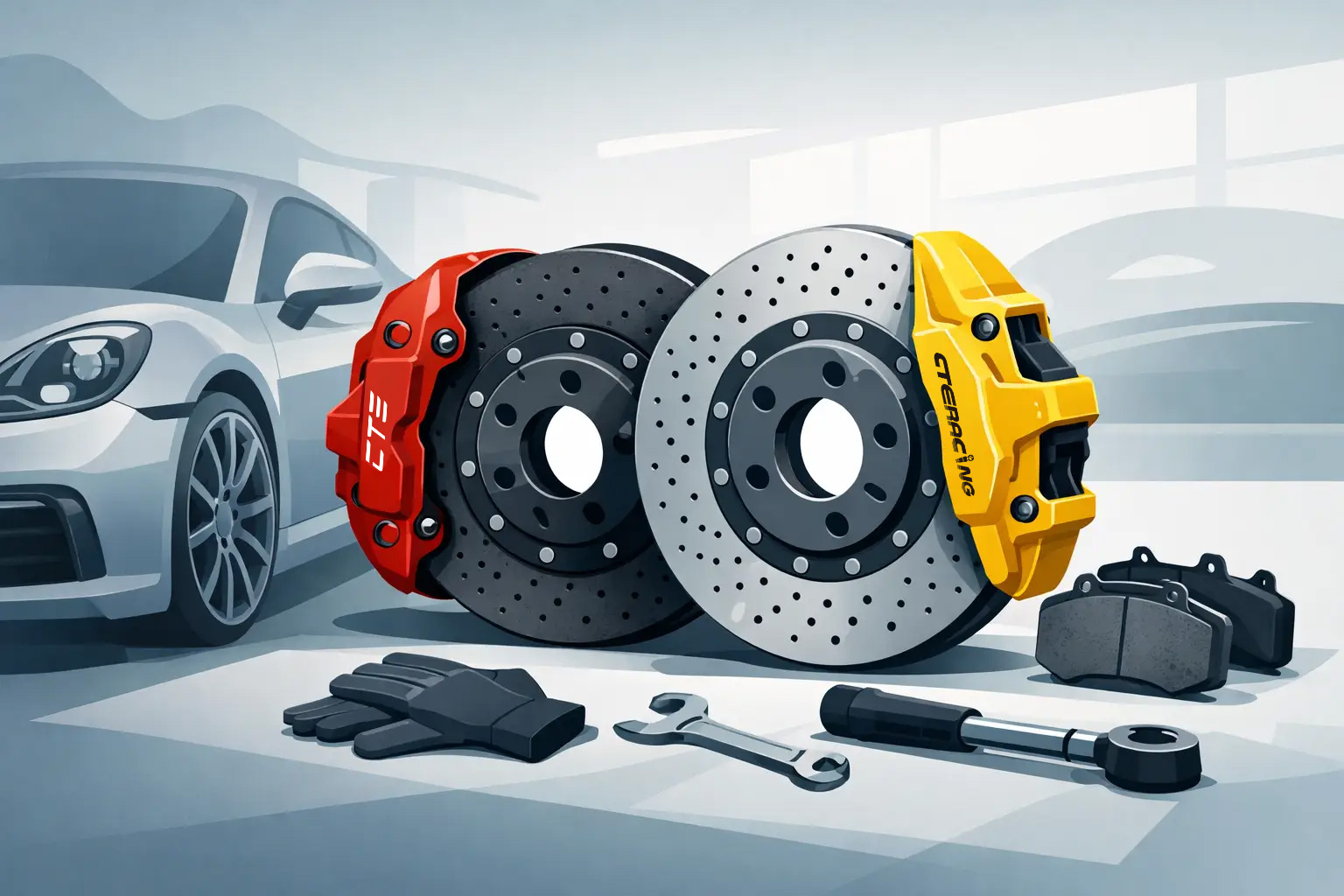
A Porsche that will accelerate hard but cannot repeatedly stop with the same authority is not ready for fast road or track use. Carbon ceramic brakes are built for extreme heat, low unsprung weight, and confident pedal response, but they demand accurate replacement decisions. This Porsche carbon ceramic replacement guide explains how to identify the correct components, avoid expensive compatibility mistakes, and return the system to the performance level the vehicle deserves.
Start With the Exact Porsche Brake Specification
Porsche carbon ceramic systems are not interchangeable simply because two vehicles share a badge, platform, or rotor diameter. PCCB-equipped models can differ by model year, axle, wheel size, center-lock or five-lug hub design, caliper generation, rotor offset, disc thickness, and electronic wear-sensor arrangement. A 911, Cayenne, Panamera, Taycan, Macan, and GT model may each require a different brake configuration.
Before ordering any part, verify the vehicle identification number, model year, trim, factory brake option, front and rear rotor dimensions, caliper part number, and wheel clearance. The original rotor and pad set should be inspected rather than assumed to be factory-correct, particularly on vehicles with a prior performance build or accident repair history.
Fitment is a safety requirement, not a catalog convenience. A rotor with an incorrect hat offset can move the friction ring out of the caliper centerline. A disc that is only a few millimeters different in overall diameter or thickness can compromise pad sweep, wheel clearance, and pedal feel. For professional workshops and distributors, confirming these details before shipment prevents installation delays and costly returns.
Decide Whether You Need a Direct Replacement or a Complete System
A direct carbon ceramic replacement is generally the right route when the existing Porsche calipers, master cylinder, brake booster calibration, and wheel package remain in service. In that situation, the new rotors, pads, mounting hardware, and sensors must match the original system's operating geometry.
A complete kit may make more sense when an iron-brake vehicle is being upgraded, the original PCCB hardware is unavailable, or the vehicle will see more frequent track use than the factory setup was intended to support. A correctly engineered kit addresses more than the disc itself. It should be designed around caliper piston area, rotor mass, friction surface, pad compound, mounting brackets, brake lines where applicable, wheel clearance, and axle balance.
Do not treat carbon ceramic as a cosmetic conversion. Changing only the front axle, using mismatched pad compounds, or combining unverified rotors with factory calipers can alter brake bias and thermal behavior. The most expensive answer is often a piecemeal answer that creates a second round of work.
OEM-style replacement versus aftermarket performance systems
An OEM-style replacement prioritizes original dimensions, factory-like driving behavior, and direct fitment. It is typically preferred for restoration, warranty-conscious owners, and street-driven Porsches that already have a well-matched PCCB system.
An aftermarket carbon ceramic system can be the stronger choice for performance workshops that need a specific wheel fitment, a different rotor configuration, or higher thermal capability for repeated braking. The key is engineering discipline. The manufacturer must provide vehicle-specific fitment and support, not a generic rotor that happens to share a diameter with the original part.
CCYS supports this approach through complete carbon ceramic brake solutions engineered with 90% in-house production control, IATF 16949 and ISO 9001 quality management, and manufacturer warranty coverage.
Inspect Carbon Ceramic Rotors Before Condemning Them
Carbon ceramic discs do not wear like iron rotors. Their long service life is a major advantage, but they still have a finite structural and friction-life limit. Visual appearance alone is not enough to determine whether a rotor is serviceable.
A qualified inspection should look for impact damage, cracks, chipping at drilled holes or edges, excessive heat distress, uneven surface condition, mounting-face damage, and abnormal wear patterns. Rotor mass is also a critical measurement on many carbon ceramic applications because material loss may not be obvious through thickness measurement alone. Follow the approved specification for that exact rotor rather than applying a generic minimum-weight figure.
Vibration under braking does not automatically mean the ceramic disc is warped. Pad deposits, hub runout, contaminated friction surfaces, loose hardware, worn suspension joints, or an incorrectly bedded pad can create a similar complaint. Diagnose the full system before replacing high-value rotors.
Used carbon ceramic rotors are a high-risk shortcut. Their internal condition, heat history, prior impact exposure, and remaining service life may be unknown. For a vehicle driven at speed, track use, or repeated mountain-road braking, traceable new components are the professional standard.
Replace Pads, Hardware, and Sensors as a Matched Job
New rotors should not be treated as stand-alone parts. The pads, anti-rattle hardware, retaining pins, springs, wear sensors, and rotor fasteners deserve the same level of attention. Old pads can carry uneven deposits or contamination that damage the bedding process on a fresh rotor surface.
Pad selection depends on how the Porsche is used. A street-focused compound may offer quiet operation and predictable cold response. A track-oriented compound can deliver more consistent friction at elevated temperatures but may increase noise, dust, and low-temperature harshness. Neither choice is universally better. The correct compound must suit the rotor material, caliper, tire grip, driver expectations, and thermal load.
Always inspect the caliper pistons and seals while the pads are out. Carbon ceramic braking systems often live on high-performance vehicles that see hard heat cycles. Torn dust boots, sticking pistons, corroded pad abutments, and damaged pad plates can prevent even pressure distribution across a very expensive disc.
Use new fasteners where the application specifies single-use hardware. Clean the hub mounting face thoroughly and measure runout after installation. Debris or corrosion trapped behind a rotor hat can create lateral runout, pedal pulsation, and uneven pad transfer. Correct torque sequence and torque value are essential, especially on floating-disc hardware and center-lock applications.
Installation Checks That Protect Brake Performance
Brake replacement should be performed by technicians familiar with Porsche service procedures and carbon ceramic handling requirements. Ceramic friction surfaces can be damaged by careless impact, incorrect clamping, or contamination. Do not strike the disc, allow it to hang from hardware, or use aggressive abrasives on the friction ring.
Before the vehicle leaves the workshop, confirm the following:
- The rotor part number, diameter, thickness, offset, and rotational direction match the vehicle and axle.
- The disc runs true on a clean hub face, and all mounting hardware is installed and torqued to the applicable specification.
- Pads move freely in the caliper, sensors are correctly routed, and caliper pistons retract and apply evenly.
- Brake fluid condition, hose condition, pedal travel, and electronic warning functions have been checked.
- The wheels clear the caliper and rotor assembly through full steering travel and suspension movement.
If a brake fluid flush is due, use the fluid grade specified for the Porsche and bleed the system in the approved sequence. On modern models, diagnostic procedures may also be required to clear brake warnings, service electronic parking brake functions, or validate vehicle systems after repair.
Bed the New Components Correctly
The first heat cycles establish the interface between pad and rotor. Skipping bedding, or using an overly aggressive procedure, can create uneven deposits and lead the owner to believe the new brakes are defective.
Use the pad and rotor manufacturer's specified bedding process. In general, it involves a controlled series of moderate-to-firm stops, enough cooling time to prevent heat soak, and a complete cooldown period before sustained heavy braking. Avoid holding the car stationary with hot brakes applied immediately after bedding, particularly after repeated high-energy stops. This can imprint pad material onto the rotor surface.
The driver should also understand that cold response, noise, and initial pedal character may differ from worn factory components. A short road test after bedding should verify straight-line stability, pedal consistency, warning-light status, and the absence of abnormal noise.
Know When Carbon Ceramic Is the Right Investment
Carbon ceramic replacement makes the strongest case for Porsche owners who value reduced rotating mass, resistance to fade under repeated braking, corrosion resistance, and long-term durability. It is especially compelling for GT cars, turbocharged models, heavy luxury SUVs, and vehicles used for demanding road or track driving.
It is not automatically the lowest-cost choice for every daily-driven Porsche. Iron systems can be more economical to service and may be easier to support in certain motorsports classes. But when the vehicle already relies on a carbon ceramic system, replacing it with correctly engineered, vehicle-specific components protects the braking balance and performance character built into the car.
Treat the replacement as a system decision. Confirm fitment, inspect every supporting component, use matched friction materials, and insist on documented manufacturing quality. When the road closes up, the confidence to brake late and stop straight is earned long before the pedal is pressed.