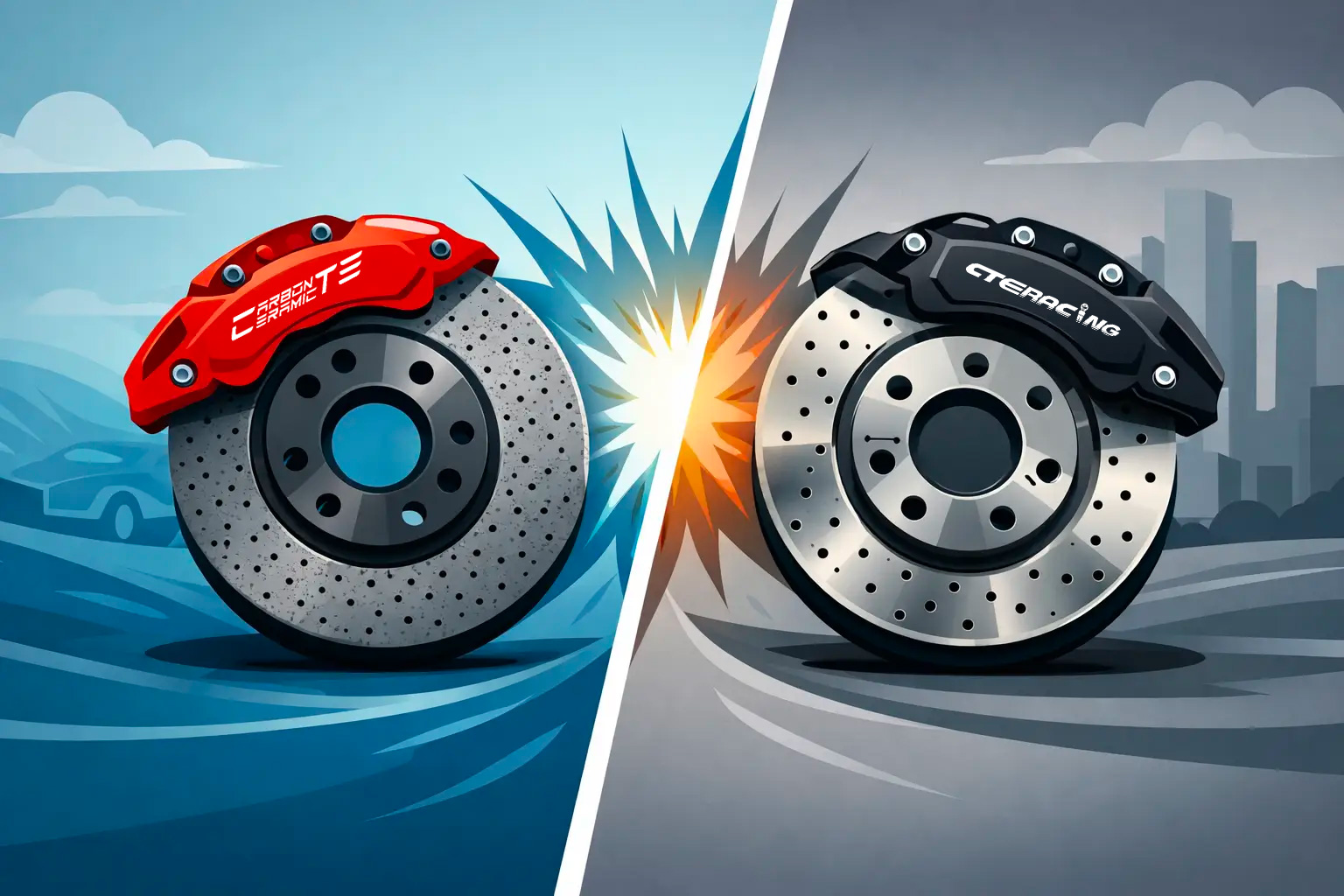
A long downhill, a late braking zone, or one more hard stop after a fast highway pull can expose the weakness in an otherwise powerful vehicle. When pedal feel lengthens and braking confidence disappears, horsepower no longer matters. The question of ceramic brakes versus steel brakes is not about buying the most expensive hardware. It is about matching the brake system to vehicle weight, speed, heat load, wheel fitment, and the way the vehicle is actually driven.
For performance workshops, distributors, and drivers building premium street or track-capable vehicles, both materials have a place. Steel remains practical and capable for many applications. Carbon ceramic delivers major advantages where repeated thermal load, lower unsprung mass, corrosion resistance, and long-term performance justify the investment.
Ceramic Brakes Versus Steel Brakes Under Heat
The biggest difference is how each rotor manages heat. A conventional steel brake rotor absorbs substantial energy during braking, then releases that heat through its mass, ventilation design, and surface area. Quality two-piece steel rotors can perform extremely well, especially with correct pads, caliper sizing, brake fluid, cooling, and vehicle-specific engineering.
But steel has a limit. Under repeated high-energy stops, rotor temperatures rise quickly. The result can be pad fade, fluid boil, uneven deposits, cracking, distortion, or a soft and inconsistent pedal. The brake system may still function, but confidence and repeatability decline precisely when the driver needs them most.
Carbon ceramic brake discs are designed for a different thermal environment. Their carbon-fiber-reinforced ceramic structure tolerates far higher operating temperatures than steel while transferring less heat into surrounding components. This helps protect brake fluid, caliper seals, wheel bearings, and other hardware exposed to the heat generated during aggressive braking.
That does not mean a carbon ceramic system is immune to poor setup. Pad compound, rotor dimensions, cooling airflow, tire grip, vehicle mass, and driver behavior still determine braking results. A poorly matched carbon ceramic kit is not a substitute for engineering. A correctly specified system, however, can maintain more stable performance during track sessions, mountain driving, high-speed use, and heavily loaded premium vehicle applications.
Weight Changes More Than Acceleration
A carbon ceramic rotor can weigh significantly less than a comparable steel rotor. That reduction occurs at the wheel, where it matters more than a similar weight reduction inside the cabin. Lower unsprung and rotating mass helps the suspension respond more effectively to road surfaces, can improve steering precision, and reduces the energy required to accelerate and decelerate the rotating assembly.
On vehicles such as Porsche, BMW M models, Tesla performance platforms, Nissan GT-Rs, and supercars, this effect is noticeable when the rest of the chassis is capable enough to reveal it. The vehicle can feel more responsive during turn-in and more composed over uneven pavement. For a workshop preparing a car for fast road use or track work, braking and chassis decisions should be considered together.
Steel is heavier, but its mass can also be useful in ordinary driving. It is forgiving, widely available, and easy to service. On a daily-driven vehicle that sees occasional spirited use rather than sustained high-temperature braking, the weight advantage of carbon ceramic may not deliver enough practical value to offset its higher purchase price.
Stopping Distance Is Not a Material-Only Decision
Many buyers expect ceramic discs to automatically create dramatically shorter stopping distances. In reality, maximum stopping distance is often determined by tire grip, road surface, ABS calibration, suspension geometry, and weight transfer. If the tires cannot transmit additional braking force to the pavement, a larger or more exotic rotor will not overcome that limit.
The real performance advantage of a properly engineered carbon ceramic system is repeatability. It can deliver strong, predictable braking after repeated heavy stops when a standard system may begin losing consistency. That difference matters to drivers who brake hard at high speed, run consecutive track laps, tow with a heavy performance SUV, or operate vehicles with substantial curb weight and power.
Caliper design also matters. Monobloc calipers provide high rigidity, helping convert hydraulic pressure into controlled clamp force with less caliper flex. Rotor size, piston area, pad shape, brake bias, and master-cylinder compatibility must work as a system. Installing oversized components without considering hydraulic balance can create poor pedal behavior or destabilize the vehicle under braking.
Wear, Corrosion, and Daily Ownership
Steel rotors wear through normal friction and can corrode when exposed to moisture, road salt, and long periods of storage. Surface rust after rain is common and usually clears after a few brake applications, but severe corrosion can shorten rotor life and affect appearance. Pads also generate visible dust, particularly high-friction performance compounds.
Carbon ceramic discs resist corrosion and often produce less visible brake dust. Their service life can be substantially longer than steel in the right application because the disc material wears more slowly under normal use. That is attractive to owners of high-value vehicles, where wheel appearance, long-term service intervals, and preservation of premium components matter.
There is an important trade-off: carbon ceramic rotors must be handled correctly. Damage from improper installation, impact, incompatible pads, or careless wheel service can be expensive. They should be inspected using the manufacturer’s procedures rather than judged by steel-rotor habits. A qualified installer should verify disc condition, minimum thickness requirements, hardware torque, pad compatibility, and bedding procedures.
For steel systems, replacement parts are generally less costly and easier to source. That can make steel the smarter operational choice for fleet-like use, budget-focused track builds, or vehicles that consume rotors and pads regularly. A track car on steel brakes with excellent cooling, premium fluid, and disciplined maintenance can be faster and safer than a car with carbon ceramic hardware installed without proper support.
Cost Should Be Measured Across the Build
Upfront cost is the most obvious difference. Carbon ceramic brake systems cost more because the materials, manufacturing processes, and engineering requirements are more specialized. A complete upgrade may include discs, calipers, brackets, pads, brake lines, hardware, and application-specific fitment development.
That price should be evaluated against the purpose of the vehicle. For a high-performance street car, a premium SUV used in demanding terrain, or a track-oriented build where fade resistance and weight reduction are priorities, the value can extend beyond initial purchase. Longer rotor life, lower corrosion exposure, improved heat control, and stronger resale appeal may matter to the owner or customer.
For an entry-level performance build, the budget may produce better results elsewhere first. High-quality tires, brake fluid, pads, cooling, suspension maintenance, and a well-engineered steel brake package can transform a vehicle without the cost of carbon ceramic discs. The right answer is based on the limiting factor, not on the material with the highest status.
Fitment Is a Safety Requirement, Not a Detail
Brake upgrades must clear the wheel barrel and spokes, match the hub and mounting geometry, maintain appropriate brake balance, and work with the vehicle’s electronic systems. This is especially critical for modern performance cars with tightly packaged wheels, advanced ABS, regenerative braking, and electronic stability control.
A complete kit engineered for a specific application removes much of this uncertainty. The rotor offset, disc diameter, caliper position, bracket strength, and pad sweep should be validated as a package. Piecemeal combinations can create clearance problems, uneven pad contact, incorrect rotor centering, or unnecessary stress on mounting hardware.
Manufacturing consistency matters here. CCYS controls approximately 90% of its production in-house, from development and precision machining through quality management, supporting application-specific carbon ceramic brake solutions built around repeatable fitment and performance standards. For distributors and workshops, that level of control is more useful than an attractive specification sheet without documented execution.
Choosing the Right Brake System
Choose a high-quality steel system when the vehicle is primarily street-driven, service cost is a major priority, replacement parts must be readily available, or the vehicle sees limited repeated high-temperature braking. Steel remains the dependable workhorse for a broad range of performance applications.
Choose carbon ceramic when the vehicle regularly faces high brake temperatures, weight reduction is meaningful, corrosion resistance and long service life are valued, or the customer expects premium braking hardware that supports aggressive driving without rapid performance loss. This is particularly relevant for high-powered luxury vehicles, EVs with substantial curb weight, track-focused builds, and supercar platforms.
The most effective upgrade begins with an honest load calculation: vehicle weight, tire capability, wheel size, driving environment, and the frequency of hard stops. Specify the brake system for the heat the vehicle will generate, not just the appearance it needs to project. When every component is matched correctly, the driver gets what matters most at speed: a firm pedal, predictable response, and the confidence to brake hard again.