

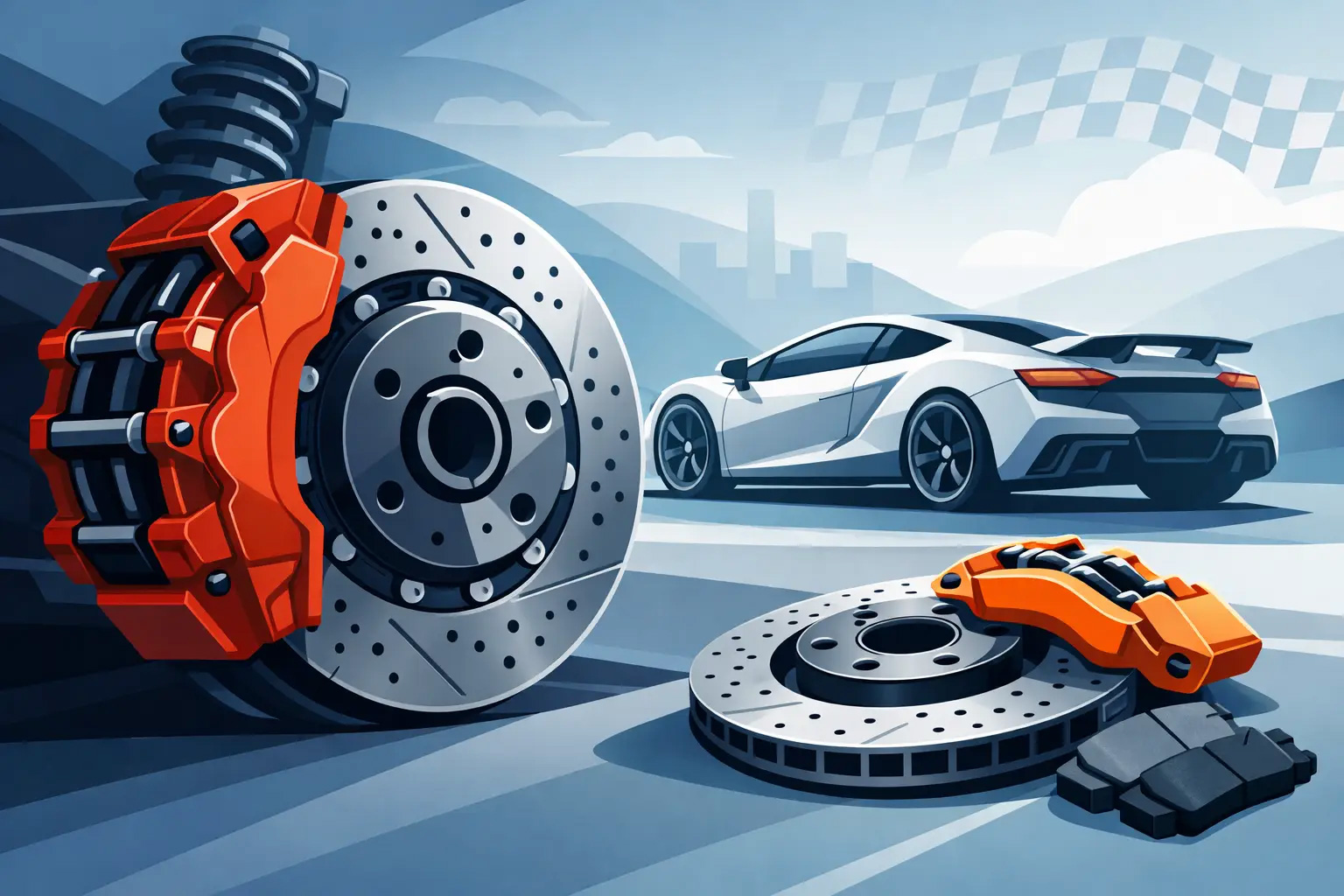
A brake pedal that goes longer after a few hard corners changes the entire character of a supercar. The engine may still deliver the acceleration buyers expect, but confidence disappears when the braking system cannot repeat its first stop. A properly engineered supercar brake upgrade addresses that problem through thermal capacity, clamping control, reduced unsprung mass, and vehicle-specific fitment. It is not simply a visual modification behind an expensive wheel.
For performance workshops, distributors, and owners, the question is not whether larger brakes look appropriate. The real question is whether the system can manage the energy generated by a heavy, high-powered vehicle at speed, lap after lap, without creating noise, imbalance, clearance issues, or an unpredictable pedal.
Why Factory Brakes Reach Their Limit
Original equipment brake systems are designed around a broad operating brief. They must work quietly in traffic, remain cost-effective at production scale, perform in cold and wet conditions, and satisfy the expected use case for the majority of owners. On many premium vehicles, that is a capable starting point. It may not be enough for repeated high-speed deceleration, mountain driving, performance road use, or track sessions.
Every hard stop turns kinetic energy into heat. As vehicle speed and mass increase, the heat load rises quickly. When rotors, pads, fluid, and calipers cannot control that heat, the driver may experience fade, a softer pedal, longer braking distances, vibration, glazing, cracking, or inconsistent response from one braking zone to the next.
A supercar can expose these weaknesses rapidly. High horsepower builds speed aggressively, aerodynamic downforce can increase corner-entry grip, and wider tires create the traction needed to demand more from the brake system. The vehicle may be able to arrive at a braking zone much faster than its original brake package can repeatedly support.
A Supercar Brake Upgrade Must Work as a System
The strongest brake conversion is a matched system, not a collection of oversized components. Rotor dimensions, disc material, caliper stiffness, piston sizing, pad compound, brake line condition, wheel clearance, and master-cylinder compatibility all affect the result.
A larger rotor increases leverage at the wheel and can provide more thermal mass. That does not automatically make it the right answer. Excessive rotor size can add weight, interfere with wheel fitment, or alter front-to-rear brake balance if the full system has not been engineered around the vehicle. The objective is controlled, repeatable braking, not maximum hardware size.
Caliper design matters just as much. A rigid monobloc caliper is built to reduce flex under pressure, helping maintain a firmer and more consistent pedal feel. Proper piston arrangement supports even pad loading across the rotor face. Poorly matched piston areas, however, can change hydraulic balance and create an unstable or unnatural brake response.
Pads are another critical decision. A high-friction race-oriented compound may deliver powerful bite at operating temperature, but it can also increase dust, noise, rotor wear, and cold-performance compromises. A customer who drives a supercar mainly on public roads needs a different friction profile from a driver who runs long track sessions. A qualified workshop should define the vehicle's actual duty cycle before specifying components.
Carbon Ceramic Brakes and Thermal Control
Carbon ceramic brake systems are selected for their ability to manage demanding heat conditions while reducing weight compared with conventional iron systems. Lower unsprung weight can benefit steering response, suspension control, and ride behavior because the wheel assembly has less mass to manage over changing road surfaces.
For high-performance use, thermal stability is the central advantage. Carbon ceramic rotors are engineered to resist the extreme heat cycles that can challenge conventional discs during repeated deceleration. This supports a more consistent braking feel when the vehicle is driven hard, particularly where long braking zones and high entry speeds are involved.
There are trade-offs. Carbon ceramic components require the correct pads, installation procedures, bedding process, and service practices. They are not a universal answer for every vehicle or every budget. A conversion should also account for the intended environment. Street-driven cars need cold response, low noise, and daily usability. Track-focused cars prioritize fade resistance, pedal consistency, and durability under sustained heat.
The right carbon ceramic kit is engineered around these requirements rather than marketed as a generic premium option. Vehicle-specific rotor hats, brackets, caliper positioning, hardware, and wheel-clearance data are essential. A brake system is a safety component, so approximate fitment is not acceptable.
Fitment Is More Than Bolt Pattern and Rotor Diameter
A complete brake package must clear the wheel barrel and spokes, align precisely with the hub, and maintain correct caliper-to-rotor geometry. It must also be compatible with the vehicle's ABS, electronic stability systems, suspension travel, and intended wheel setup. These details determine whether an upgrade performs correctly after installation.
Wheel clearance is one of the most common overlooked issues. A caliper can clear a wheel's diameter but contact its spoke profile. For this reason, workshops should verify fitment using the wheel template or technical drawing for the exact wheel model, offset, and diameter. Assumptions based on a similar-looking wheel can lead to costly delays.
Hub condition also deserves attention. A new high-performance rotor mounted on a corroded, damaged, or improperly run-out hub will not perform as intended. Excessive runout can contribute to disc-thickness variation, pedal pulsation, and uneven pad transfer. Supporting components such as wheel hubs, brake lines, and properly rated hardware should be inspected as part of the upgrade process.
What Professional Buyers Should Ask a Brake Supplier
For distributors and performance workshops, brake performance begins before the kit reaches the vehicle. The supplier must be able to provide accurate application data, component specifications, installation guidance, and support when unusual wheel, suspension, or use-case conditions arise.
Ask where the major components are designed and manufactured. Vertical production control matters because it gives the manufacturer direct oversight of machining, material selection, assembly standards, and quality consistency. It also makes technical revisions and application development more controlled than sourcing a collection of unrelated parts.
Certification is another practical indicator. IATF 16949 and ISO 9001 quality systems show that a manufacturer operates with documented processes rather than relying on appearance-based claims. For a braking product, that discipline supports repeatability across production batches and gives channel partners greater confidence in the parts they represent.
A serious supplier should also stand behind its system with a manufacturer warranty and technical support. Installation questions, pad selection, replacement rotor specifications, and bedding requirements should have clear answers. CCYS supports this approach through in-house control of approximately 90% of production, combining carbon ceramic brake systems, monobloc calipers, rotors, pads, hubs, and supporting chassis components for demanding vehicle applications.
Installation and Bedding Determine the Result
Even an engineering-grade brake kit can underperform if installed without correct preparation. The hub surface must be clean and measured, fasteners must be tightened to specified torque, brake fluid must be suitable for the heat level expected, and all hydraulic work must be completed carefully. Caliper mounting alignment and brake-line routing should be checked through the full range of steering and suspension movement.
Bedding is not an optional final step. It establishes the transfer layer between pad and rotor that allows the system to generate stable friction. The exact procedure varies by pad and disc specification, but the goal remains the same: build temperature progressively, avoid holding the pedal hard while stationary with hot brakes, and allow controlled cooling before the first demanding session.
After installation, drivers should assess pedal feel, initial bite, noise, and vehicle stability in a controlled setting. Any pulling, vibration, fluid loss, unusual contact, or warning light requires immediate inspection. Braking performance should never be judged by a single hard stop on an uncontrolled public road.
Choose Braking Capacity for the Way the Car Is Driven
The best supercar brake upgrade is the one that remains composed when the driver needs it most. For a road-focused vehicle, that may mean lower weight, strong cold response, clean fitment, and dependable stopping power during occasional spirited use. For a track-oriented build, it may mean greater thermal reserve, caliper rigidity, and pad durability under repeated high-energy braking.
Specify the complete system around the vehicle, the wheel package, and the real operating conditions. When braking hardware is engineered as a matched solution rather than selected for appearance alone, every approach to the next corner can feel controlled, precise, and earned.