

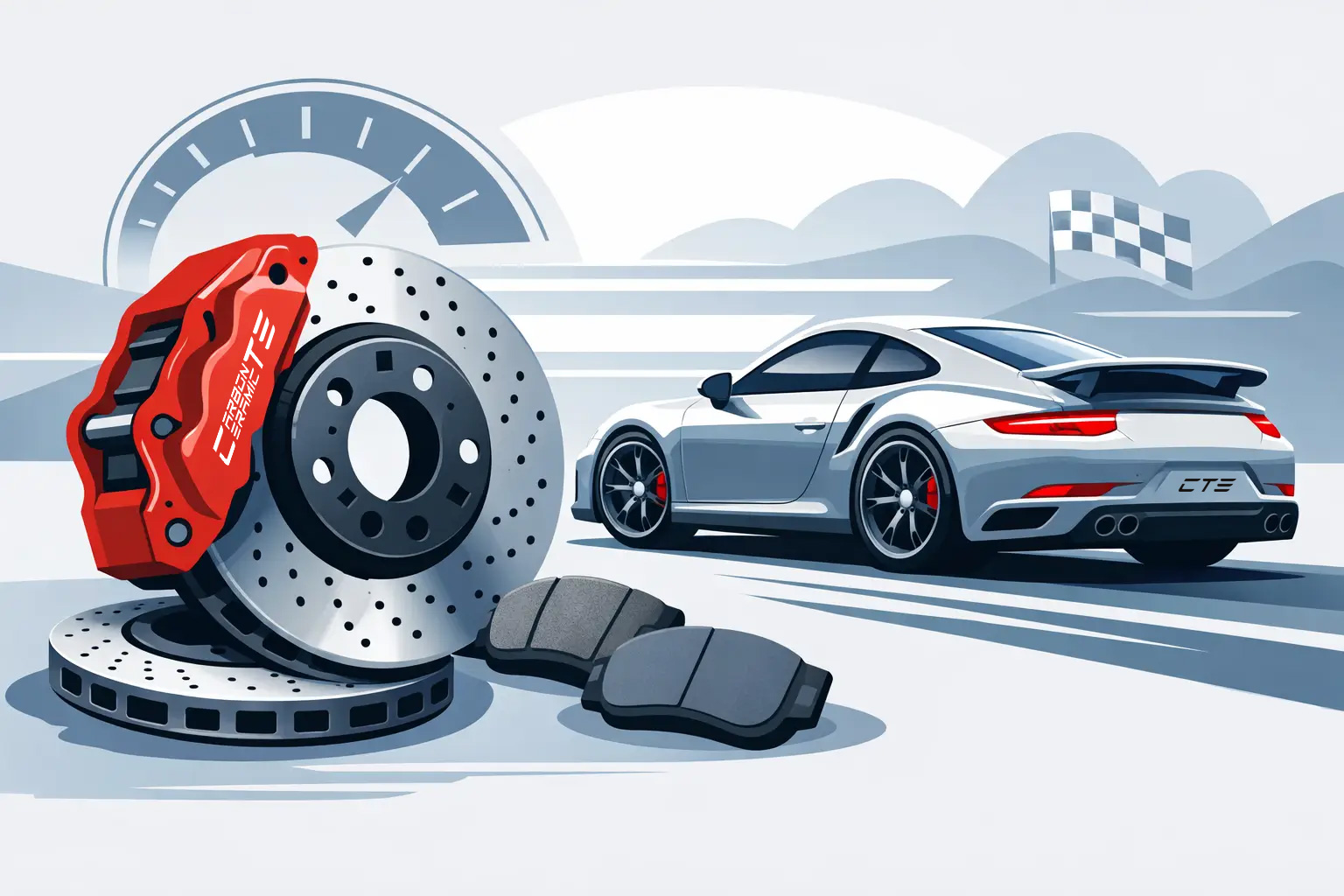
A Porsche that pulls hard but loses pedal confidence after three demanding corners has a braking problem, not a minor inconvenience. Fade, a long pedal, vibration, and inconsistent bite turn speed into risk. The best Porsche brake upgrades are not defined by the biggest caliper or the most aggressive pad compound. They are the parts that match the car’s weight, power, tire grip, wheel clearance, and real operating temperature.
For a spirited 911, a track-focused Cayman GT4, or a heavy and powerful Cayenne, brake selection must begin with the duty cycle. A daily-driven Porsche needs quiet, predictable cold performance. A canyon car needs stronger initial response and repeatable stopping force. A track car needs thermal capacity that remains stable after repeated high-speed braking. Treat every use case the same, and the result is often excess noise, premature wear, or a system that still overheats when it matters.
Best Porsche Brake Upgrades Start With the Weak Point
The correct upgrade path depends on what is actually limiting performance. Drivers often blame the caliper when the real issue is overheated fluid, glazed pads, old rubber lines, or undersized rotors for the vehicle’s current power level and weight.
Before selecting hardware, inspect pad thickness and wear pattern, rotor condition, fluid age, caliper seals, flexible lines, wheel bearing play, and tire condition. A brake system is only as capable as its least controlled component. Uneven pad deposits or steering-wheel shake under braking, for example, may point to rotor surface condition, hub runout, or installation accuracy rather than a lack of clamping force.
Porsche platforms also vary significantly. A 718 Cayman or Boxster benefits from maintaining sharp response without adding unnecessary unsprung mass. A turbocharged 911 or modified 997, 991, or 992 may need far greater heat rejection. A Macan, Cayenne, or Panamera demands braking hardware designed for SUV mass, high center-of-gravity weight transfer, and repeated heavy-road use.
Performance Pads Are Often the First Meaningful Step
A pad compound changes the character of a Porsche brake system more quickly than almost any other component. The right compound can increase friction stability at elevated temperatures, improve pedal consistency, and resist fade during repeated hard stops.
For road-driven cars, choose a performance street pad with predictable cold bite, low noise potential, and manageable dust. A full race compound may deliver impressive high-temperature friction but can squeal, dust heavily, wear rotors faster, and feel weak before it reaches operating temperature. That is a poor trade for a car that spends most of its time in traffic.
For regular track use, a higher-temperature pad is appropriate, but it should be selected alongside suitable rotors and fluid. Aggressive pads generate more heat at the disc surface. Without enough thermal capacity, the upgrade simply moves the failure point from the pad to the rotor, fluid, or seals.
High-Temperature Brake Fluid Protects Pedal Feel
Brake fluid is not a cosmetic maintenance item. Under hard braking, heat transfers from the rotor and pad through the caliper and into the fluid. Once fluid approaches its boiling point, vapor can form, producing a soft or sinking pedal. At that point, a large brake kit alone will not restore confidence.
Fresh, high-temperature fluid is one of the most cost-effective upgrades for a Porsche used in canyon driving, autocross, or track sessions. It should be changed on a schedule that reflects the vehicle’s use, not only mileage. Track-driven vehicles may require fluid service before major events and again after sustained high-temperature use.
Stainless braided brake lines can also improve pedal consistency by reducing the expansion associated with aging rubber hoses. They are most effective when installed correctly, routed to prevent abrasion, and combined with properly bled fluid. They do not create more thermal capacity, but they can make the driver’s input more direct and repeatable.
When a Complete Porsche Brake Kit Is the Right Upgrade
A complete brake kit becomes necessary when the original system cannot manage the heat load, rotor mass, or clamping requirements of the vehicle. This is common on heavily modified turbo cars, repeated track-use vehicles, and high-performance SUVs that carry substantial weight into every braking zone.
A properly engineered kit should be treated as a system. It includes vehicle-specific calipers, rotors, brackets, pads, mounting hardware, and clear fitment requirements. Mixing unrelated components may appear less expensive, but it can create incorrect brake bias, inadequate clearance, poor pad sweep, and unreliable pedal behavior.
Carbon Ceramic Systems Reduce Mass and Resist Heat
Carbon ceramic brake systems are among the most capable Porsche brake upgrades when the goal is major thermal resistance and lower unsprung weight. Compared with conventional iron rotors, a carbon ceramic setup can significantly reduce rotating mass at each corner. The practical effect is not only reduced weight on a specification sheet. Suspension response, steering precision, and wheel control can benefit because the damper has less mass to manage.
The key advantage is thermal stability. Carbon ceramic rotors are designed to tolerate extreme temperatures with exceptional resistance to fade under repeated heavy braking. For high-speed road driving, track-focused Porsche builds, and premium performance applications, that capacity supports more consistent braking behavior over long sessions.
There are trade-offs. Carbon ceramic systems require the correct pads, careful installation, and realistic expectations about cost. They are not automatically the best choice for every stock daily driver. Replacement economics, wheel fitment, and the driver’s actual temperature range must be considered. A quality iron rotor system with the right pad and fluid can be the more sensible package for an occasional spirited street car.
For buyers who need carbon ceramic performance, manufacturing quality matters as much as material selection. CCYS produces racing-grade carbon ceramic brake systems with 90% of manufacturing controlled in-house, supporting consistency across R&D, precision machining, and quality management. IATF 16949 and ISO 9001-certified processes, vehicle-specific applications, and complete kit support are meaningful safeguards when braking hardware will be exposed to repeated high loads.
Caliper Design and Rotor Size Must Work Together
More pistons do not automatically mean better braking. A monobloc caliper should provide rigid construction, controlled piston movement, even pad loading, and a design matched to the hydraulic requirements of the Porsche platform. Caliper stiffness helps preserve pedal feel, while proper piston sizing helps maintain intended front-to-rear brake balance.
Rotor diameter and thickness determine much of the system’s thermal capacity. Larger rotors provide greater leverage and more surface area for heat management, but the kit must fit behind the chosen wheels and maintain correct offset. A rotor that barely clears the barrel may complicate service and leave no room for wheel flex or manufacturing variation.
Ask for documented wheel-clearance templates before ordering. Porsche wheel designs vary widely, even within the same generation, and spoke shape can matter as much as nominal wheel diameter. A 20-inch wheel does not guarantee clearance for a large caliper.
Fitment and Installation Decide Whether the Upgrade Performs
A brake upgrade should be specified by exact model, model year, drivetrain, current wheel size, and intended use. Include any power additions, tire changes, suspension modifications, and planned track activity. These details affect heat load and fitment decisions.
Installation quality is equally critical. Mounting faces must be clean and flat. Hardware must be torqued to specification. Rotors must be checked for runout, brake lines must be secured away from heat and moving suspension parts, and the system must be thoroughly bled. New pads and rotors also require a controlled bedding procedure to establish a stable transfer layer and prevent uneven deposits.
Do not overlook chassis condition. Worn control-arm bushings, ball joints, tie-rod ends, or wheel hubs can make a braking issue feel worse by allowing movement under load. Strong brakes expose weaknesses elsewhere because they place greater forces through the suspension and steering system.
Choose Braking Capacity, Not Just Brake Size
The best upgrade is the one that stays controlled when the road gets fast, the vehicle gets heavy, and the braking zone arrives sooner than expected. Start with the actual weakness, choose a complete and vehicle-specific solution when thermal capacity demands it, and insist on proven materials, manufacturing control, and professional installation. Your Porsche should feel most composed at the exact moment you ask it to stop.