

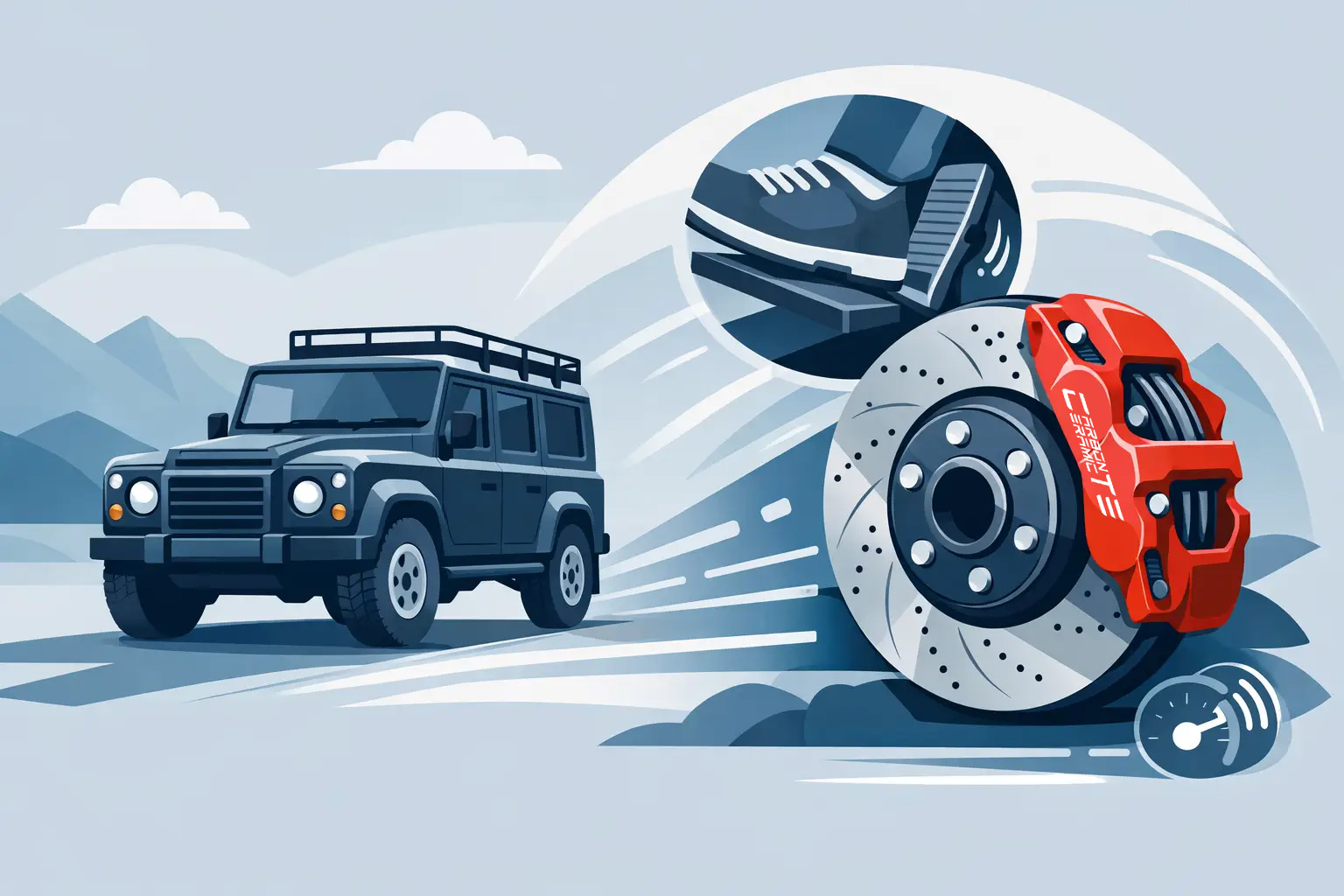
A loaded Defender gathering speed downhill, a heavy trailer pushing from behind, or repeated hard stops on a fast road all expose the same weak point: braking reserve. A properly engineered Defender brake upgrade is not about fitting the largest possible caliper. It is about building dependable, repeatable stopping performance that matches the vehicle’s weight, tire package, power output, and intended use.
For performance workshops and Defender owners, the right system delivers a firmer pedal, greater thermal capacity, controlled rotor temperatures, and confidence when the vehicle is asked to stop hard more than once. The wrong combination can introduce poor pedal feel, clearance issues, uneven pad wear, warning lights, or a braking balance that does not suit the platform.
When a Defender Brake Upgrade Is Necessary
Factory Defender brakes are designed around a broad range of driving conditions, expected vehicle loads, and cost targets. They can be entirely adequate for normal commuting. The margin becomes narrower when a Defender is modified, driven aggressively, used for towing, or fitted with larger and heavier wheels and tires.
A brake upgrade should be considered when drivers report pedal fade after repeated stops, longer stopping distances when loaded, vibration caused by overheated discs, or inconsistent response during mountain driving. These symptoms should not be ignored or covered up with a more aggressive pad compound alone. Pads influence friction, but they cannot create the thermal mass, clamping force, cooling path, or structural stability that a complete brake system may require.
Vehicle weight is especially important on the Defender platform. Added armor, roof equipment, recovery hardware, passengers, cargo, and towing loads all increase the energy that the brake system must convert into heat. Larger wheels may also add rotating and unsprung mass. More power increases the speed reached before the next braking event. Each change makes a case for reviewing the complete system rather than treating brakes as an afterthought.
What a Complete Defender Brake Upgrade Should Deliver
A performance brake package must work as a system. Rotor diameter and thickness, caliper piston area, pad shape, brake line routing, mounting brackets, wheel clearance, and hydraulic compatibility are connected. Changing one component without understanding the others can create an expensive compromise.
A vehicle-specific Defender brake upgrade typically centers on larger, thermal-resistant rotors, rigid multi-piston or monobloc calipers, matched high-performance pads, application-specific brackets, and the required mounting hardware. This approach increases usable braking capacity while preserving the fitment discipline required for a premium vehicle.
The objective is not simply maximum initial bite. Excessive bite can make low-speed driving abrupt and can overwhelm tire grip on low-traction surfaces. The stronger target is predictable friction through a wide temperature range, stable pedal response, and braking force that remains available after repeated high-energy stops.
Rotor Design and Thermal Capacity
The rotor is the brake system’s primary heat sink. Under heavy use, an undersized or overheated rotor can suffer fade, cracking, distortion, or uneven friction transfer. Greater rotor diameter provides more leverage at the wheel, while appropriate thickness and internal ventilation increase the capacity to absorb and release heat.
Carbon ceramic brake systems offer a different route to performance. Their major advantages can include substantial weight reduction, exceptional heat resistance, corrosion resistance, and long service life when the system is correctly specified. Reducing rotating and unsprung weight can also support steering response, suspension control, and ride quality over uneven surfaces.
However, carbon ceramic is not an automatic answer for every Defender. System cost is higher, pad selection matters, and the kit must be engineered around the exact application. The vehicle’s wheel design, real operating temperatures, terrain, and owner expectations should guide the recommendation. A well-developed iron-based performance system may be the correct choice for some towing or off-road builds, while a carbon ceramic setup can be compelling for high-performance road-focused Defenders seeking lower weight and sustained thermal control.
Calipers, Pads, and Pedal Confidence
A rigid monobloc caliper helps maintain consistent clamping force under high temperature and pressure. Compared with a less rigid caliper design, it can reduce flex and support a more precise pedal response. Piston sizing must be calculated carefully, because changing caliper area affects hydraulic balance and pedal travel.
Pad material completes the system. A track-focused compound may tolerate extreme temperatures, but it can create more noise, dust, or reduced cold response than a street-oriented option. A Defender used for daily driving and towing needs a different friction profile from one built for high-speed road use. Workshops should specify pad compounds based on actual duty cycles, not marketing labels.
Fitment Is an Engineering Requirement
The Defender name covers different generations, brake architectures, wheel sizes, and electronic systems. A kit that fits one vehicle configuration should never be assumed to fit another. Exact model year, wheel diameter, wheel spoke profile, offset, hub dimensions, and axle application all need verification before installation.
Wheel clearance deserves particular attention. Large calipers may clear the barrel of a wheel but contact the inner spoke face. This is why a brake kit should be validated with technical drawings, clearance templates where available, and vehicle-specific fitment data. Spacer use should not be a casual solution, as it can alter wheel bearing load, track width, and suspension geometry.
Brake upgrades must also retain proper operation with ABS, stability control, electronic brake-force distribution, and parking-brake systems where applicable. The safest upgrade is one developed to integrate with the vehicle, not one that forces the vehicle to work around mismatched parts.
Avoid Piecemeal Brake Modifications
Replacing only the front calipers or installing an aggressive pad without addressing rotor capacity can produce an unbalanced result. Front brakes carry a significant portion of braking load, but the rear axle still contributes to vehicle stability and stopping performance. A poorly matched front-to-rear setup can change brake bias and reduce confidence during high-speed deceleration or low-grip braking.
The same principle applies to hoses, fluid, wheel hubs, and supporting chassis components. High-temperature brake fluid can help resist a soft pedal caused by fluid boiling, but it cannot cure overheated rotors. Worn control arms, ball joints, tie-rod ends, bushings, or wheel hubs can create steering instability that is easily mistaken for a brake problem. A proper inspection should establish the condition of these components before a high-performance system is installed.
For distributors and workshops, complete kits also reduce installation uncertainty. Matched components, defined hardware, documented fitment, and technical support provide a better foundation than collecting parts from multiple sources and hoping the finished system behaves as intended.
Installation and Bedding Are Part of Performance
A premium brake kit can only perform to its design potential when installation is correct. Mating surfaces must be clean, mounting hardware torqued to specification, brake lines routed without tension or interference, and fluid properly bled. Rotor runout should be checked rather than assumed, particularly on vehicles that have seen off-road use, hub corrosion, or prior brake service.
Pad bedding is equally important. Controlled heat cycles transfer an even friction layer to the rotor surface and stabilize the pad compound. Skipping this process can lead to vibration, uneven deposits, inconsistent bite, and customer complaints that appear to be hardware failures. Workshops should give drivers clear bedding instructions suited to the selected rotor and pad materials.
Ongoing inspection remains necessary. Check pad thickness, rotor condition, fastener torque where specified, brake fluid condition, and any signs of stone damage after severe off-road operation. Performance braking is durable engineering, not maintenance-free engineering.
Specify the System Around the Defender’s Real Job
A Defender built for family travel, expedition use, towing, fast road driving, or performance restoration does not need the same brake specification. Start with vehicle weight, wheel package, power level, typical load, and the conditions that create the hardest repeated stops. Then select a complete, vehicle-specific system with verified clearance and components designed to work together.
CCYS develops racing-grade carbon ceramic brake systems with 90% of production controlled in-house, supported by IATF 16949 and ISO 9001 quality standards, manufacturer warranty coverage, and technical fitment support. For workshops, resellers, and owners who will not accept uncertain braking performance, the next practical step is to confirm the exact Defender configuration and specify the system before the first component is ordered.