

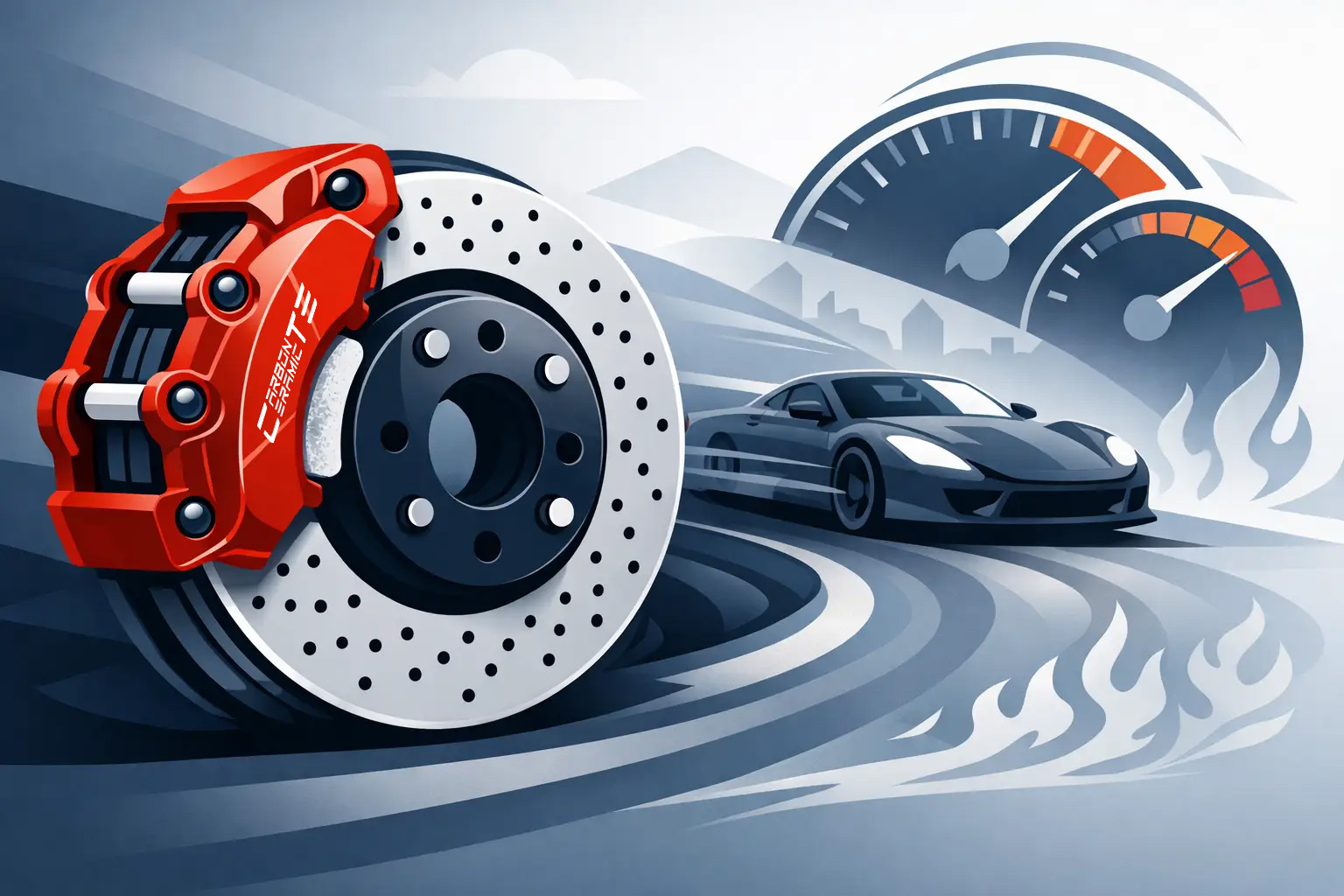
The moment a brake pedal goes long after repeated hard stops, power figures stop mattering. A fast vehicle that cannot shed speed with confidence is not performance-ready. The most meaningful ceramic brake benefits come from their ability to maintain consistent braking force under heat, reduce rotating mass, and give demanding drivers a wider performance margin when the road, track, or load puts the system under pressure.
For premium vehicles, modified street cars, and track-focused builds, carbon ceramic brakes are not simply a visual upgrade behind an open-spoke wheel. They are an engineered system. Rotor material, caliper rigidity, pad compound, mounting hardware, cooling airflow, and vehicle-specific fitment must work together. When they do, the result is sharper response and stronger confidence during repeated heavy braking.
Ceramic Brake Benefits That Matter Under Pressure
The phrase "ceramic brakes" is often used broadly, but performance applications usually refer to carbon ceramic brake systems. These rotors combine carbon fiber reinforcement with a ceramic matrix to create a disc that is significantly different from conventional cast iron. The advantage is not one dramatic claim. It is a combination of thermal stability, lower weight, corrosion resistance, and durability in the right operating environment.
Stronger resistance to brake fade
Brake fade is a heat-management problem. Under repeated braking, a conventional system can transfer enough heat into the rotor, pad, fluid, and caliper that pedal feel changes and friction performance declines. This is especially relevant on track, during mountain driving, in high-speed road use, or when stopping a heavy, high-output vehicle.
Carbon ceramic rotors are designed to tolerate substantially higher operating temperatures than typical iron discs. Their thermal-resistant construction helps the system remain more stable through repeated braking cycles. That does not mean any brake system is immune to overheating. Pad selection, brake fluid condition, cooling design, driving technique, and vehicle weight still matter. But a properly specified carbon ceramic kit gives the driver and workshop a stronger foundation for demanding use.
Lower unsprung and rotating weight
Weight at the wheel has a greater effect on vehicle behavior than weight carried inside the cabin. A lighter brake rotor reduces unsprung mass, allowing the suspension to respond more effectively to road changes. It also reduces rotating mass, which can improve steering response, suspension control, and the vehicle’s willingness to accelerate and change direction.
This is one reason carbon ceramic conversions are relevant to more than supercars. Porsche, BMW, Tesla, Nissan GT-R, Toyota Supra, Jaguar, Land Rover, and Defender platforms can all benefit when the brake package is matched to the vehicle’s real use. On a heavy EV or SUV, the weight reduction at each corner can support more controlled chassis behavior while providing the heat capacity required for demanding stops.
More consistent pedal feel
A confident brake pedal is built on system rigidity and heat control. High-quality monobloc calipers resist flex under hydraulic pressure, while correctly engineered rotor hats, brackets, pads, and lines support stable engagement. The driver feels this as a more direct response when applying the pedal at speed.
Consistency is valuable because it makes braking repeatable. Instead of guessing how much pedal pressure will be needed after several corners or several high-speed stops, the driver can build trust in the same response. For performance workshops, that predictability is equally important during setup, testing, and customer handover.
Reduced corrosion and cleaner wheel appearance
Cast iron rotors can develop surface rust quickly, particularly in wet climates or when a vehicle sits for extended periods. Carbon ceramic discs do not corrode in the same way. That is a practical advantage for premium vehicles, collector cars, and owners who care about the appearance of the braking system as much as its performance.
Carbon ceramic systems also typically produce less visible brake dust than many conventional iron-rotor setups. Actual dust levels still depend heavily on pad compound and driving conditions, so this should not be treated as a promise of dust-free wheels. Still, the reduced corrosion and cleaner presentation are meaningful ownership benefits for many high-end applications.
Why Complete Carbon Ceramic Systems Perform Better
A rotor alone cannot solve a braking problem. Installing a carbon ceramic disc with an incompatible pad, undersized caliper, poorly designed bracket, or incorrect bias can create new issues rather than improve the vehicle. Brake upgrades must be engineered as a complete system around axle loads, wheel clearance, master-cylinder behavior, electronic brake controls, and intended use.
A vehicle-specific kit should include correctly matched rotors, calipers, pads, mounting brackets, hardware, and supporting components. Proper piston sizing and pad surface area influence hydraulic balance. Rotor diameter and thickness affect leverage and thermal capacity. The caliper’s bridge stiffness affects pedal feel and pad pressure distribution. These are not cosmetic details. They determine whether the system delivers controlled stopping performance without compromising drivability.
This is where manufacturing control matters. CCYS completes 90% of production in-house, covering development, precision machining, and quality management. That level of direct control helps maintain consistency across critical components rather than relying on disconnected sources for the parts that must function as one braking package. IATF 16949 and ISO 9001 quality standards add further assurance for distributors, workshops, and vehicle owners who need more than an aggressive product claim.
When Carbon Ceramic Brakes Make Sense
Carbon ceramic brakes are most compelling when a vehicle sees repeated high-energy stops or when reducing unsprung weight is a genuine performance goal. Track-day cars, high-horsepower street builds, premium SUVs, EVs with significant curb weight, and performance restoration projects are common candidates.
They can also make sense for drivers who value long-term rotor durability and corrosion resistance. While the initial investment is higher than an iron brake upgrade, the ownership equation can look different over time for vehicles driven hard, kept for years, or maintained to a premium standard.
However, carbon ceramic is not automatically the best answer for every car. A lightly driven commuter may not justify the cost. Some drivers prefer the cold-bite characteristics of a particular iron-rotor and pad combination, especially in consistently cold climates. Replacement parts, wheel fitment, and the availability of qualified installation support should also be considered before specifying a system.
The right question is not, “Are ceramic brakes better?” It is, “Better for this vehicle, this driver, and this duty cycle?” A professional assessment should consider wheel diameter, wheel spoke clearance, tire grip, vehicle weight, power output, brake cooling, use of regenerative braking on EVs, and whether the car will be used primarily on the street, at track events, or both.
Installation and Service Still Matter
High-performance materials do not eliminate the need for correct installation. Rotor direction, caliper centering, fastener torque, brake-line routing, fluid bleeding, and pad bedding procedures all affect the finished result. A high-quality kit deserves the same discipline applied to engine calibration or suspension geometry.
Workshops should inspect rotor and pad condition at scheduled intervals, confirm that hardware remains secure, and follow the manufacturer’s service guidance. Pads must be compatible with the carbon ceramic rotor material. Using an unsuitable compound may reduce performance, accelerate wear, create noise, or compromise the intended thermal behavior.
Drivers should also understand that some operating noise can occur with performance brake systems, particularly during low-speed use, cold conditions, or after sustained high-temperature operation. The goal is not silence at every moment. The goal is controlled, dependable braking when the vehicle is being driven at the level it was built to handle.
Choose Engineering, Not Just Material
The strongest ceramic brake benefits are realized when material technology is matched with precise system engineering. Lower rotating mass is valuable. Thermal resistance is valuable. Longer rotor life and corrosion resistance are valuable. But each benefit depends on correct fitment, balanced component selection, and manufacturing quality that can be verified.
For distributors and performance shops, that means specifying complete, vehicle-specific systems with documented standards and technical support. For drivers, it means choosing the brake package that matches how the vehicle is actually used, then allowing a qualified installer to set it up correctly. When braking confidence is the deciding factor at the end of a straight, engineering discipline is the upgrade that matters most.