

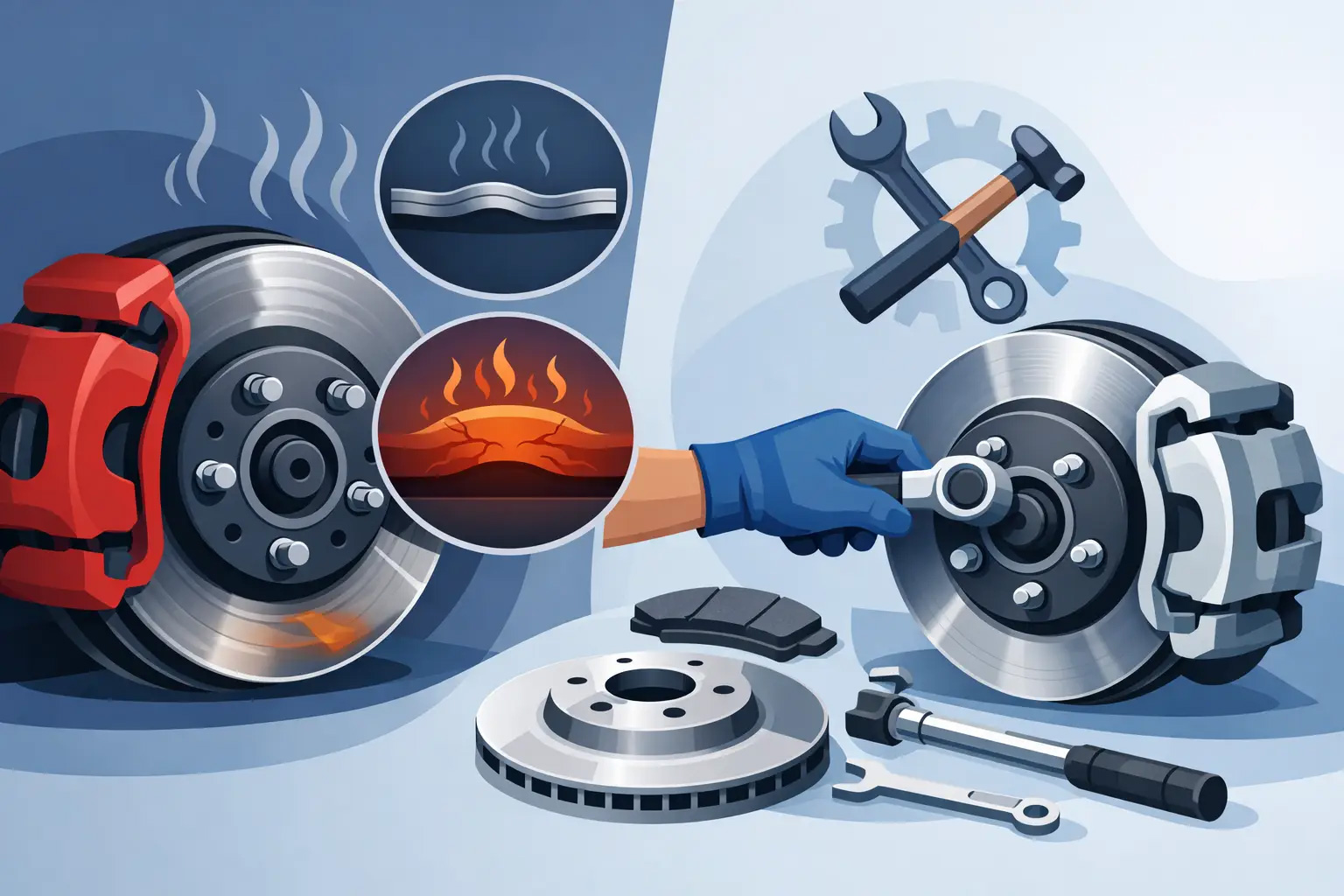
A steering wheel that shakes under hard braking is more than an annoyance. At highway speed, during a mountain descent, or at the end of a fast track straight, that vibration can make a driver question the car exactly when braking confidence matters most. Brake rotor warping is the term drivers commonly use, but the real fault is often more specific - and diagnosing it correctly prevents unnecessary parts replacement.
For performance workshops, distributors, and owners of high-output vehicles, the objective is not simply to eliminate a pulsation. It is to identify why the brake system lost consistency, correct the root cause, and fit hardware that can manage the vehicle's thermal load.
Brake Rotor Warping Is Often a Diagnosis Problem
A brake pedal pulse or steering-wheel vibration during braking is typically caused by disc thickness variation, uneven friction transfer, excessive rotor runout, or a combination of these conditions. True rotor distortion can occur after extreme heat exposure, but it is less common than the phrase "warped rotor" suggests.
Modern brake discs operate through a controlled friction layer. As the pads bed into the rotor, pad material transfers evenly onto the braking surface. When that transfer layer becomes uneven, the brake pads encounter changing friction and thickness as the disc rotates. The driver feels it as pedal pulsation. On a front axle, it may also travel through the steering system as vibration.
This distinction matters because replacing discs without finding the underlying reason can send the same vehicle back to the workshop with the same complaint. A new rotor installed on a dirty hub face, paired with compromised pads, or subjected immediately to repeated overheating is not a durable repair.
What Causes Rotor Vibration Under Braking?
Thermal overload is the most visible suspect. Repeated heavy stops can drive rotor temperatures beyond the range the disc, pad compound, brake fluid, and cooling system were designed to handle. A high-powered BMW, Porsche, Tesla, Nissan GT-R, or modified Toyota Supra can generate far more braking energy than its original equipment setup sees in routine commuting. Vehicle weight, speed, wheel fitment, and driving environment all affect the result.
But heat is only one part of the picture. Uneven torque at the wheel mounting face is another frequent cause. If rust, coating buildup, dirt, or a damaged hub prevents the rotor from seating flat, lateral runout begins before the vehicle leaves the lift. Over time, that runout can create thickness variation in the disc.
Improper wheel-fastener torque can worsen the issue. Impact-gun installation without a calibrated final torque procedure may load the rotor and hub unevenly. The problem may not be obvious immediately, yet it can appear after several heat cycles.
Caliper and pad behavior also matter. A sticking caliper piston, seized guide hardware, restricted brake hose, or pad that does not retract correctly can hold friction against one section of the disc. That localized heat can alter the friction layer and create hot spotting. On high-performance applications, inadequate brake cooling, undersized discs, or a pad compound selected for the wrong operating temperature can produce similar symptoms.
The driving pattern can expose a weak system
A driver who makes one hard stop and then parks with the brakes clamped may leave a concentrated pad imprint on a hot rotor. More commonly, a performance vehicle develops vibration after repeated high-speed stops because the system lacks enough thermal capacity for its mass and power.
That is why the same brake package can feel acceptable on a daily-driven vehicle but struggle on a supercharged SUV, a loaded Defender, or a track-driven coupe. The brake system must be matched to actual use, not just vehicle fitment.
How to Diagnose Brake Rotor Warping Correctly
A professional inspection starts before parts are ordered. Confirm the complaint during a controlled road test when safe to do so. Note whether the vibration occurs only under braking, whether it is felt mainly through the pedal or steering wheel, and whether it changes with speed or brake pressure.
Next, inspect the disc surfaces, pads, calipers, hardware, hoses, wheel bearings, suspension joints, and hub faces. A vibration through the steering wheel can be amplified by worn control-arm bushings, ball joints, tie-rod ends, or wheel-bearing play. Brake work should not become a shortcut around chassis diagnosis.
Measure rotor thickness at multiple points around the friction ring using a micrometer. Compare the readings against the vehicle manufacturer's allowable disc thickness variation. Then measure lateral runout with a dial indicator after the rotor is mounted on a clean hub face. If runout is excessive, index the rotor, inspect the hub, and verify the mounting surface before condemning the disc.
Pad inspection is equally revealing. Look for glazing, tapered wear, cracking, crumbling edges, or material transfer. A rotor with uneven deposits should not automatically receive a new set of pads and be sent out. The workshop must determine whether the deposits came from overheating, poor bedding, caliper drag, or a compound mismatch.
For carbon ceramic systems, follow the manufacturer-specific inspection criteria. Carbon ceramic discs have different wear characteristics, material behavior, and service limits than cast-iron rotors. Visual appearance alone is not a sufficient basis for replacement decisions.
Correct Fixes Depend on the Failure Mode
If the issue is mild uneven pad transfer and the disc remains within specification, a controlled re-bedding process may restore a consistent friction layer. This is not a universal remedy. It only makes sense when the rotor surface, pad condition, runout, and overall system inspection support it.
Where thickness variation exceeds limits, the rotor must be replaced. Pads should generally be replaced or evaluated carefully at the same time, particularly if they are glazed, contaminated, unevenly worn, or matched to the failed disc surface. Installing fresh discs with damaged pads risks transferring the original problem directly onto the replacement components.
If hub runout is the root cause, clean and correct the mounting surface before installing new hardware. If caliper drag is present, repair the hydraulic or mechanical cause. If the vehicle is exceeding the thermal capacity of the original braking system, replacing only the rotors may offer temporary improvement without solving the operating-limit problem.
A complete upgrade can be the more disciplined answer for vehicles used in repeated heavy-braking conditions. Larger effective rotor diameter, greater thermal mass, rigid monobloc calipers, correctly matched high-temperature pads, and vehicle-specific mounting hardware can improve braking consistency. Reduced unsprung weight can also benefit steering response and suspension control, provided the kit is engineered for the vehicle rather than assembled from generic components.
Preventing Brake Rotor Warping on Performance Vehicles
Prevention begins at installation. The hub face must be clean and flat, discs must seat correctly, and wheel fasteners must be tightened in the specified sequence and torque range. Shops should avoid using impact tools as the final torque method.
After installation, bed pads and rotors according to the brake manufacturer's procedure. Proper bedding creates the stable transfer layer the system needs. It also gives the technician a controlled opportunity to confirm that pedal feel, brake balance, and release behavior are correct before the vehicle returns to demanding use.
For track-capable or high-mass vehicles, monitor more than rotor condition. Brake fluid with an appropriate boiling point, functional cooling ducts, healthy caliper seals, and properly selected pads all support rotor life. A carbon ceramic brake system can offer exceptional thermal resistance and substantial weight reduction, but it still requires correct fitment, compatible friction materials, and disciplined service practices.
CCYS develops vehicle-specific carbon ceramic brake solutions with controlled in-house manufacturing, racing-grade materials, and quality systems aligned with IATF 16949 and ISO 9001 requirements. For distributors and performance workshops, the value of a complete engineered kit is not only stronger stopping force. It is the confidence that calipers, rotors, pads, brackets, and supporting hardware are designed to work as one braking system.
The next time a customer reports a pulsing pedal, treat it as evidence, not a parts-ordering instruction. Measure the disc, inspect the hub and caliper, check the chassis, and match the brake package to the heat the vehicle actually creates. That approach protects the repair, the vehicle, and the driver who depends on the brakes when the road gets serious.