

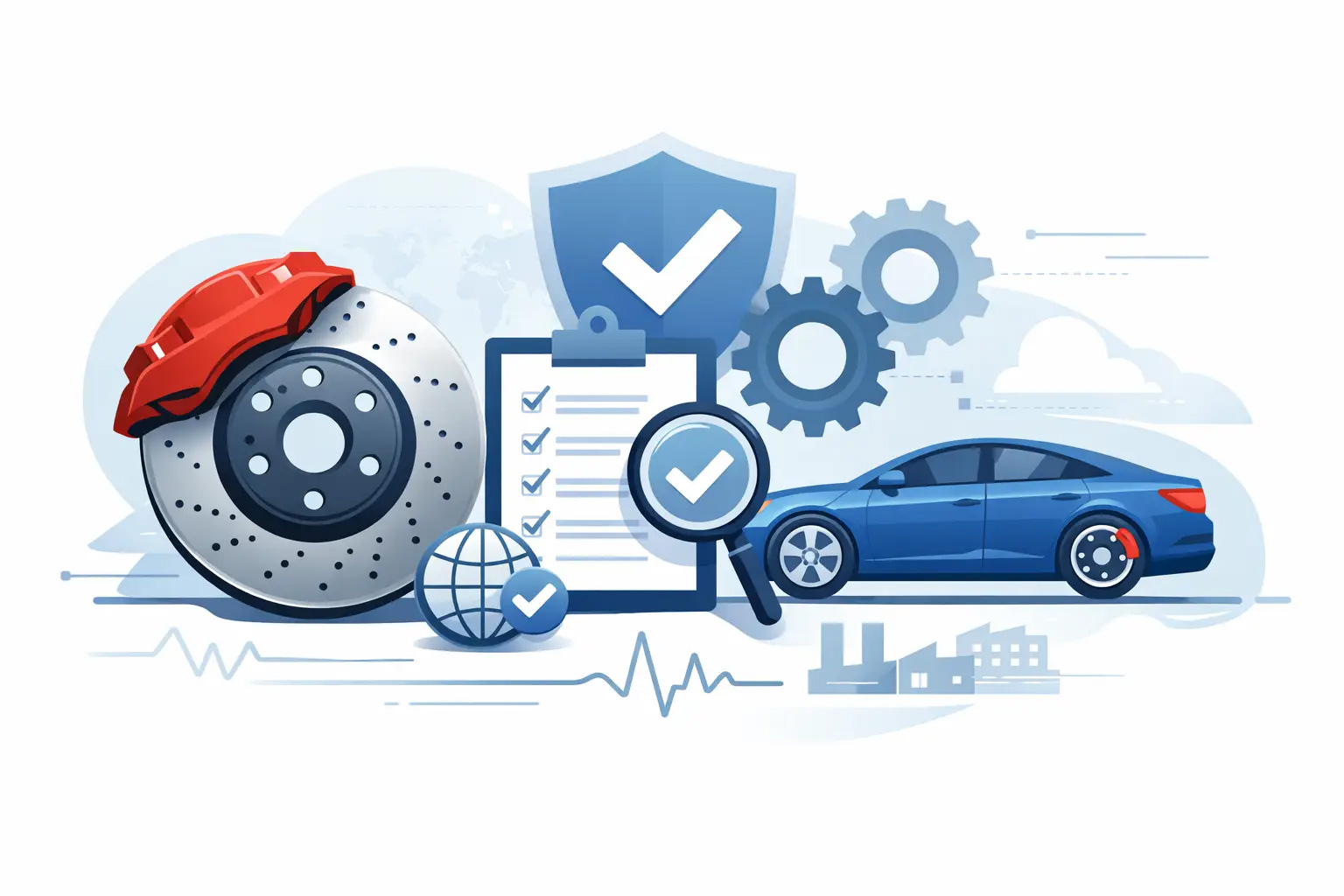
A brake system is only as dependable as the process behind every rotor, caliper, pad, bracket, and fastener. When a driver hits the pedal after repeated high-speed stops, there is no margin for inconsistent machining, an unverified material batch, or a fitment change that never reached production. That is why IATF 16949 certification matters to performance-brake distributors, workshops, and serious vehicle owners. It is evidence that a manufacturer operates under an automotive quality-management system built to control variation before it reaches the vehicle.
For carbon ceramic brake systems, the standard has practical value far beyond a certificate on a wall. It influences how components are designed, sourced, produced, inspected, documented, and improved when a problem is found. Buyers still need to evaluate the brake kit itself, its vehicle-specific engineering, and its intended use. But certification provides a stronger basis for confidence that those decisions are supported by disciplined manufacturing.
What IATF 16949 Certification Demands
IATF 16949 is the automotive quality-management standard used throughout the global vehicle supply chain. It is built on ISO 9001, then adds automotive-specific requirements for defect prevention, risk management, traceability, supplier control, product safety, and continuous improvement.
The distinction matters. ISO 9001 establishes a broad quality framework that can apply to nearly any industry. IATF 16949 goes further because automotive components face higher consequences when process control fails. A dimensional inconsistency in a brake caliper mounting point, for example, is not simply a cosmetic defect. It can affect installation, pad alignment, rotor clearance, pedal feel, and braking stability.
Certification is awarded to a manufacturing organization for a defined scope, not to every individual product as a blanket approval. It does not mean a carbon ceramic brake kit is automatically legal for every road market, track rulebook, or vehicle application. It does mean the certified manufacturer is audited against an automotive-grade system intended to identify risks, control production, and correct failures systematically.
Why Process Control Matters Under Braking Heat
Performance braking exposes every weak point in a production process. Heavy vehicles, modified SUVs, supercars, track-driven coupes, and high-output EVs generate extreme thermal loads. The hardware must manage heat while maintaining dimensional accuracy, structural integrity, and predictable operation through repeated braking cycles.
A carbon ceramic rotor is not a commodity disc. Its material behavior, friction pairing, mounting design, cooling architecture, and tolerance requirements must work together. The same is true of monobloc calipers, which depend on accurate bore geometry, fluid passage machining, piston movement, seal installation, and bracket alignment. A small inconsistency can become noticeable as uneven pad wear, noise, vibration, drag, reduced clearance, or compromised braking confidence.
IATF 16949 requires manufacturers to approach these risks through planned controls rather than final inspection alone. Final inspection can catch some issues. It cannot reliably compensate for a process that allows variation to build into parts from the start. The stronger approach is to define the critical characteristics, measure them at appropriate points, verify equipment capability, and react quickly when a process begins to drift.
The Automotive Tools Behind the Certificate
A credible automotive quality system is not just paperwork. It uses structured methods to turn engineering requirements into repeatable production. Depending on the product and manufacturing scope, these methods commonly include Advanced Product Quality Planning, Failure Mode and Effects Analysis, Production Part Approval Process documentation, Statistical Process Control, and Measurement System Analysis.
Risk is addressed before volume production
Failure Mode and Effects Analysis asks a manufacturer to consider how a component or process could fail, why it could fail, and how that risk will be controlled. In braking applications, this can include machining variation, coating adhesion, rotor mounting accuracy, incorrect hardware selection, packaging damage, or an assembly error at a critical stage.
The value is not that a risk list exists. The value is whether the list changes the process. If a particular dimension controls rotor centering or caliper clearance, it should receive an appropriate measurement method, inspection frequency, and reaction plan. Engineering concerns must become shop-floor controls.
Measurement must be trustworthy
A measurement recorded with an unreliable gauge is not meaningful quality data. Measurement System Analysis evaluates whether the tools and methods used for inspection can repeatedly distinguish an acceptable part from an unacceptable one.
For a brake-system buyer, this supports a basic expectation: claimed tolerances should be verified with capable equipment and consistent procedures. This becomes especially relevant when supplying vehicle-specific kits for platforms such as Porsche, Tesla, BMW, Nissan GT-R, Toyota Supra, Jaguar, Land Rover, Defender, and other high-performance applications where space, hub geometry, wheel clearance, and mounting details vary significantly.
Traceability turns a problem into an answer
No manufacturer can honestly promise that a concern will never occur. The professional question is what happens when one does. Traceability allows a manufacturer to identify affected material, production lots, inspection records, and shipment history without guessing.
That capability protects distributors and workshops. If a supplier needs to investigate a reported issue, clear records help isolate the relevant parts and determine whether the cause came from material, machining, assembly, handling, or installation conditions. Without traceability, a small concern can become a costly, wide-ranging disruption.
What Certification Means for Distributors and Workshops
For channel partners, IATF 16949 is a useful supplier-screening signal because it indicates that quality is managed as an operating discipline. It can support more reliable part consistency, clearer corrective-action processes, better documentation, and stronger control of supplier inputs.
That said, certification should not replace technical due diligence. A distributor should still ask whether the brake system is engineered for the target platform, whether the kit includes the required brackets and hardware, what wheel-clearance requirements apply, and how the manufacturer supports installation questions. A workshop should confirm rotor direction, mounting torque procedures, pad bedding requirements, brake-fluid recommendations, and intended road or track use before fitting any performance system.
The most capable supplier combines documented process control with practical application knowledge. Buyers need complete solutions, not a box of impressive-looking parts that leave critical fitment decisions unresolved.
How to Evaluate IATF 16949 Certification Claims
When a manufacturer references IATF 16949, ask direct questions. Confirm the certificate is current and that its scope covers the relevant manufacturing location and activities. A company may hold certification for one facility while sourcing key operations elsewhere, so the production scope matters.
Also ask how the manufacturer controls critical operations. For a brake supplier, relevant areas may include raw-material verification, precision machining, component assembly, inspection, final testing, packing, and serial or batch traceability. The answer should be specific enough to show that quality control is connected to the actual parts being purchased.
Finally, distinguish between process certification and product validation. Certification does not replace application testing, installation verification, warranty review, or compliance requirements in the buyer's market. It is one powerful part of the purchasing decision, not the entire decision.
In-House Manufacturing Creates a Stronger Control Loop
Vertical manufacturing control can strengthen the benefits of an automotive quality system. When engineering, machining, inspection, and quality management are closely connected, feedback moves faster. A dimensional concern found during inspection can be reviewed against the machining process. A workshop fitment question can reach the engineering team with less delay. A recurring issue can be corrected at its source instead of passing through several disconnected vendors.
CCYS completes 90% of production in-house, giving its teams direct control over carbon ceramic brake development, precision manufacturing, and quality execution. For international distributors and performance workshops, that control supports a more accountable supply relationship than one built around anonymous, fragmented sourcing.
This does not mean every project needs the same level of specification. A street-driven luxury SUV and a track-focused GT-R have different operating demands. The right system depends on vehicle weight, tire grip, power output, wheel design, driving conditions, and customer expectations. The advantage of a controlled manufacturer is the ability to match those needs with defined components, documented fitment, and technical support.
Buy Braking Confidence, Not Just Brake Hardware
A larger rotor, lighter disc, or multi-piston caliper can look compelling in a product listing. The harder question is whether the manufacturer can repeatedly deliver that same engineering standard across every batch, every application, and every market. IATF 16949 provides meaningful evidence that the manufacturer takes that responsibility seriously.
Before selecting a performance brake supplier, request the fitment details, warranty terms, installation guidance, and quality documentation that apply to the parts you plan to sell or install. The right conversation should end with more than a price and a part number. It should give you confidence in what happens before the brake kit reaches the vehicle - and what support is available after it does.