

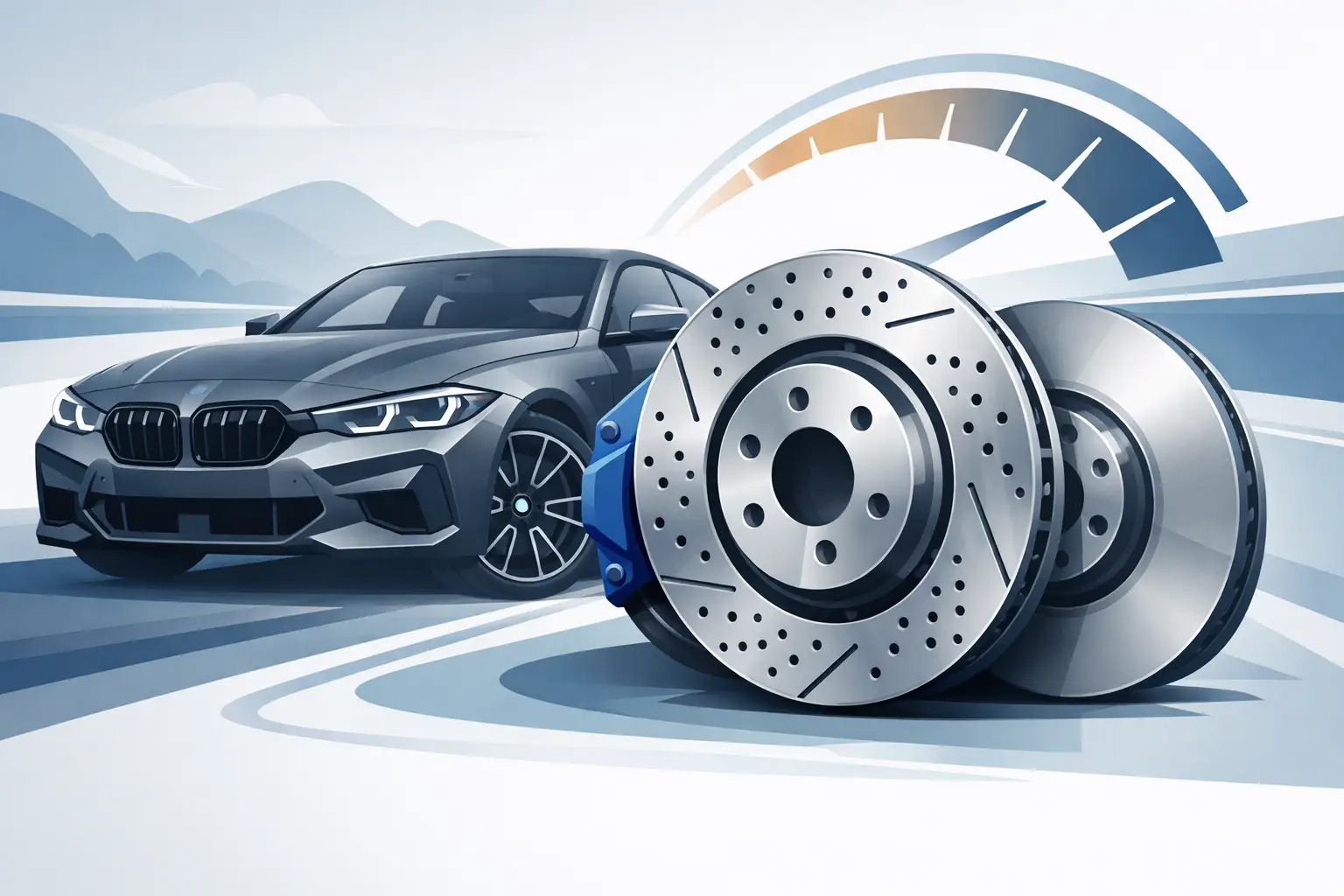
A long brake pedal after two hard stops is not a cosmetic problem. On a fast BMW, it is the moment when speed, vehicle weight, tire grip, and heat exceed the capacity of the existing brake hardware. Proper BMW brake rotor selection begins with that reality: a rotor must manage thermal energy, preserve pedal consistency, work with the caliper and pad, and fit the vehicle without compromising brake balance or electronic systems.
For a daily-driven 330i, the answer may be a high-quality replacement rotor. For an M car used on mountain roads, high-speed runs, or track days, the correct answer can be a larger two-piece rotor or a complete carbon ceramic brake system. The right choice depends on the duty cycle, not the appearance of the disc.
BMW Brake Rotor Selection Starts With the Job
BMW uses a wide range of braking configurations across its platforms. Rotor diameter, thickness, hat offset, mounting method, caliper location, parking brake arrangement, and wheel clearance can vary substantially between trims that appear similar from the outside. A rotor that fits one 5 Series configuration may not fit another, even within the same model year.
Start with the exact chassis, engine, production year, axle, factory brake option, and wheel size. For performance upgrades, also confirm the caliper dimensions and the internal barrel clearance of the wheel. Large rotors and fixed multi-piston calipers create a clearance issue long before the vehicle reaches the road.
The next question is how the vehicle is actually used. A street BMW that sees normal commuting needs predictable cold response, quiet operation, corrosion resistance, and reasonable operating cost. A car that repeatedly brakes from triple-digit speeds needs more thermal mass, better airflow, and a pad-and-rotor combination that remains stable at elevated temperatures. Track use exposes weak selections quickly: cracking, pad deposits, fluid boil, pedal lengthening, and inconsistent bite are all signs that the system is operating beyond its intended range.
Rotor selection should never be isolated from the rest of the system. Brake pads, fluid, caliper stiffness, brake lines, tire compound, and suspension setup all influence stopping performance. Installing an aggressive rotor with a street-only pad does not create a track-ready brake package.
Choose the Rotor Construction Before the Surface Design
Cross-drilling and slotting receive attention because they are visible. Construction and material determine much more of the rotor's real capability.
One-piece iron rotors
A one-piece cast iron rotor remains a practical option for many BMW road cars. It is economical, widely available, and provides strong cold performance with the correct pad. For standard replacement work or lightly modified vehicles, a premium iron rotor can be the right engineering decision.
Its limitation is heat. Iron is durable, but a heavy one-piece disc transfers significant mass to the hub and suspension. Repeated high-energy braking can push temperatures beyond the pad's working range, accelerate wear, and create vibration concerns when deposits build unevenly on the friction surface. That does not mean every iron rotor will fail under spirited use. It means its capacity must match the vehicle's weight, speed, power, and braking frequency.
Two-piece floating or semi-floating rotors
Two-piece rotor designs combine an iron friction ring with an aluminum center hat. This construction reduces rotating and unsprung weight compared with a comparable one-piece iron disc. Lower unsprung weight helps the suspension respond more accurately over uneven pavement, while lower rotational mass can improve steering response and acceleration feel.
The separate hat and ring also provide a better path for managing thermal expansion. Under repeated braking, the iron ring grows significantly. A properly engineered floating or semi-floating arrangement allows controlled movement rather than forcing the entire assembly to absorb stress in one piece.
For high-performance street cars and occasional track BMWs, this is often the strongest middle ground. The trade-off is cost and service complexity. Hardware, bobbins, rings, and hats must be manufactured to precise tolerances. A poorly designed two-piece rotor is not an upgrade simply because it has more parts.
Carbon ceramic rotors
Carbon ceramic brake rotors are built for severe thermal demand, reduced weight, and long-term resistance to corrosion. Compared with iron systems, they can substantially reduce unsprung and rotating mass, which benefits steering precision, suspension control, and overall vehicle response. Their thermal resistance is particularly valuable in repeated heavy-braking conditions where iron components accumulate and retain heat.
They are not a universal replacement for every BMW. Carbon ceramic systems require matched pads, calipers, rotor dimensions, mounting hardware, and fitment engineering. The friction behavior differs from iron, especially across temperature ranges, so mixing individual components without system validation is not acceptable for a safety-critical application.
A complete vehicle-specific carbon ceramic kit is the correct approach when the goal is meaningful performance improvement, not just a premium-looking disc behind the wheel. It should be engineered around caliper piston area, hydraulic pressure, rotor leverage, pad sweep, thermal capacity, and front-to-rear balance.
Size, Thickness, and Airflow Control Brake Capacity
A larger rotor creates more leverage at the wheel. Moving the friction surface farther from the centerline gives the caliper more mechanical advantage, allowing the system to generate braking torque with greater efficiency. Larger diameter also usually provides more surface area to absorb and reject heat.
Thickness matters just as much. A thicker rotor has greater thermal mass, which slows temperature rise during repeated stops. Internal vane design then determines how effectively that heat moves through the disc. Directional vanes, correctly installed for the vehicle side, can improve airflow through the rotor. A directional rotor installed on the wrong side may look normal while moving air in the wrong direction.
Do not select diameter based on wheel size alone. An oversized front rotor can alter brake torque distribution if the rear system remains unchanged. On modern BMW platforms, brake balance also interacts with ABS, stability control, and brake-based torque management. The goal is not maximum front brake size. The goal is stable, repeatable deceleration with predictable vehicle behavior at the limit.
Drilled, Slotted, or Plain: Select for the Operating Environment
Plain-faced rotors offer the greatest uninterrupted friction surface and are often preferred for demanding track use. They provide consistent pad contact and avoid the stress concentration associated with drilled holes. For many serious drivers, a plain rotor with excellent vane design and the correct pad is the most durable configuration.
Slotted rotors can help refresh the pad surface and provide a clear visual indication of wear. They are useful when matched with appropriate pad compounds, though they can increase pad wear and operating noise. Slot geometry should be engineered, not treated as decoration.
Drilled rotors can reduce mass and offer a performance appearance, but drilling introduces localized stress points. High-quality carbon ceramic rotors and purpose-engineered systems may use drilled patterns successfully because the material, manufacturing method, and thermal behavior are designed around them. A generic drilled iron rotor used under sustained track temperatures is a different calculation. For repeated severe braking, rotor integrity takes priority over appearance.
Match the Rotor to Pads, Calipers, and Fluid
The rotor is only one heat-management component. A pad with too low a temperature ceiling will fade regardless of rotor quality. A highly aggressive track pad on a street car may create noise, dust, poor cold bite, and accelerated disc wear. The right friction compound must match both the rotor material and the vehicle's intended use.
Caliper selection matters because stiffness and piston configuration affect pedal feel, clamping force distribution, and pad wear. Monobloc calipers can offer high rigidity under load, helping maintain consistent pressure and response during hard braking. But caliper upgrades must be paired with correctly sized rotors and hydraulic calculations, not installed as standalone visual modifications.
Fresh high-temperature brake fluid is also non-negotiable for performance use. If the pedal becomes soft after repeated braking, the system may be boiling fluid rather than exceeding the rotor's capability. Diagnose the complete system before blaming one component.
Fitment Precision Is a Safety Requirement
A BMW rotor must center correctly on the hub, maintain the specified offset, clear the caliper bracket, and operate within the intended thickness range. Runout, hub corrosion, incorrect wheel bolt torque, and contaminated mating surfaces can create pedal pulsation that is often mistakenly called a warped rotor.
Before installation, inspect the hub face, measure runout where appropriate, confirm wheel clearance, and follow the specified torque procedure. With a big brake kit, confirm that the supplied brackets, hardware, brake lines, and pads belong to the exact application. A kit designed for an F80 M3 is not automatically suitable for an F82 M4 or another BMW chassis with a similar wheel pattern.
For distributors and workshops, documented fitment is as valuable as peak performance claims. It reduces installation risk, protects the customer, and prevents costly returns. Manufacturers that control machining, rotor development, caliper production, and quality inspection can provide a more consistent system-level result. CCYS maintains 90% of production in-house and works to IATF 16949 and ISO 9001 quality standards because brake performance cannot depend on uncontrolled component variation.
The best rotor choice is the one that still delivers a firm, repeatable pedal at the end of the hardest stop your BMW is expected to make. Build around that demand, verify every fitment detail, and choose a complete engineered system when the vehicle's speed and use leave no room for compromise.