

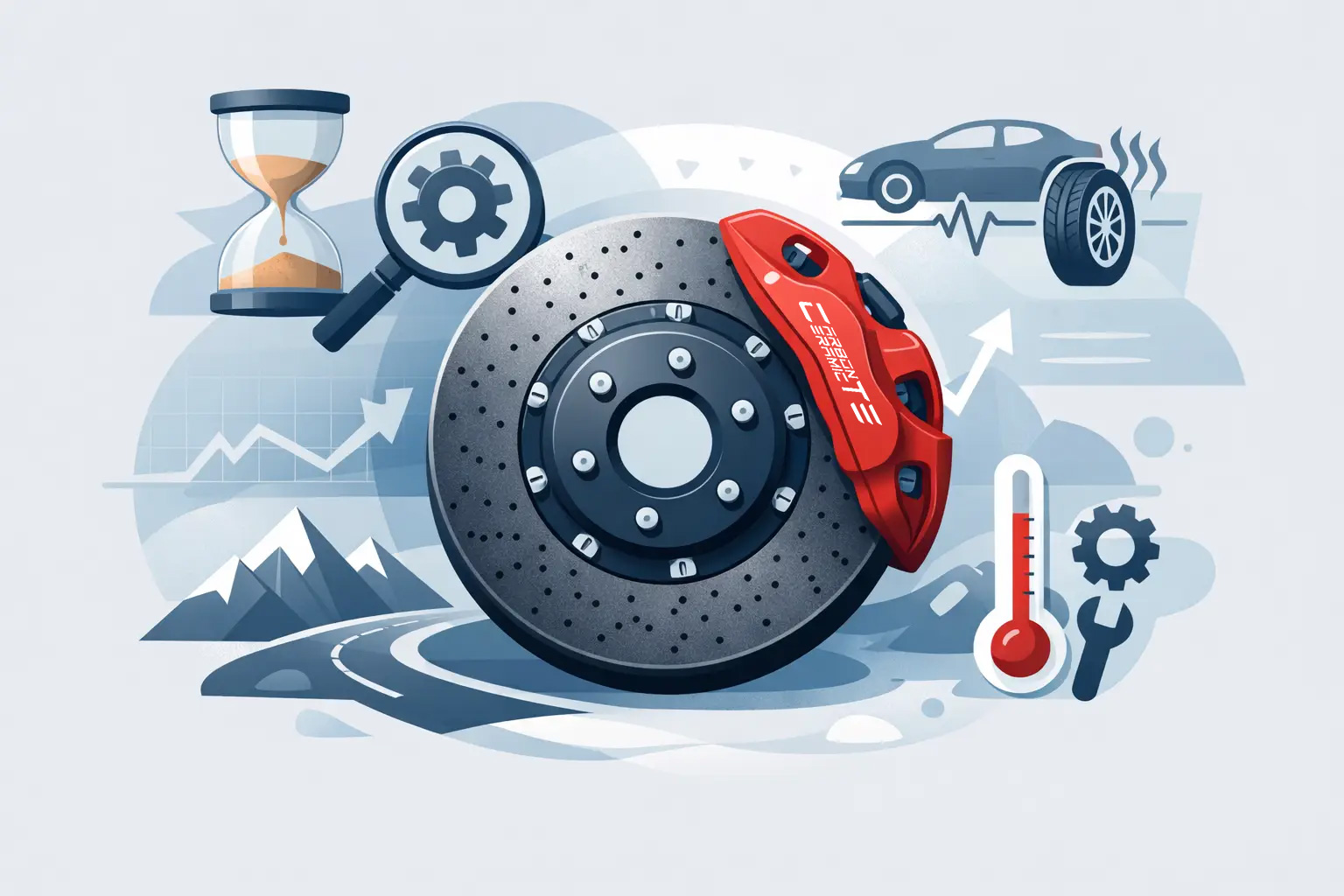
A brake pedal that goes long after repeated hard stops is not a minor inconvenience. On a fast road car, a heavy EV, or a track-prepared build, it is the moment when confidence disappears. Carbon ceramic brake lifespan matters because these systems are purchased for repeatable stopping force, extreme heat resistance, and lower unsprung weight - not simply for an impressive rotor behind the wheel.
For the right vehicle, a properly engineered carbon ceramic system can outlast conventional iron brakes by a substantial margin. But no rotor material is immune to incorrect fitment, incompatible pads, impact damage, or track temperatures beyond the system's operating design. The realistic answer is not one mileage number. It is a combination of vehicle use, installation quality, hardware selection, and disciplined inspection.
Carbon Ceramic Brake Lifespan: What to Expect
A carbon ceramic rotor is typically made from a carbon fiber-reinforced ceramic matrix, often described as carbon-silicon carbide. It is dramatically lighter than an equivalent iron rotor and highly resistant to the heat cycles that can cause iron discs to distort, crack, or lose consistent friction characteristics under repeated heavy braking.
For road-driven premium and performance vehicles, carbon ceramic rotors can commonly remain serviceable for 100,000 miles or more. Some systems last far longer when they see mostly highway mileage and moderate brake loads. Pads will usually require replacement before the rotors, often more than once.
That number changes quickly when a vehicle is used for frequent track days, mountain runs, towing, or high-speed braking with significant vehicle mass. A Porsche used for occasional spirited driving and a heavy modified SUV repeatedly braked from high speeds do not impose the same energy load. Likewise, an EV's regenerative braking can reduce friction-brake use in ordinary driving, but its mass can create extreme rotor demand during aggressive downhill or track operation.
The key point for workshops and owners is simple: rotor life should be measured by condition, not mileage alone. Wear limits, rotor mass, surface condition, disc runout, and the presence of cracks or edge damage all matter more than an optimistic estimate.
Why Carbon Ceramic Rotors Last Longer
The long service potential of carbon ceramic brakes comes from material behavior. Unlike cast iron, a carbon ceramic disc does not corrode in the same way, does not add significant weight as a larger disc is specified, and handles high temperatures with exceptional stability. Reduced unsprung and rotating mass can also improve steering response, suspension control, and acceleration feel.
Heat management is the major advantage. During repeated braking, conventional rotors can store enormous energy and transfer it through the caliper, fluid, pads, hubs, and wheel area. As temperatures rise, drivers may experience fade, inconsistent pedal response, or accelerated pad breakdown. A correctly matched carbon ceramic system provides much stronger thermal resilience.
However, thermal resistance is not a license to ignore system design. Rotor diameter, thickness, ventilation, caliper piston area, pad compound, brake fluid, tire grip, and the vehicle's intended duty cycle must work together. Installing a carbon ceramic disc without matching the caliper, bracket, and pad specification is not a performance upgrade. It is an uncontrolled combination of parts.
The Conditions That Shorten Rotor Life
Carbon ceramic discs are durable, but they require informed handling. The most common causes of shortened service life are not ordinary street braking. They are poor component matching, physical damage, and use outside the engineered application.
An aggressive pad compound can be excellent for high-temperature track work yet unsuitable for a road-focused carbon ceramic rotor. A pad that is too abrasive, runs outside its intended temperature window, or transfers material inconsistently can damage the disc surface and create vibration or uneven friction. Pad compounds must be specified for the exact rotor material and operating environment.
Improper installation creates another avoidable risk. Contaminated mounting faces, incorrect torque procedures, damaged floating hardware, or a hub with excessive runout can place uneven stress into the disc. Carbon ceramic rotors are not normally machined or resurfaced like iron rotors. Once a disc is damaged beyond its allowable condition, replacement is generally the correct repair.
Physical impact also matters. Striking a curb, driving through severe debris, using careless wheel-changing practices, or allowing a loose stone to cause damage can chip a rotor edge or affect the braking surface. During tire and wheel service, technicians should treat carbon ceramic hardware as high-value precision equipment, not as a standard service part.
Four operating factors deserve particular attention:
- Repeated high-energy stops that exceed the system's intended track or vehicle-weight capacity.
- Pads that are not approved for the carbon ceramic disc and caliper combination.
- Wheel, hub, or mounting errors that introduce runout, vibration, or uneven clamping load.
- Infrequent inspection after track events, impacts, or braking abnormalities.
Street Driving, Track Use, and Heavy Vehicles
Street use is generally favorable to carbon ceramic brake lifespan. Regular road braking rarely pushes a properly sized system to its thermal ceiling, and corrosion resistance is a meaningful advantage for vehicles that sit for extended periods. Owners still need normal pad and fluid service, but rotor replacement can be infrequent.
Track use is different because braking energy rises with vehicle speed and mass. Braking from 140 mph generates far more heat than braking from 70 mph, and repeated sessions do not give components the same recovery time as public-road driving. A lightweight sports car with a well-matched kit may see excellent track durability. A high-horsepower, heavy luxury sedan, SUV, or EV may require a larger rotor and caliper package to maintain the same margin.
For performance workshops, this is where vehicle-specific engineering becomes essential. The correct brake kit considers wheel clearance, rotor offset, caliper position, hub load, cooling path, ABS behavior, and intended use. A large-disc conversion that clears the wheel but ignores these details is not the same as a complete braking system.
Maintenance That Protects Carbon Ceramic Brakes
Carbon ceramic brakes do not require complicated maintenance, but they do require the right maintenance. Inspect the discs and pads at scheduled services and after demanding events. Look for surface damage, unusual grooves, chips, cracks, discoloration associated with abnormal operation, uneven pad wear, loose hardware, or noise that was not previously present.
Rotor condition should be evaluated using the manufacturer's criteria. Depending on the system, this can include measuring disc thickness, checking disc mass, inspecting the friction ring and mounting hardware, and confirming that runout remains within specification. Do not assume a rotor is acceptable because it looks clean through the wheel spokes.
Use approved pads and follow a controlled bedding procedure after pad replacement. Bedding establishes a stable transfer layer between pad and disc. Skipping this process, especially after fitting track-oriented pads, can lead to inconsistent friction and unnecessary stress on the braking surface.
Brake fluid remains critical. Carbon ceramic rotors reduce heat transfer compared with conventional systems, but fluid can still degrade under hard use. A performance vehicle that sees track days should receive fluid service based on brake temperature exposure and event frequency, not only a generic calendar interval. Check caliper seals, bleed screws, hoses, and mounting fasteners at the same time.
Choosing a System Built for Long-Term Use
The lowest-priced carbon ceramic components can become the most expensive choice when fitment, material consistency, and technical support are uncertain. Buyers should look for a complete vehicle-specific system with documented rotor dimensions, caliper specifications, approved pad options, replacement-part availability, and clear inspection guidance.
Manufacturing control matters because braking performance depends on consistency across every component. CCYS completes 90% of production in-house and operates under IATF 16949 and ISO 9001 quality systems, supporting the precision required for racing-grade carbon ceramic kits, rotors, calipers, and related hardware. For distributors and workshops, that control helps reduce the uncertainty that comes with piecing together critical brake components from unrelated sources.
The best way to protect your investment is to specify the brake system for the vehicle you actually drive. Match rotor size and pad compound to vehicle weight, power, tire grip, wheel fitment, and the hardest braking scenario the car will regularly face. Then inspect it with the same seriousness you apply to engine tuning, suspension geometry, and tires. Strong braking confidence is earned long before the next high-speed stop.