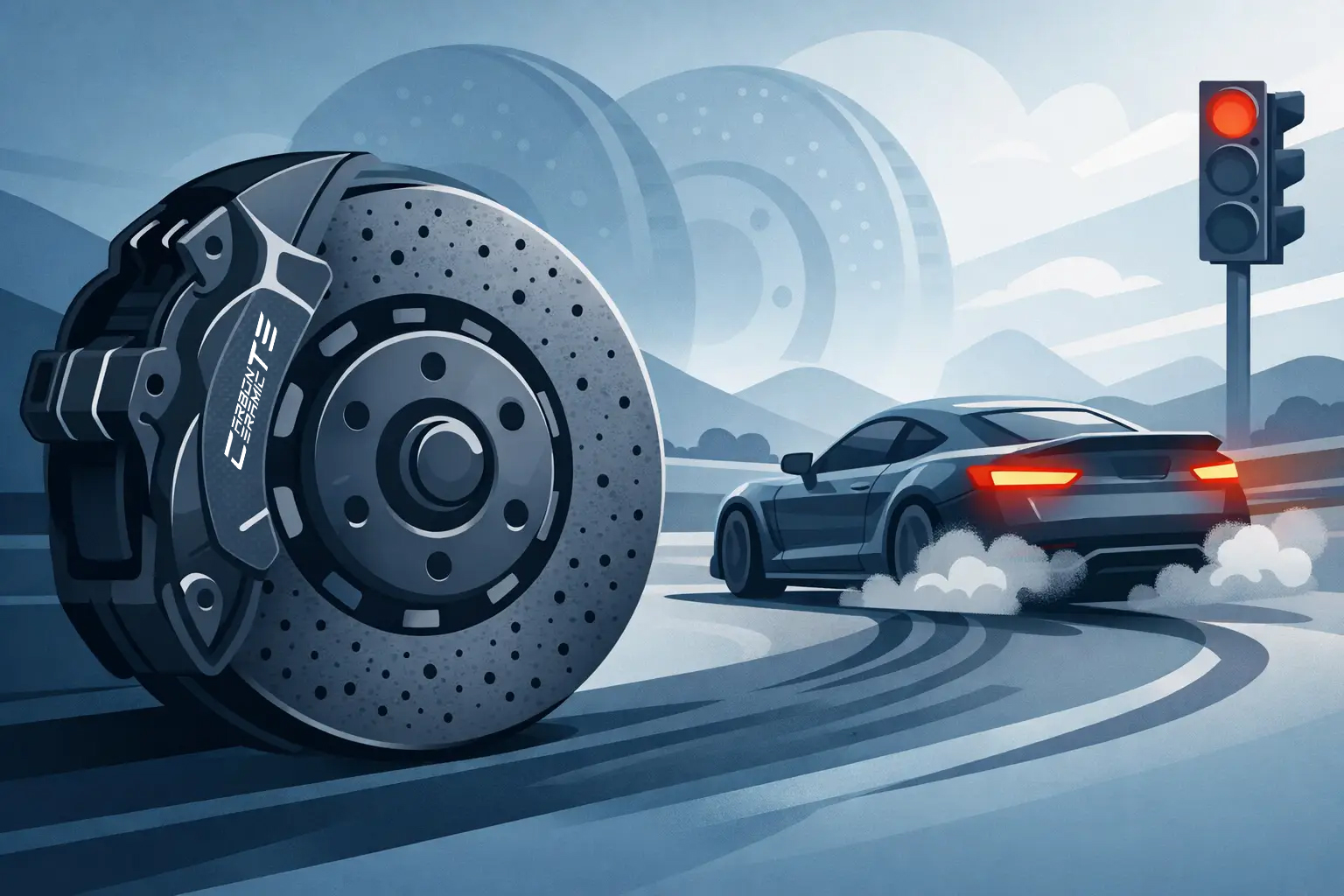
A brake pedal that goes long after a few hard stops is not a minor inconvenience. At highway speed, on a mountain descent, or at the end of a fast straight, it is a direct warning that the system is carrying more heat than it can manage. Carbon ceramic brakes are engineered for drivers and workshops that refuse to accept brake fade, inconsistent pedal feel, or heavy rotating mass as the price of performance.
For premium street builds, track-focused cars, and high-output SUVs, the right brake system must do more than look substantial behind a large wheel. It must control heat, maintain clamping performance, fit the vehicle correctly, and work as a complete system. That is where carbon ceramic technology earns its place.
What Carbon Ceramic Brakes Are Built to Do
A carbon ceramic rotor is typically made from carbon fiber reinforced silicon carbide, often described as C/SiC. The material is very different from the cast iron used in conventional brake discs. Its structure is designed to tolerate extreme temperature cycles while delivering a major reduction in rotor weight.
That reduced mass matters in two ways. First, it lowers the vehicle's unsprung weight - the weight carried below the springs, including wheels, tires, hubs, and brake components. Lower unsprung weight helps the suspension react more accurately to rough pavement, curbing, and rapid load changes. Second, a lighter rotor reduces rotational inertia, which can improve steering response and acceleration feel.
The larger advantage, however, is thermal stability. Repeated heavy braking creates enormous frictional energy. If a conventional system cannot shed and manage that energy, disc temperatures rise, pad material can degrade, brake fluid can be stressed, and pedal confidence can disappear. A properly engineered carbon ceramic system is designed to remain stable under conditions that expose the limits of ordinary street braking hardware.
Carbon ceramic does not rewrite the laws of traction. Tire grip, vehicle weight, suspension geometry, ABS calibration, road surface, and driver input still determine real stopping distance. What the system can do is provide a more consistent braking platform when heat and repeated load are the challenge.
Why Carbon Ceramic Brakes Matter on Performance Vehicles
High-performance vehicles create braking demands that are easy to underestimate. A tuned BMW, Porsche, Tesla, Nissan GT-R, Toyota Supra, Jaguar, Land Rover, Defender, or supercar may carry more power, more weight, or more tire than its original braking package was asked to support. Even when the factory system is capable, track use, aggressive mountain driving, added horsepower, or larger wheels can change the equation.
Carbon ceramic brake kits address that equation through a matched combination of rotors, calipers, pads, brackets, brake lines, and vehicle-specific mounting hardware. The rotor alone is not the system. Caliper stiffness, piston sizing, pad compound, disc diameter, cooling airflow, and hub interface all affect pedal response, torque distribution, wear behavior, and overall safety.
A monobloc caliper, for example, uses a rigid one-piece construction to control flex under high hydraulic pressure. Combined with correctly selected pistons and pad surface area, it can provide more repeatable clamping behavior during demanding use. A larger effective rotor radius can also increase braking torque without requiring an excessive pedal effort.
This is why professional workshops should avoid mixing unrelated parts based only on appearance or diameter. A brake conversion must be engineered around the vehicle platform, wheel clearance, offset, hub dimensions, hydraulic requirements, and intended driving environment.
Heat Resistance Is More Than a Track-Day Feature
Track driving makes thermal demand obvious, but it is not the only situation that matters. A heavily loaded luxury SUV descending a long grade, an electric vehicle carrying significant battery mass, or a high-speed street car making repeated stops can all place sustained energy into the brake system.
Heat affects every component. Pads can lose friction consistency, discs can develop surface damage, seals can face higher temperatures, and fluid can approach a point where pedal feel changes. Carbon ceramic rotors are valued because they retain their structural integrity and operating consistency through high-temperature cycles that would be far more punishing for standard discs.
That does not mean every driver needs carbon ceramic hardware. A commuter vehicle driven in urban traffic may be better served by a high-quality iron rotor and street compound pad. Carbon ceramic brakes make the most sense when the vehicle, duty cycle, and owner expectations justify the investment in lower weight, thermal resistance, durability, and premium system performance.
The Real Trade-Offs of Carbon Ceramic Systems
Performance buyers should expect an honest evaluation, not a blanket claim that one material is right for every build. Carbon ceramic systems cost more than conventional brake upgrades because the material process, precision machining, component design, and vehicle-specific engineering are more demanding. Replacement planning also matters. The rotor, pad compound, and service procedure should be treated as a matched package.
Cold behavior can vary by system and pad formulation. Racing-oriented compounds may need temperature before they deliver their best response, while a street-performance pad may prioritize quieter operation and more immediate cold bite. The right answer depends on whether the car is used primarily for roads, occasional track events, dedicated circuit work, or high-load daily driving.
Noise, dust, and rotor surface appearance also deserve realistic expectations. Brake noise is influenced by pad compound, bedding procedure, installation quality, temperature, and driving style. A high-performance system should be selected for its functional target, not judged by the same standards as a quiet economy-car brake package.
Wheel fitment is another critical consideration. Larger calipers and rotors require adequate barrel clearance, spoke clearance, and the correct offset. A kit that fits one wheel design may not fit another wheel with the same stated diameter. Experienced installers verify fitment before final assembly, especially on vehicles with aftermarket wheels.
What to Verify Before Specifying a Brake Kit
For distributors, resellers, and performance shops, accurate specification protects both vehicle performance and customer confidence. The first question is not simply, “What is the biggest rotor available?” It is, “What system is correct for this chassis and this use case?”
Confirm the exact vehicle year, model, drivetrain, factory brake configuration, wheel size, and intended use. A Tesla used for daily commuting has different priorities than one used for repeated high-speed braking. A Porsche built for weekend track events may require a different pad choice from a Land Rover used for towing and long-distance travel.
Then assess the complete installation environment: wheel clearance, brake line condition, fluid specification, hub health, suspension geometry, and any changes in tire diameter or wheel offset. Brake performance can be compromised by worn control arms, loose ball joints, degraded bushings, or incorrect alignment. The brake system is only as controlled as the chassis supporting it.
A complete package should include the components required to install and operate the system as engineered. That commonly means carbon ceramic rotors, calipers, pads, mounting brackets, hardware, and application-specific accessories. Supporting components such as hubs and brake lines may be relevant depending on the platform and the design of the conversion.
Installation and Bedding Are Part of Performance
Even the best components can underperform when installation is rushed. Mounting surfaces must be clean and true, fasteners must be torqued to specification, brake lines must be routed correctly, and the hydraulic system must be bled thoroughly. Rotor direction, pad placement, caliper centering, and wheel clearance should all be checked before road testing.
Bedding establishes a stable transfer layer between pad and rotor. The precise procedure depends on the pad and disc system, but the principle is consistent: controlled heat cycles help the surfaces work together as intended. Random hard stops immediately after installation can create uneven deposits and lead to vibration, noise, or inconsistent bite.
After bedding, the system should be inspected for fluid leaks, abnormal contact patterns, fastener movement, and clearance concerns. For race-oriented use, a workshop should also establish routine inspection intervals based on temperature exposure, track time, pad wear, and vehicle load.
Manufacturing Control Is a Safety Requirement
Carbon ceramic braking is not a category where inconsistent production is acceptable. Rotor geometry, fiber architecture, silicon infiltration, machining accuracy, caliper tolerances, and quality control all influence how a system performs under pressure. For professional buyers, documented manufacturing capability is as important as an impressive product specification.
CCYS maintains approximately 90% of production in-house, giving its engineering and quality teams direct control over development, machining, inspection, and product consistency. That manufacturing discipline, supported by IATF 16949 and ISO 9001 quality systems, is especially valuable for distributors and workshops that need dependable fitment, repeatable performance, and warranty-backed confidence across multiple vehicle platforms.
The strongest brake upgrade is not the one with the largest caliper or the most dramatic appearance. It is the one matched to the vehicle, installed correctly, and built by a supplier that understands what happens when heat, speed, weight, and repeated braking all arrive at the same corner. Specify the complete system carefully, verify the fitment, and give the driver a brake pedal worth trusting when the road runs out.