

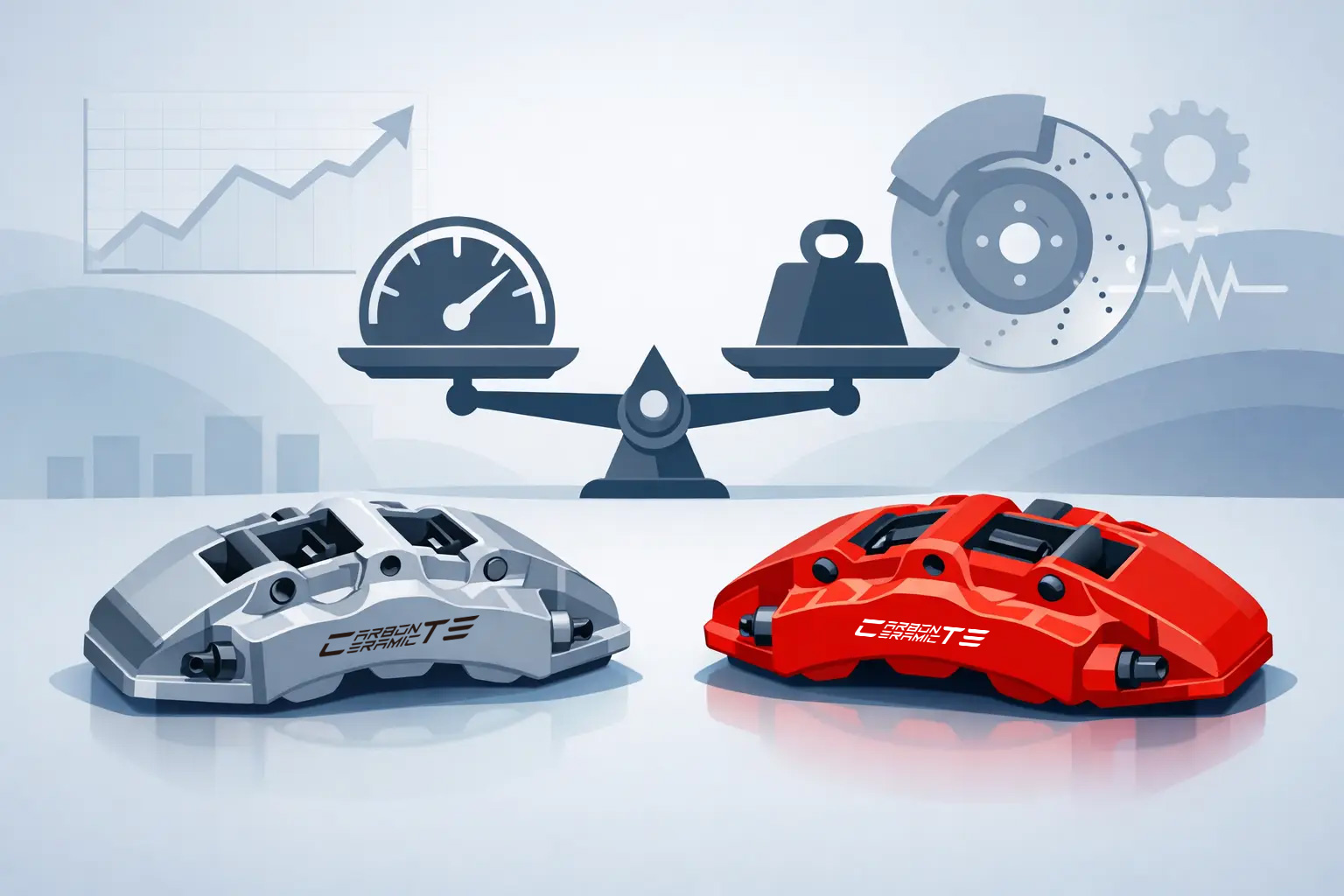
A long pedal at the end of a fast straight is not a cosmetic problem. It is the moment when caliper stiffness, rotor capacity, pad compound, fluid condition, and hydraulic balance stop being specifications and become driver confidence. A proper monobloc caliper comparison starts there: not with the number of pistons or the color of the finish, but with the brake system's ability to deliver consistent clamping force under heat.
For performance workshops, distributors, and serious vehicle owners, a monobloc caliper should be evaluated as part of a complete engineered system. The strongest caliper design cannot correct an undersized rotor, incompatible master cylinder, poor pad selection, or a bracket that compromises alignment. When every component is matched correctly, a monobloc design provides the rigid platform needed for precise pedal response, stable pad contact, and repeated high-load braking.
What a Monobloc Caliper Actually Changes
A monobloc caliper is machined from a single forged or billet aluminum body rather than assembled from two separate caliper halves. Its primary advantage is structural continuity. There is no center joint that can flex under hydraulic pressure, so the caliper body can maintain more consistent geometry when the driver applies high pedal force.
That rigidity matters because hydraulic pressure is only useful when it is converted efficiently into pad clamping force. If the caliper body deflects, some pedal travel is spent flexing the hardware rather than pressing the pads firmly and evenly against the disc. A well-engineered monobloc caliper reduces this lost motion, helping produce a firmer, more repeatable pedal.
The one-piece construction also removes the sealing interface and fasteners found between caliper halves. This can reduce potential leak paths and support a cleaner, more compact package. However, monobloc does not automatically mean better in every application. Material selection, forging quality, machining accuracy, bridge design, piston sizing, and thermal management determine whether the caliper performs as intended.
Monobloc Caliper Comparison: The Engineering Criteria
The most useful comparison is not four-piston versus six-piston or forged versus billet in isolation. It is a review of how the caliper will behave on the intended vehicle, tire, rotor, and duty cycle.
Body stiffness and bridge design
A rigid body is the core value of a monobloc caliper. Look beyond the term itself and inspect how the caliper is engineered around the disc. The bridge section, piston bores, mounting ears, and wall thickness must resist deformation without adding unnecessary mass.
Forged aluminum is widely preferred for high-performance calipers because its grain structure supports strength and fatigue resistance at low weight. Precision machining after forging is equally critical. Piston bores must be concentric, seal grooves must be accurately formed, and mounting surfaces must maintain proper alignment with the rotor centerline.
For a street-performance Porsche, BMW, Tesla, Toyota Supra, or Nissan GT-R, this stiffness contributes to a more direct pedal. For track-oriented use, it also helps preserve pedal consistency after repeated heat cycles. The benefit is real, but it is only realized when the rest of the system has the fluid capacity and thermal control to match.
Piston count is not the final answer
More pistons can improve pad support and allow engineers to distribute clamping force across a larger pad area. That can be useful on large-diameter rotors and heavy vehicles that require substantial braking torque. Six- and eight-piston configurations are common in front axle performance systems for this reason.
Still, piston count alone is a poor buying metric. Total piston area determines the hydraulic relationship with the master cylinder, while individual piston sizing affects pressure distribution across the pad. A carefully designed four-piston monobloc caliper can outperform a poorly matched six-piston unit if its piston area, pad shape, and rotor dimensions are correctly specified.
Staggered piston diameters are often used to manage taper wear as the rotor pulls the pad through the caliper. This is a detail that matters to workshops and fleet-minded owners because uneven pad wear can reduce braking consistency and increase service cost. The right caliper is the one that creates correct front-to-rear brake balance and stable pad loading for the vehicle, not simply the one with the largest piston count.
Rotor size, thickness, and thermal capacity
Calipers create clamping force. Rotors absorb and reject heat. Treating either component as an independent upgrade is one of the fastest ways to create an unbalanced brake package.
A larger effective rotor radius increases braking torque for the same clamp load. Greater rotor thickness adds thermal mass, allowing the disc to absorb more energy before temperatures rise to the point where pad friction changes, fluid temperatures climb, or surface damage becomes a concern. Carbon ceramic discs add another performance dimension through substantially lower weight and strong thermal resistance, particularly where reduced unsprung mass and repeated high-speed braking are priorities.
The caliper must be designed around the rotor's diameter, thickness, swept area, and thermal expansion characteristics. Pad backing plates need stable support, and the caliper should preserve adequate clearance as the disc reaches operating temperature. A mismatch can create dragging, noise, uneven transfer layers, or premature wear.
Weight and vehicle response
Reducing unsprung mass is not just a catalog claim. Lighter calipers and carbon ceramic rotors reduce the weight the suspension must control at each corner. This can improve wheel response over uneven pavement and help a performance chassis maintain tire contact under rapid load changes.
The trade-off is that lightweight hardware must retain enough structural and thermal capacity for its role. A very light caliper with insufficient stiffness will not deliver a meaningful performance advantage. Similarly, a lightweight rotor package must be selected for the vehicle's mass, power, tire grip, and intended use. A heavy electric performance sedan and a lightweight sports coupe place different energy demands on the same braking event.
Pad access, serviceability, and daily use
Race-derived calipers should not make routine maintenance unnecessarily difficult. Top-loading pad access, durable anti-rattle hardware, correctly located bleed screws, and accessible crossover passages save workshop time and reduce the chance of service errors.
For road-driven vehicles, caliper design must also account for low-speed noise, cold response, dust, and corrosion exposure. An aggressive track pad may deliver excellent hot friction yet be unsuitable for a customer who drives through traffic every day. The caliper does not choose the pad compound, but its pad shape and retention system define the options available to the buyer.
A complete kit should include the application-specific bracket, hardware, brake lines where required, and the correct rotor and pad combination. This matters especially on premium platforms with electronic parking brakes, factory wheel-clearance limits, and sensitive brake-bias requirements.
Fitment Is a Safety Requirement, Not a Sales Detail
A monobloc caliper can be mechanically excellent and still be the wrong product if it does not fit the vehicle correctly. Wheel-spoke clearance, barrel clearance, rotor offset, hub condition, mounting geometry, and brake-line routing all require verification.
Caliper position must center the pads over the rotor friction ring. Mounting brackets must be engineered for the specific upright and fastener loads, not treated as generic adapters. On vehicles equipped with advanced driver-assistance systems, the installation must also preserve proper hydraulic behavior and respect any required electronic procedures.
Distributors and workshops should request complete fitment documentation before committing to inventory or installation. Vehicle-specific engineering prevents costly returns and, more importantly, prevents compromises that a brake system should never accept. A system designed for a Defender's vehicle mass and wheel package should not be judged by the same assumptions used for a low-slung sports car.
Manufacturing Control Separates a Caliper From a Commodity
The visible shape of a performance caliper tells only part of the story. Quality depends on traceable materials, controlled forging or billet processes, precision CNC machining, validated seals, consistent anodizing, and inspection at every critical stage. Piston bores, threads, bridge dimensions, and mounting faces are all functional surfaces.
For professional buyers, supplier capability matters as much as product appearance. CCYS maintains approximately 90% of production in-house, giving its engineering and quality teams direct control from development through machining and final inspection. IATF 16949 and ISO 9001-certified quality systems add the documented discipline needed for performance-braking products that must operate under severe temperature and pressure.
That level of control supports more than consistency from one caliper to the next. It supports repeatable fitment, technical troubleshooting, warranty confidence, and the ability to build complete carbon ceramic brake solutions instead of asking customers to assemble critical components from unrelated sources.
Choosing the Right Monobloc Brake Package
The best choice depends on the vehicle and how it is actually driven. A premium street car may prioritize lower unsprung weight, clean fitment behind factory-style wheels, quiet operation, and strong confidence during occasional mountain or highway use. A track-focused build may require larger rotors, higher-temperature pads, more fluid volume, and thermal capacity that remains stable through repeated sessions.
Start with the vehicle's weight, power output, tire grip, wheel diameter, and intended braking duty. Then match caliper piston area to the existing or planned hydraulic system, select rotor dimensions for the energy load, and specify a pad compound that fits the driver's real operating temperature range. Verify wheel clearance before installation, not after the caliper arrives at the shop.
The useful question is not, “Which monobloc caliper has the most pistons?” Ask which complete brake system will still provide a stable, confident pedal after the braking event that matters most. That is the standard worth building around.