

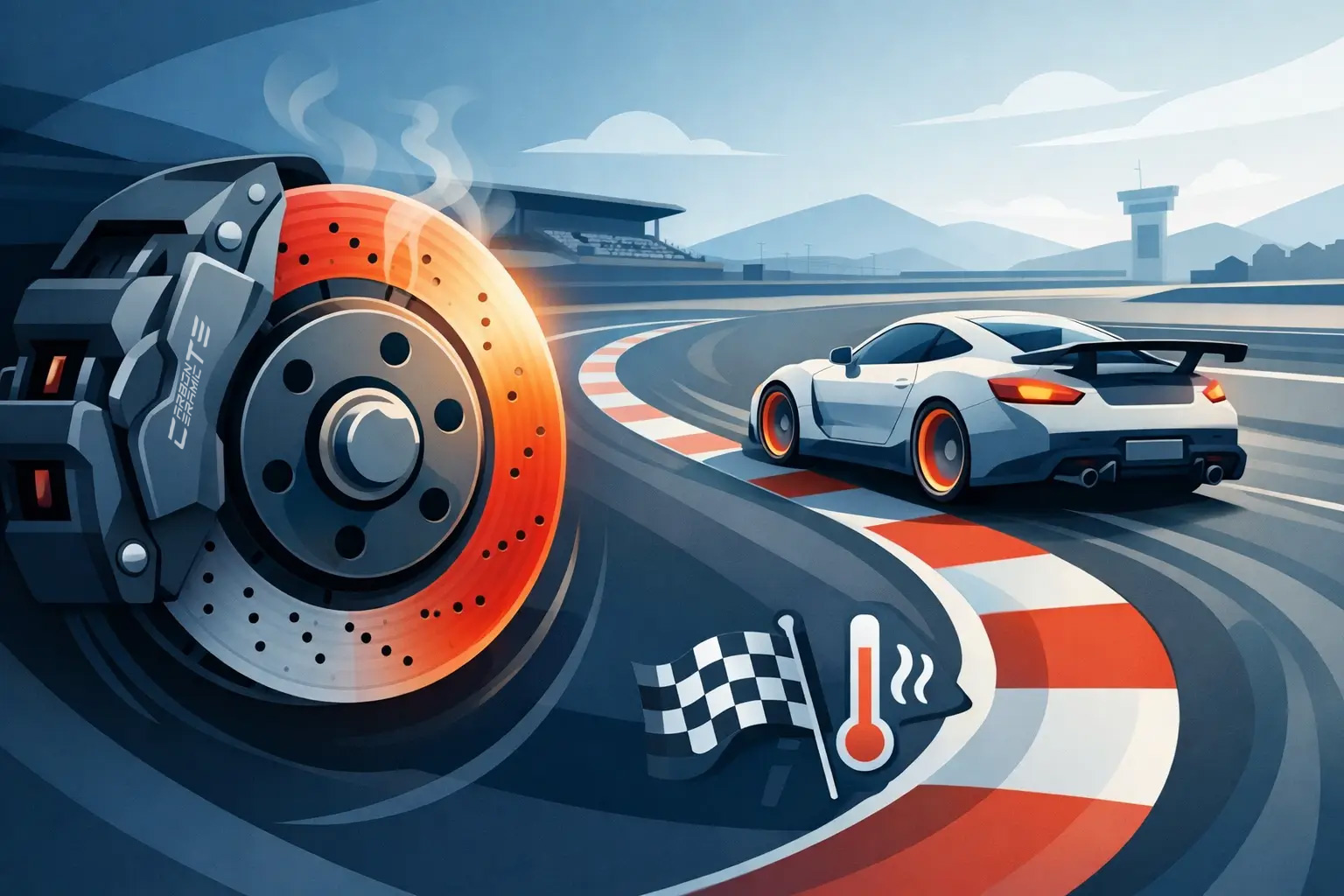
A long pedal at the end of a fast straight is not a minor inconvenience. It is the moment a driver realizes the car may not stop where expected. Preventing brake fade on track starts before the first session, with a braking system engineered for the vehicle’s weight, speed, tire grip, and repeated thermal load.
Track braking is a system problem, not simply a pad problem. Pads, discs, calipers, brake fluid, cooling airflow, wheel fitment, and driver technique all influence whether the pedal remains firm and the car delivers repeatable deceleration. Upgrade one weak component while ignoring the rest, and fade can still return when lap times drop and temperatures rise.
What Brake Fade Actually Feels Like
Drivers often use “brake fade” to describe any loss of braking confidence, but several different failures can produce a similar feeling. Identifying the symptom correctly prevents expensive, ineffective upgrades.
A firm pedal with reduced stopping power usually points to friction fade. The pad compound has exceeded its effective operating range, so it produces less friction against the rotor. This can happen quickly with street-oriented pads during repeated high-speed braking, especially on heavier performance vehicles.
A soft or sinking pedal is more often a fluid issue. Brake fluid absorbs moisture over time, lowering its boiling point. When fluid boils, vapor forms in the hydraulic system. Because vapor compresses far more than fluid, pedal travel increases and braking response becomes unpredictable.
Judder, vibration, or a pulsing pedal may be linked to uneven pad deposits, rotor surface distress, excessive runout, or hardware movement. These conditions are not always fade, but they can reduce confidence and make heat management worse. A proper inspection should include rotor thickness, surface condition, disc runout, pad wear pattern, caliper operation, brake line condition, and wheel bearing play.
Preventing Brake Fade on Track Begins With Heat Capacity
Every braking zone converts vehicle speed into heat. The faster and heavier the car, the more energy the system must absorb. Add sticky tires, late braking, elevation changes, and a driver running consecutive hot laps, and brake temperatures can exceed the limits of an OE road-car setup.
The first engineering question is not, “Which pad is most aggressive?” It is, “Where will the heat go?” Rotor mass, material, diameter, ventilation design, and airflow determine how much thermal energy the system can absorb and reject. Larger effective rotor diameter also increases braking torque by moving the pad contact area farther from the hub center.
That does not mean the biggest possible rotor is automatically correct. A brake system must fit the wheel, clear the suspension, preserve proper front-to-rear balance, and work with the vehicle’s ABS and stability-control calibration. The right solution is a vehicle-specific package with matched discs, calipers, brackets, pads, and hardware.
Carbon ceramic systems can offer a significant advantage where low weight and thermal resistance are priorities. Their reduced rotating and unsprung mass can support sharper suspension response, while the disc material is designed to perform under severe repeated braking. However, the full system matters. A carbon ceramic rotor must be paired with compatible pad material, correct caliper geometry, and a fitment engineered for the platform.
Choose Pads for Temperature Range, Not Marketing Claims
Street pads are designed around cold response, low noise, low dust, and daily-drive comfort. Those priorities can conflict with sustained track performance. A street compound may feel excellent during the first few laps, then lose bite when its friction materials overheat.
Track-capable pads need a temperature range that matches real use. For a lightly modified sports car running short sessions, a high-performance street-track compound may be sufficient. For a heavy EV, high-powered SUV, supercar, or dedicated track build, a true racing-grade compound may be necessary to maintain torque as rotor temperatures climb.
Higher-temperature pads come with trade-offs. They can create more dust, noise, and rotor wear. Some require heat before they feel their best on the street. This is why workshops should avoid treating pad selection as a universal upgrade. The correct compound depends on vehicle mass, power, tire, circuit layout, session length, cooling capacity, and whether the car must remain civil for daily use.
Pad bedding also matters. Follow the component manufacturer’s procedure to establish an even transfer layer on the rotor. Skipping this process can cause inconsistent bite, vibration, and misleading diagnosis after the first hard session.
Use Fresh, High-Temperature Brake Fluid
Brake fluid is one of the least expensive and most critical track consumables. A fluid’s dry boiling point describes new fluid in a sealed container. Its wet boiling point is more relevant to a car that has spent months or years absorbing moisture through the system.
Before track use, flush the system with a quality high-temperature fluid appropriate for the vehicle and intended brake temperatures. Bleed every caliper carefully and confirm the pedal is firm before the car enters the circuit. If the pedal begins to lengthen during a weekend, do not assume the issue will disappear after cooling down. Inspect the system and bleed as needed.
Fluid service intervals should be based on use, not only mileage. A weekend track car may need fluid changed far more often than a commuter. Professional shops should document the fluid specification, service date, pedal condition, and any evidence of heat stress for the customer’s maintenance record.
Improve Cooling Before Adding More Aggression
Cooling is the difference between surviving one hard braking zone and repeating it for twenty minutes. Factory brake ducts can be limited, blocked by wheel design, or inadequate once power and grip increase. Proper ducting directs air toward the center of a vented rotor, allowing internal vane passages to pump air outward through the disc.
Avoid crude solutions that blow air only at the rotor face. Uneven cooling can create thermal stress without effectively cooling the internal structure. Duct routing should also be secure through steering lock and suspension travel. A loose hose near a rotating wheel is a safety issue, not a minor installation flaw.
Wheel selection affects cooling as well. Dense spoke designs, tight barrel clearance, and poorly matched caliper-to-wheel fitment can trap heat. When specifying a big brake kit, confirm wheel diameter, inner-barrel profile, spoke clearance, and airflow rather than relying on diameter alone.
Inspect the Hardware Between Sessions
Track work exposes issues that street driving hides. A pre-event inspection should verify pad thickness, rotor condition, caliper fasteners, brake line routing, hub play, and fluid level. During the day, check for uneven pad wear, discoloration, cracking, leaking seals, or changes in pedal feel.
Pay special attention to rotor condition. Heat checking may be normal on certain high-performance discs, but deep cracking, severe grooves, excessive lip formation, or discs below minimum thickness require action. Reusing compromised components to save one more session risks damage to calipers, pads, wheels, and the driver’s margin for error.
For complete braking conversions, component consistency is a performance and safety advantage. CCYS manufactures 90% of its braking products in-house, combining carbon ceramic disc, monobloc caliper, pad, and mounting-system development with IATF 16949 and ISO 9001 quality controls. That level of production control helps workshops specify complete, vehicle-specific systems instead of assembling unverified parts from multiple sources.
Drive Within the System’s Thermal Window
Good hardware cannot compensate for poor session management. Do not treat every out-lap as a qualifying lap. Bring tires, pads, and fluid up to operating temperature progressively, then monitor pedal consistency and brake response as pace builds.
If the pedal changes, bite drops, or a burning smell becomes excessive, take a cool-down lap or pit the car. Continuing to push through early fade can overheat fluid, glaze pads, damage rotors, and turn a manageable issue into a full brake-service event. After a hard session, avoid parking with the brakes applied for an extended period when possible, since hot pads clamped against stationary rotors can encourage uneven material transfer.
The fastest lap is only useful when the car can repeat it with the same braking confidence. Build the system around thermal capacity, inspect it like racing equipment, and treat any change at the pedal as information worth acting on before the next braking zone.