

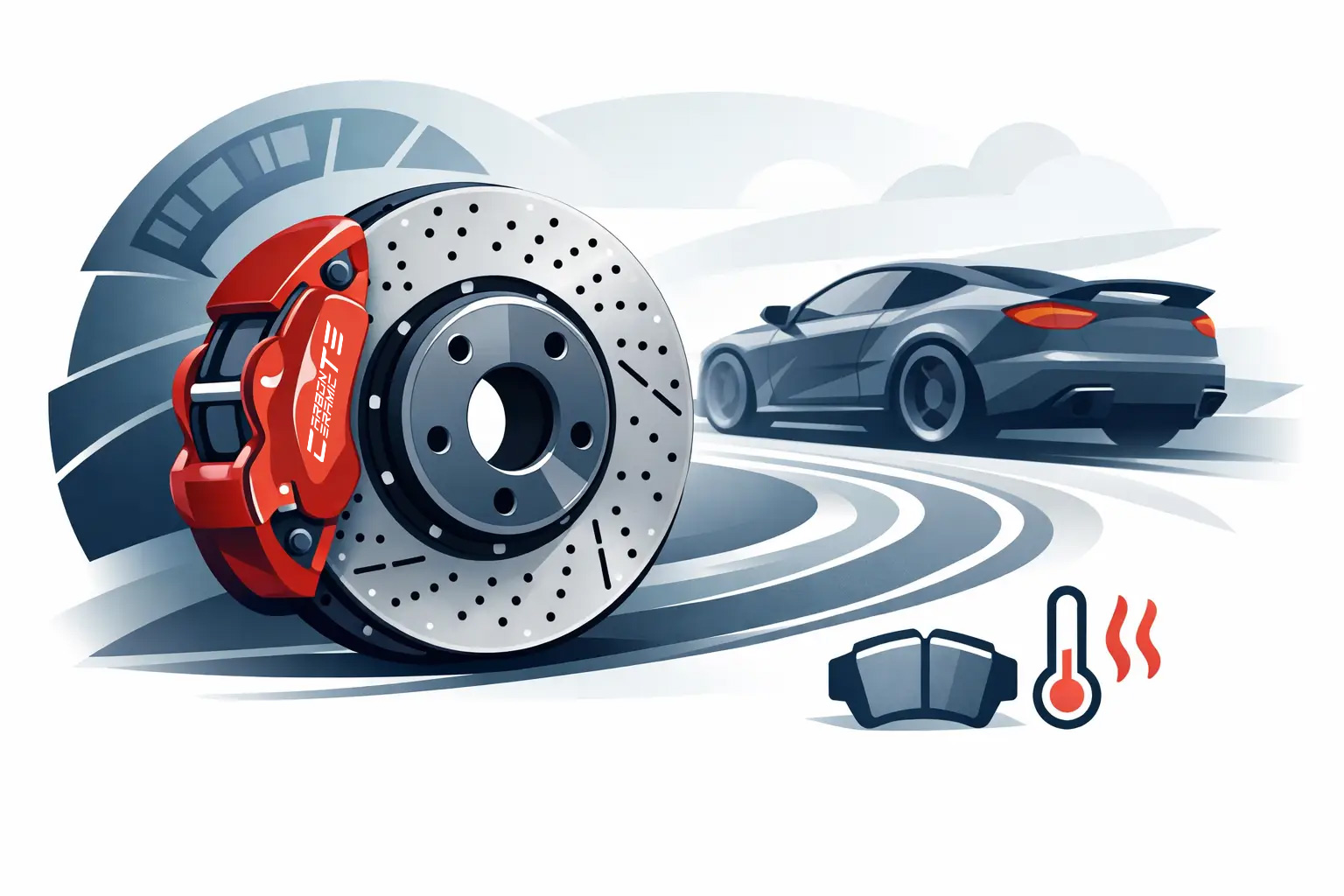
The moment a brake pedal goes soft after repeated hard stops, the conversation stops being about upgrades and becomes about control. A serious ceramic rotor review should answer one question before anything else: will this brake system remain predictable when heat, vehicle speed, and driver demand rise together?
For high-performance road cars, track-focused builds, and premium vehicle restorations, carbon ceramic rotors can deliver a meaningful advantage over conventional iron discs. They reduce unsprung and rotating mass, tolerate extreme temperatures, resist corrosion, and can provide exceptional service life in the right application. But carbon ceramic is not a universal answer. The rotor, pad compound, caliper, bracket design, brake balance, wheel clearance, and vehicle-specific engineering must work as one system.
What a Ceramic Rotor Actually Changes
A carbon ceramic rotor is typically built around a carbon-fiber-reinforced ceramic matrix, often using silicon carbide as a key material. This construction is fundamentally different from a cast-iron disc. Its lower density reduces mass at the wheel, which matters because wheels, tires, hubs, calipers, and rotors move with the suspension.
Less unsprung weight can help the suspension respond more accurately over rough pavement, curbing, and uneven track surfaces. Reduced rotational mass also means the drivetrain has less inertia to accelerate and decelerate. The effect is not a dramatic horsepower gain, but on a performance vehicle it contributes to a sharper, more controlled feel.
The larger benefit appears under thermal load. Iron rotors absorb and release heat effectively, but repeated high-energy braking can push an undersized or poorly matched iron system beyond its stable operating range. That is where pedal consistency, pad friction, and rotor condition begin to suffer. A properly engineered carbon ceramic system is designed to remain stable at temperatures that challenge conventional street-oriented brake packages.
That thermal resistance does not mean the system is immune to abuse. Brake fluid can still boil, pads can still be used outside their intended temperature window, and poor cooling airflow can still create problems. Carbon ceramic technology raises the ceiling. It does not remove the need for correct system design.
Ceramic Rotor Review: The Criteria That Matter
Performance buyers should be skeptical of any ceramic rotor evaluation that only talks about rotor weight or appearance. A premium rotor must be judged by the complete engineering package around it.
First, examine fitment accuracy. The disc must match the vehicle’s hub interface, offset, center bore, wheel mounting arrangement, and caliper location. Small dimensional errors can affect pad sweep, wheel clearance, runout, and brake balance. On applications such as Porsche, Tesla, BMW, Jaguar, Land Rover, Toyota Supra, Nissan GT-R, Defender, and supercar platforms, vehicle-specific design is not an optional detail. It is the difference between a brake kit that installs correctly and one that creates expensive clearance or drivability problems.
Second, evaluate the rotor’s effective diameter and thickness in relation to the caliper and pad. Increasing diameter adds mechanical leverage and can improve torque capacity. Rotor thickness influences thermal mass and stiffness. However, simply installing the largest rotor possible is not always the best approach. The system needs enough wheel clearance, an appropriate caliper piston area, and a pad shape that uses the friction surface correctly.
Third, look closely at the mounting architecture. Two-piece carbon ceramic assemblies commonly use an aluminum center hat connected to the friction ring. This approach can reduce weight and manage the different thermal expansion rates of dissimilar materials. The quality of the hat, hardware, drive interface, machining, and protective finish matters. Those are not cosmetic details. They affect durability, balance, and installation confidence.
Finally, consider the intended temperature window. A road-driven luxury SUV, a 700-horsepower GT car used for canyon runs, and a dedicated track car may all benefit from carbon ceramic braking, but they do not demand the same pad friction profile or cooling strategy. The correct setup depends on vehicle mass, tire grip, speed, track use, and driver behavior.
Where Carbon Ceramic Rotors Deliver Their Best Value
The strongest case for ceramic rotors is repeated, high-energy braking. Heavy premium vehicles, modified high-horsepower cars, and vehicles that see track work place substantial energy into the brake system. In these conditions, a carbon ceramic package can provide more consistent response and greater resistance to heat-related fade.
Weight reduction is also valuable on vehicles where handling precision matters. Replacing heavy iron rotors with carbon ceramic components can remove significant mass near each corner of the vehicle. A complete conversion may also include lightweight monobloc calipers, further reducing unsprung weight while increasing caliper stiffness.
Corrosion resistance is another practical advantage. Iron rotors can develop surface corrosion quickly in humid climates, after storage, or following winter exposure. Carbon ceramic friction rings do not rust in the same way. For premium vehicles that spend time parked, this can preserve appearance and reduce the rough first-stop sensation often associated with corroded iron discs.
Long-term wear can favor carbon ceramic systems, but only when the correct pads and operating conditions are used. A rotor’s life is tied to pad compatibility, installation quality, bedding procedure, contamination control, and whether the system has been damaged by impact or improper service. Buyers should view durability as a system outcome, not a promise attached to one component.
Trade-Offs a Good Review Should Not Ignore
Carbon ceramic braking is a specialized performance investment. Initial cost is higher than a conventional iron rotor and pad replacement. The material, manufacturing process, precision machining, and application-specific development all contribute to that price. For a commuter vehicle with modest power and no sustained heavy-braking use, a high-quality iron brake package may be the more rational choice.
Cold behavior also deserves an honest discussion. Modern carbon ceramic systems can work very well in normal street conditions when matched with the right pad compound, but pedal feel and initial bite may differ from an iron system. Some drivers prefer the immediate cold response of a street-focused iron setup. Others prioritize the lighter weight, clean appearance, and high-temperature composure of carbon ceramic components.
Noise is another variable. Brake squeal is influenced by pad formulation, rotor condition, caliper hardware, shims, temperature, and driving pattern. It is not exclusive to carbon ceramic brakes, nor is it always evidence of a defect. A well-engineered kit should minimize unwanted noise, but buyers should expect performance brakes to have different NVH characteristics than an OE comfort-focused system.
Ceramic friction rings must also be inspected correctly. Unlike iron discs, they are not evaluated primarily by rust, surface color, or a simple visual check for a lip. Service professionals should inspect for edge damage, cracks, abnormal wear patterns, hardware condition, and rotor mass or thickness according to the manufacturer’s specifications. Incorrect handling during wheel or brake service can cause costly damage.
Why Complete-System Engineering Is Non-Negotiable
A rotor cannot create stopping force alone. Clamping force comes from the caliper and hydraulic system. Friction comes from the pad and rotor interface. Thermal capacity depends on rotor geometry, airflow, and the total system’s ability to absorb and reject heat. Pedal feel depends on caliper rigidity, line expansion, fluid condition, and proper bleeding.
That is why piecemeal upgrades often disappoint. Installing a carbon ceramic rotor without a compatible caliper, mounting bracket, pad, and hydraulic match can compromise the very performance the buyer expects. A complete kit engineered for a specific platform provides a clearer path to correct rotor position, pad contact area, brake bias, wheel clearance, and installation procedure.
For distributors and performance workshops, manufacturer control also matters. CCYS completes approximately 90% of production in-house, from development and precision machining to quality management. Combined with IATF 16949 and ISO 9001 certification, that level of control supports consistency across the components that must perform together under severe braking loads.
Fitment and Installation Decide the Real Result
Before ordering, confirm the exact vehicle year, chassis, drivetrain, existing brake package, wheel diameter, wheel barrel profile, and intended use. A 20-inch wheel diameter does not automatically guarantee clearance. Spoke shape and inner-barrel geometry can interfere with calipers even when the rotor diameter appears compatible.
Installation should be handled with clean mating surfaces, correct torque procedures, approved hardware, and careful inspection of brake lines and fluid. New pads and rotors require a controlled bedding process to establish a stable transfer layer and consistent friction behavior. Skipping this step can lead to uneven deposits, vibration complaints, or reduced performance.
The best ceramic brake choice is not the most expensive component in isolation. It is the properly fitted system that gives a heavy, fast, or repeatedly driven vehicle the same decisive response at the end of a session as it had at the beginning. Specify the vehicle accurately, match the kit to the job, and treat braking hardware as the safety-critical engineering it is.