

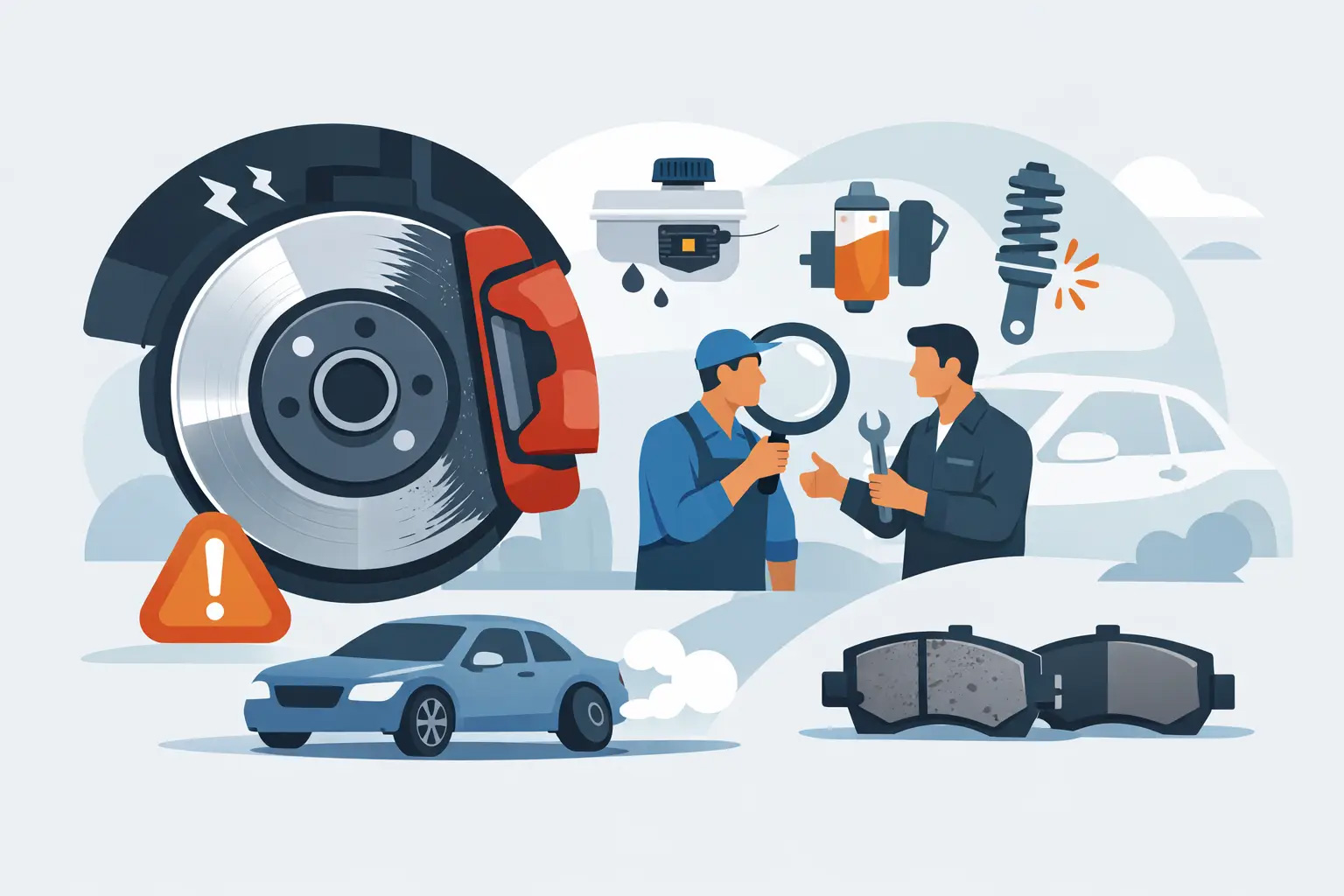
A vehicle that pulls under braking, develops a steering-wheel vibration, or consumes one pad far faster than the other is not giving you a minor maintenance reminder. It is signaling that brake force is no longer being applied or released evenly. So, what causes uneven brake wear? Usually, it is a mechanical, hydraulic, thermal, or installation problem that changes how the pad contacts the rotor.
For performance vehicles, uneven wear deserves immediate attention. A Porsche, BMW, Tesla, Nissan GT-R, or modified SUV can generate far more brake heat and load than an ordinary commuter vehicle. A small fault that might only shorten pad life on the street can become fade, instability, rotor damage, or reduced stopping confidence after repeated high-speed braking.
What Causes Uneven Brake Wear in a Brake System?
Brake pads are meant to wear gradually and predictably across their friction surface. The inner and outer pad should wear at a similar rate, and the left and right sides of an axle should remain reasonably close. Perfectly identical wear is not always realistic, especially on vehicles with electronic brake distribution, staggered use, or track driving. Large differences, tapered pads, deep grooves, cracked friction material, or one pad worn to the backing plate are not normal.
The root cause is often not the pad itself. Pads reveal the condition of the complete braking system: caliper movement, piston operation, rotor condition, brake fluid behavior, hub runout, wheel bearing integrity, and suspension geometry all influence the contact patch between pad and disc.
Seized Caliper Pistons and Sticking Slide Pins
A caliper must apply pressure evenly and release cleanly when the driver lifts off the pedal. If a piston binds because of corrosion, damaged seals, contaminated fluid, or heat-related damage, it can hold one pad against the rotor. That pad then overheats and wears rapidly, while the rotor may show blue heat marks, cracking, or a heavily polished band.
Floating calipers rely on slide pins or guide pins to center the caliper body. When those pins lose lubrication, corrode, or bind in their bores, the outer and inner pads will not receive equal clamping force. A common pattern is one inner pad significantly thinner than the outer pad, or the reverse depending on the failure point.
This is not a problem to solve by fitting pads only. Replacing friction material without restoring caliper movement risks damaging the new pads and rotors almost immediately. The caliper must be inspected, rebuilt, or replaced as required, with correct high-temperature lubricant used only where the manufacturer specifies.
Rotor Runout, Disc Thickness Variation, and Poor Hub Preparation
A rotor must rotate true relative to the hub. Rust, paint, debris, or burrs trapped between the rotor hat and hub face can create lateral runout. Even a small mounting error can cause the disc to sweep side to side as it rotates, repeatedly pushing the pads back and changing their contact pattern.
Over time, this can contribute to disc thickness variation, pedal pulsation, uneven transfer layers, and tapered pad wear. The driver may describe the issue as warped rotors, but the underlying cause is often runout, hub contamination, incorrect wheel torque, or a hub and bearing assembly that is no longer running true.
Professional installation matters here. The hub face should be clean and measured where appropriate, rotor runout should be checked with a dial indicator, and wheel bolts or lug nuts should be torqued in the proper sequence and specification. On premium and high-performance platforms, shortcuts at the hub can undermine an otherwise excellent brake package.
Overheating and Incorrect Pad-to-Rotor Matching
Excessive heat changes both the pad and rotor surface. A pad compound operated beyond its intended temperature range can smear, glaze, crumble at the edges, or deposit friction material unevenly across the disc. This produces inconsistent bite and can make wear appear patchy from one section of the pad to another.
Repeated hard stops with inadequate cooling create the same risk. Track use, mountain driving, towing, heavy vehicles, aggressive street driving, and repeated high-speed deceleration all raise rotor temperature quickly. Standard road pads may not tolerate that environment, while a racing-oriented compound may need more heat than typical street driving provides to work cleanly and consistently.
The right system is always application-dependent. Larger rotors, properly sized calipers, thermal-resistant discs, suitable friction compounds, and correct brake cooling work together. Fitting a high-friction pad to an undersized or poorly ventilated setup may increase initial bite, but it can also accelerate heat stress and uneven wear.
Brake Hose Restrictions and Hydraulic Imbalance
A damaged flexible brake hose can fail internally. The outer hose may look intact, yet the inner liner can restrict fluid flow. In some cases, pressure reaches the caliper when braking but does not release efficiently afterward. The result resembles a seized caliper: drag, heat, odor, rapid wear, and one wheel noticeably hotter than the others.
Hydraulic imbalance can also stem from contaminated brake fluid, an improperly functioning master cylinder, or faults within electronically controlled braking systems. These issues are less common than sticking calipers or slides, but they should not be ignored when mechanical inspection does not explain the wear pattern.
A workshop should compare wheel temperatures after a controlled road test, inspect for drag with the vehicle safely lifted, and evaluate fluid condition. Brake fluid that has absorbed moisture lowers its boiling point and can contribute to inconsistent pedal behavior under high temperature. For performance applications, fluid service intervals should reflect actual driving demand, not just mileage.
Suspension and Chassis Problems That Affect Brake Wear
Uneven brake wear is sometimes blamed on braking hardware when the real contributor is chassis movement. Worn control arm bushings, ball joints, tie-rod ends, wheel bearings, or stabilizer links can allow the wheel to shift under braking. That movement changes the relationship between pad, rotor, and caliper during the highest-load moment of a stop.
A loose wheel bearing can create runout under load. Excessive bushing compliance can make the vehicle unstable while also increasing uneven tire and brake wear. On lowered, modified, or track-driven vehicles, alignment settings and suspension travel must be considered alongside the brake inspection.
This is particularly relevant when a new brake kit is installed on an older chassis. High-performance calipers and carbon ceramic rotors can reduce unsprung weight and manage heat at a far higher level, but they cannot compensate for a hub, bearing, or control arm that no longer holds the wheel precisely in position.
Installation Errors That Create Immediate Wear Problems
Incorrect installation can cause uneven wear from the first drive. Pads installed in the wrong position, anti-rattle hardware fitted incorrectly, damaged pad shims, improperly seated caliper brackets, or missing retaining hardware can prevent free movement. Grease or brake fluid on the friction surface can create hot spots and uneven deposits.
Bedding procedure also matters. New pads and rotors need controlled heat cycles to establish a stable transfer layer. Hard stops before proper bedding, or gentle use that never reaches the required operating temperature, can produce poor contact and inconsistent performance. Follow the specifications for the exact rotor and pad combination rather than applying a generic process.
For carbon ceramic systems, correct fitment is especially critical. Rotor direction, hardware torque, pad compound compatibility, and caliper centering should all be verified before the vehicle returns to demanding road or track use.
How to Read the Wear Pattern
The location and shape of wear provide useful diagnostic evidence. An inner pad much thinner than the outer pad often points to a seized piston or slide issue. An outer pad worn more aggressively can indicate restricted caliper movement. Tapered friction material suggests caliper misalignment, loose mounting hardware, or movement in the hub and suspension.
Glazing, discoloration, cracking, and crumbling point toward heat overload or an unsuitable friction pairing. Grooves in the rotor may indicate debris embedded in the pad, worn material contacting the disc, or damage carried over from a previous pad failure. If one wheel is dramatically hotter after normal driving, treat it as a brake-drag concern until proven otherwise.
Do not rely on visual inspection through the wheel alone. Remove the pads, measure thickness at multiple points, inspect both rotor faces, and compare components across the axle. A proper diagnosis is more cost-effective than repeatedly replacing pads and discs without correcting the source of the imbalance.
Restore Brake Performance Before Replacing Parts
Uneven brake wear is a system-level warning. Inspect caliper operation, slide movement, hoses, rotors, hub faces, bearings, fluid, suspension joints, and installation quality before selecting replacement components. Then choose parts that match vehicle weight, wheel fitment, road use, track temperature, and expected braking load.
For workshops and performance builders, complete vehicle-specific systems reduce compatibility guesswork. CCYS supports this approach with racing-grade carbon ceramic brake systems, supporting chassis components, and factory-controlled manufacturing built around consistent fitment and thermal performance. Address the fault, verify the entire system, and let every hard stop feel controlled rather than uncertain.