

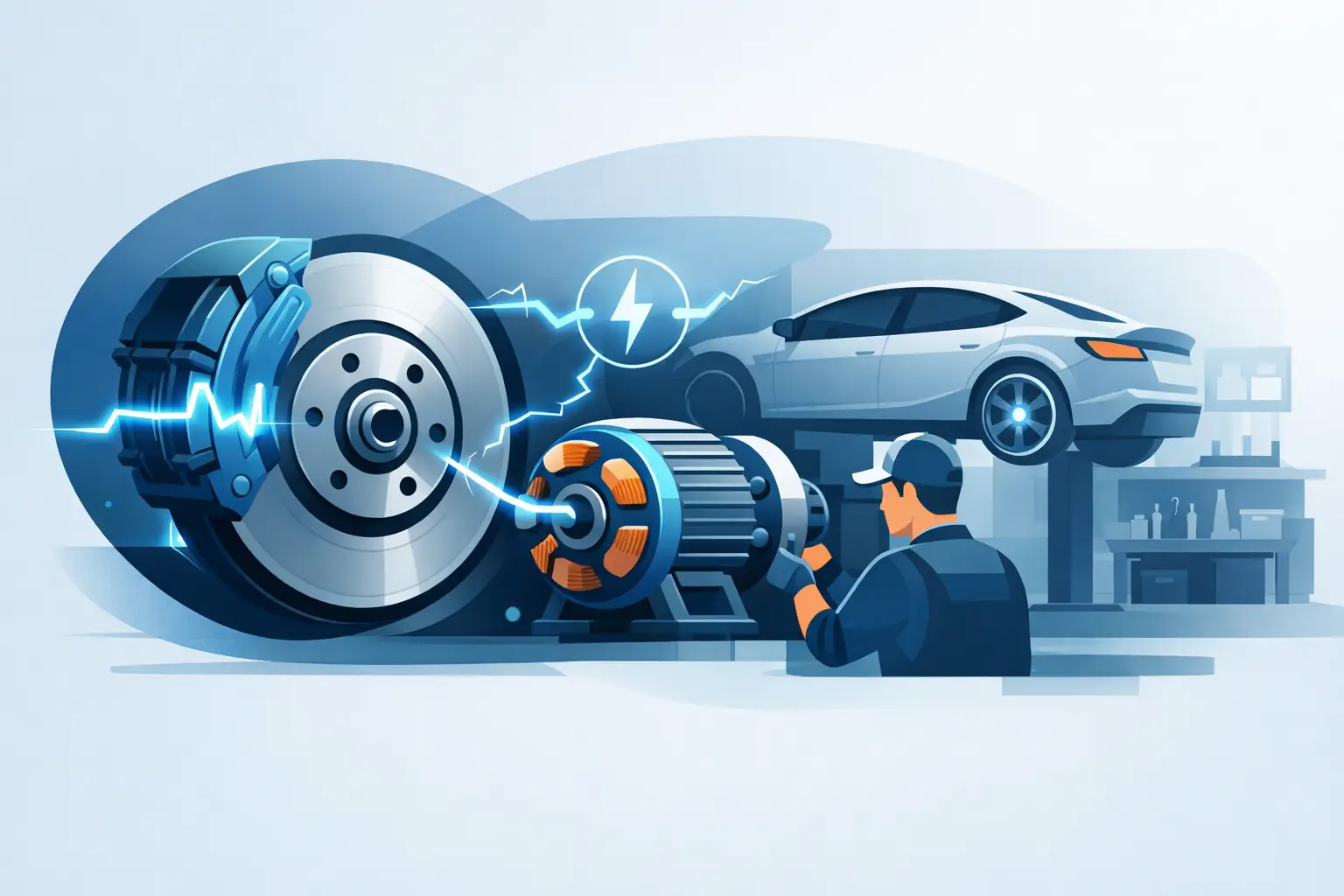
A hard stop should never become a software surprise. On modern EVs, hybrids, and increasingly advanced performance vehicles, electric braking changes how deceleration is requested, delivered, and monitored. The driver still expects a firm pedal and repeatable stopping power. Behind that pedal, however, regenerative braking, hydraulic friction brakes, electronic boosters, sensors, and control modules may all be working at once.
For performance workshops and distributors, that changes the upgrade conversation. A larger rotor, lighter disc, or racing-grade caliper cannot be treated as an isolated hardware swap. The brake system must retain correct geometry, electronic communication, parking-brake operation, and vehicle-specific safety functions while improving thermal capacity and confidence under repeated heavy use.
What Electric Braking Actually Means
Electric braking is often used as a catch-all term, but it can describe several different systems. The first is regenerative braking. In an EV or hybrid, the drive motor becomes a generator during deceleration, converting vehicle motion into electrical energy that returns to the battery. This reduces reliance on friction brakes during normal driving.
The second is brake-by-wire or electronically controlled braking. Here, pedal input is measured electronically and interpreted by a brake control unit. An electric brake booster may generate hydraulic pressure, while a pedal simulator creates a natural pedal response. The system then blends regenerative deceleration with hydraulic braking according to grip, speed, battery condition, vehicle stability requirements, and driver demand.
The third is the electric parking brake, which uses an electric actuator at the rear caliper or a separate mechanism. It is not the same as regenerative or brake-by-wire control, but it is a critical fitment consideration when upgrading rear brakes.
These systems still depend on friction components. Rotors, pads, calipers, brackets, hoses, hubs, and mounting hardware remain responsible for the heat management and clamping force required when regeneration is reduced, unavailable, or insufficient.
Why Friction Brakes Still Decide the Hard Stop
Regeneration is efficient, but it is not unlimited. Battery state of charge, battery temperature, motor speed, traction conditions, and system programming can all reduce regenerative braking. A fully charged battery may accept little additional energy. Cold conditions can restrict charging. At lower speeds, motor-based deceleration also becomes less effective, so the hydraulic brake system takes over.
That handoff matters most when the vehicle is driven hard. Repeated threshold braking on a canyon road, a heavy SUV descending a grade, or an EV entering a track braking zone places a different demand on the friction system than relaxed commuting. The system must deliver consistent torque despite high rotor temperatures, changing axle loads, and limited opportunities for cooling.
This is where lightweight carbon ceramic braking can offer a meaningful engineering advantage for the correct application. Carbon ceramic discs can reduce unsprung and rotating mass while offering strong thermal resistance. The benefit is not simply a larger component or an exotic material. It is a system designed to maintain predictable braking behavior as temperatures rise.
There is a trade-off. Carbon ceramic systems require proper pad compounds, compatible hardware, controlled manufacturing tolerances, and vehicle-specific calibration awareness. They are not a universal answer for every fleet vehicle or budget-oriented repair. For premium road cars, supercars, track-focused builds, and heavy high-performance platforms, the performance case is much stronger when the complete system is engineered around the vehicle.
The Upgrade Risk Is Usually Integration
A modern vehicle can detect more than many installers expect. Wheel-speed sensors support ABS, traction control, stability control, brake-force distribution, and driver-assistance functions. Brake pressure sensors and pedal-travel signals may be used by the electronic booster and brake controller. A small change in rotor offset, tone-ring position, sensor clearance, or hub geometry can create faults that have nothing to do with the quality of the caliper itself.
The rear axle deserves especially close attention. Electric parking brake motors, actuator locations, pad retraction requirements, and service procedures vary by platform. A rear performance kit must preserve clearance and operation rather than merely provide a mounting point for the caliper.
Brake balance is equally important. Increasing front brake torque without considering the rear system, tire grip, hydraulic pressure behavior, and ABS intervention can change how the vehicle behaves at the limit. A well-designed kit considers piston area, effective rotor radius, pad friction characteristics, bracket stiffness, and heat capacity as connected variables.
For workshops, the practical question is not, “Will this caliper fit behind the wheel?” It is, “Will this complete system operate correctly through every braking mode the vehicle uses?” That includes low-speed stops, emergency braking, stability-control intervention, regenerative blending, parking-brake activation, and repeated high-temperature use.
Fitment Checks Before Selling or Installing
Vehicle-specific application data is the starting point, not an afterthought. Confirm the exact model year, drivetrain, brake package, wheel diameter, wheel barrel profile, hub specification, and electronic parking-brake configuration. A platform name alone is rarely enough, particularly across Tesla, Porsche, BMW, Jaguar, Land Rover, Toyota Supra, Nissan GT-R, Defender, and supercar applications where factory brake options can differ substantially.
Then inspect the required clearances. Rotor diameter and thickness matter, but so do disc offset, hat design, caliper envelope, spoke shape, suspension travel, and steering lock. The wheel may be the limiting component even when its nominal diameter appears sufficient.
Electronic service procedures must also be planned before installation. Some electric parking brakes require a diagnostic service mode before retracting or replacing pads. Certain vehicles need fault-code checks or relearn procedures after brake work. For electronically boosted systems, correct bleeding procedures are particularly important because trapped air or an incomplete electronic bleed cycle can compromise pedal feel and system performance.
After installation, verify wheel rotation, sensor routing, hose movement at full steering lock, fastener torque, rotor runout, pad bedding, and warning-light status. A road test should confirm linear pedal response and stable deceleration before any high-load use. Track testing is not a substitute for disciplined installation control.
Pedal Feel Is an Engineering Outcome
Drivers often describe a brake system as “good” or “bad” based on the first inch of pedal travel. In an electric braking system, that sensation may be shaped by software, a pedal simulator, hydraulic pressure generation, pad friction, caliper stiffness, rotor surface condition, and tire grip. That is why pedal feel cannot be judged by component size alone.
A larger caliper can improve thermal capability and clamping distribution, but its piston sizing must suit the master cylinder or electronically controlled hydraulic unit. An aggressive pad may provide a stronger initial bite, yet it can introduce noise, dust, cold-performance compromises, or less progressive modulation. For a street-driven performance EV, the best answer may differ from a dedicated track car.
The objective is controlled confidence. The driver should be able to apply light pressure smoothly in traffic, then demand repeatable braking force at speed without fade, instability, or unexpected intervention. Engineering for that range is more valuable than pursuing a single headline number.
What Professional Buyers Should Demand From a Brake Supplier
Electric and high-performance braking applications reward suppliers with real control over the product. Distributors and workshops should look beyond surface finish and claimed rotor size. Ask how the disc, caliper, bracket, pads, and hardware are developed as a system. Ask whether fitment is documented, whether replacement components are available, and whether technical support understands electronic parking-brake and platform-specific installation issues.
Manufacturing control matters because braking components operate under high load, high heat, and direct safety responsibility. CCYS completes 90% of production in-house, combining carbon ceramic specialization with precision machining, quality management, and complete braking-system support. IATF 16949 and ISO 9001-certified processes provide meaningful assurance for buyers who need consistent products rather than one-off performance claims.
A manufacturer warranty also has practical value. It signals that the supplier stands behind materials, machining, fitment discipline, and the components required to keep the system serviceable over time.
Build for the Braking Modes the Vehicle Will Actually Use
The strongest electric braking upgrade is not the one with the most dramatic appearance. It is the system that works correctly when regeneration is limited, when the battery is full, when the road is wet, when the vehicle is heavily loaded, and when the driver asks for repeated maximum deceleration.
Choose hardware by vehicle use, verify every electronic and mechanical interface, and insist on application-specific engineering. When the next hard stop arrives, there should be no uncertainty about what happens after the driver presses the pedal.