

A hard stop should feel controlled, immediate, and repeatable. If the pedal goes long after a few high-speed braking events, the steering wheel shakes under load, or a heavy vehicle needs more distance than expected to slow down, the issue is rarely one component alone. A serious brake hardware review evaluates the entire system: rotor mass, caliper rigidity, pad compound, mounting accuracy, hydraulic balance, and the small installation parts that keep every component working as designed.
For performance workshops, distributors, and owners of premium vehicles, braking hardware is not an area to treat as a cosmetic upgrade. The correct system must produce confident stopping force while surviving heat cycles, road contamination, vehicle weight, and repeated use without compromising fitment or serviceability.
What a Brake Hardware Review Must Measure
A useful review starts with the vehicle's actual duty cycle. A Porsche used for weekend canyon driving needs a different brake package than a Tesla carrying substantial curb weight and instant torque, or a Nissan GT-R that sees regular track sessions. A Land Rover Defender and a supercar may both benefit from thermal-resistant hardware, but their rotor sizing, caliper clearance, pad selection, and expected load transfer are fundamentally different.
The key question is not whether a component looks racing-inspired. It is whether the system has been engineered around the vehicle's weight, wheel package, suspension geometry, braking demand, and intended use. Hardware that performs well during one isolated stop may still lose consistency when temperatures rise, pads wear, or repeated stops load the rotors beyond their effective operating range.
A complete assessment should examine stopping consistency, fade resistance, pedal feel, unsprung weight, durability, and vehicle-specific installation accuracy. These factors work together. A larger rotor may provide greater leverage and heat capacity, for example, but its benefit can be reduced by an incompatible pad compound, a poorly designed bracket, or a caliper that does not maintain even pressure across the pad face.
Rotor Construction Is the First Thermal Decision
Rotors absorb and release the energy created during braking. Under hard use, this is where weak systems show their limits first. Excessive heat can lead to pad fade, fluid stress, uneven deposits, surface cracking, vibration, and accelerated wear. The result is not just a slower lap or less responsive pedal. It is reduced driver confidence when braking distance matters most.
Cast-iron rotors remain practical for many street and performance applications because they are widely available, cost-effective, and serviceable. Their trade-off is mass. More weight at the wheel affects acceleration, suspension response, steering precision, and the workload placed on the damper over broken pavement.
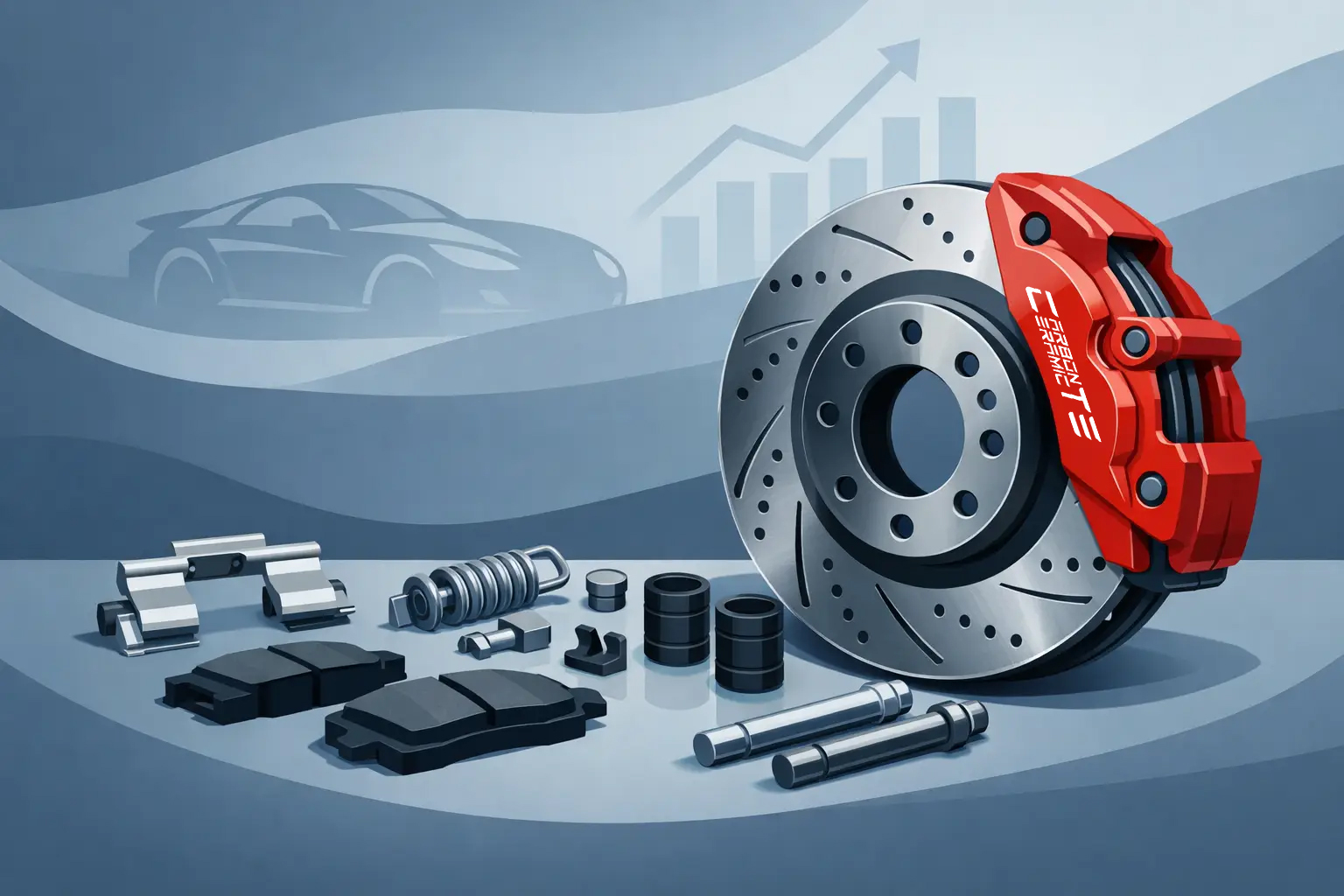
Carbon ceramic rotors address a different set of priorities. Their lower weight can reduce unsprung and rotational mass, while their material properties support strong resistance to high-temperature braking demands. They are especially relevant for premium performance vehicles, track-oriented builds, and drivers who need repeatable braking without carrying the mass penalty of a conventional large iron setup.
That does not mean carbon ceramic is automatically the right answer for every vehicle. The investment is higher, and pad selection, bedding procedure, fitment, and operating conditions must be correct. A system designed around carbon ceramic material needs compatible calipers, pads, hats, brackets, and thermal clearances. Treating the rotor as a standalone upgrade is a common and expensive mistake.
Check More Than Rotor Diameter
Diameter gets attention because it is easy to market, but it is only one performance variable. Thickness, internal vane design, friction-ring construction, rotor hat design, mounting method, and effective swept area all affect how a rotor behaves under load.
A larger disc can improve braking leverage, but sufficient thickness and airflow are necessary to manage heat. A precision-machined hat must also maintain correct offset and wheel clearance while allowing the friction ring to expand through temperature cycles. On a vehicle with tight wheel packaging, millimeters matter. Incorrect offset can create caliper interference, poor pad alignment, or uneven rotor wear.
For distributors and workshops, the strongest rotor evaluation includes documented vehicle application, wheel compatibility, service limits, and installation specifications. Guesswork is not a fitment strategy.
Calipers Need Rigidity, Balance, and Service Access
Calipers convert hydraulic pressure into clamping force. Their job sounds simple, but their design has a direct effect on pedal response, pad wear, and brake modulation. A rigid monobloc caliper resists flex under pressure, helping the driver receive a more direct pedal signal during threshold braking.
Piston count alone is not a quality measure. A six-piston caliper is not inherently superior to a four-piston design if piston sizing, fluid volume, pad geometry, and master-cylinder compatibility are wrong. The caliper must distribute pressure evenly across the pad while preserving appropriate front-to-rear brake balance.
A well-engineered performance caliper should provide accurate mounting geometry, durable seals, thermal management around the pistons, and practical access for inspection and pad changes. On a track-focused vehicle, fast pad servicing matters. On a road-driven luxury vehicle, resistance to corrosion, noise control, and long-term reliability may carry equal weight.
The caliper bracket deserves the same scrutiny. It must be precision-machined for the application, strong enough to maintain alignment under repeated load, and designed around the rotor's exact diameter and offset. An otherwise capable caliper cannot compensate for a bracket that shifts pad position or creates uneven contact.
Pads and Installation Hardware Complete the System
Pads determine much of what the driver feels. Initial bite, modulation, temperature range, dust, noise, rotor wear, and fade behavior are heavily influenced by friction material. Aggressive track compounds can deliver strong high-temperature performance but may be noisy, dusty, and less effective during cold street operation. A road-focused compound may offer excellent daily control but lose consistency during repeated high-energy stops.
The right choice depends on how the vehicle is driven. A dual-purpose BMW or Toyota Supra may need a balanced performance compound. A dedicated track car can justify a more aggressive material, provided its rotor and caliper system are engineered for it. The goal is a matched friction package, not the highest advertised friction number.
Small parts also deserve attention. Anti-rattle clips, pad retaining pins, shims, guide hardware, brake lines, fasteners, and sensors influence reliability and refinement. Reusing worn hardware can introduce noise, movement, uneven pad wear, or unreliable retention. For complete brake-kit installations, every mounting component should be supplied, specified, and installed to the correct torque requirement.
Brake fluid is part of this conversation as well. High-performance hardware cannot overcome fluid that has absorbed moisture or reached its thermal limit. A soft pedal after hard driving may point to fluid boil, but diagnosis should also include pad condition, caliper movement, rotor temperature, and hydraulic-system health.
Manufacturing Control Separates Hardware From Claims
Performance braking components operate under enormous thermal and mechanical stress. Material inconsistency, poor machining tolerance, weak coatings, or incomplete quality control can turn a promising design into a warranty issue or a safety risk.
For buyers evaluating a supplier, manufacturing capability matters as much as catalog coverage. Look for evidence of in-house engineering, precision machining, controlled assembly, documented inspection, and recognized quality systems such as IATF 16949 and ISO 9001. These are not marketing decorations. They support repeatable production, traceability, and a process for preventing defects before components reach a workshop or customer vehicle.
CCYS maintains control over 90% of its production in-house, supporting consistency across carbon ceramic brake kits, rotors, monobloc calipers, pads, and related chassis components. That level of control is particularly valuable when supplying vehicle-specific systems where rotor offset, hub interface, bracket geometry, and wheel clearance must align without compromise.
A manufacturer warranty and technical support should also be part of the review. Performance shops need answers before installation, not after a vehicle is on the lift. Clear application data, installation guidance, service information, and responsive technical communication protect both the installer and the vehicle owner.
Brake Hardware Review: Questions Before You Buy
Before specifying a kit or stocking a braking line, establish the vehicle platform, wheel diameter, intended driving conditions, existing modifications, and desired pedal characteristics. Confirm whether the package includes rotors, calipers, pads, brackets, lines, hardware, and any required sensors or adapters. A complete kit eliminates the uncertainty created when parts from different suppliers are expected to work together.
Ask how the system manages heat, what pad compounds are approved, and whether replacement components will remain available. Also confirm clearance around wheels, suspension arms, and brake hoses. On modified vehicles, changes to wheel offset, hub assemblies, control arms, or suspension travel can affect a brake conversion even when the catalog application is correct.
The best braking decision is made before the first fast stop. Match the hardware to the vehicle, verify the engineering behind every mounting surface and friction component, and insist on fitment information that a professional installer can trust. When the road tightens or the braking zone arrives sooner than expected, that preparation becomes the difference between hoping the system performs and knowing it will.