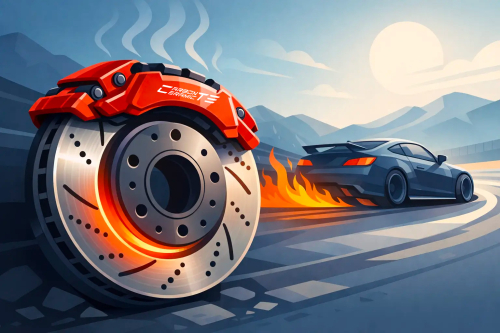
The worst brake problem does not announce itself in the driveway. It appears at the end of a fast straight, on a loaded mountain descent, or during the fifth hard stop when the pedal no longer feels connected to the vehicle’s speed. Performance brakes are built for that moment: to provide controlled, repeatable deceleration when factory components have reached their thermal and mechanical limits.
For performance workshops, distributors, and owners of premium vehicles, the right upgrade is not simply a larger caliper or an aggressive-looking rotor. It is a complete system engineered around heat management, clamping force, pedal consistency, unsprung weight, pad behavior, and vehicle-specific fitment. Get those elements right, and the driver gains confidence without compromising the quality expected of a serious road or track-focused build.
What Performance Brakes Must Deliver
A brake system converts kinetic energy into heat. Under normal commuting conditions, most original-equipment brake systems can manage that work effectively. The challenge changes when vehicle speed rises, vehicle weight increases, tire grip improves, or heavy stops occur repeatedly with little cooling time.
Performance brakes must do more than produce a strong first stop. They need to maintain stopping force across repeated braking events. That means resisting brake fade, controlling disc temperatures, keeping the pedal predictable, and returning to a stable operating condition quickly. For a Porsche on a track day, a Tesla carrying significant battery mass, or a tuned BMW making more power than stock, repeatability is often more valuable than a single headline stopping-distance number.
The system must also preserve balance. Excessive front braking bias can make a vehicle unstable under hard deceleration, while insufficient front capacity can overwork pads and rotors. Caliper piston sizing, pad area, rotor diameter, rotor thickness, and friction material all affect the final result. This is why a vehicle-specific kit is a fundamentally different proposition from fitting isolated brake parts with no system-level engineering behind them.
Why Heat Is the Main Enemy
Heat is unavoidable. Poor heat control is not.
As brakes operate beyond their designed temperature range, the friction coefficient of the pad can change. The driver may need more pedal force for the same deceleration, pedal travel can increase, and braking response may become inconsistent. In severe cases, rotor surface damage, pad glazing, fluid boiling, and seal deterioration can follow. A fast car with fading brakes is not merely frustrating. It is a safety risk.
Rotor mass and material determine how much heat the system can absorb, while internal vane design and airflow determine how effectively it can release that heat. Larger discs increase leverage at the wheel and can provide more thermal capacity. However, bigger is not automatically better. The added rotating mass, wheel clearance requirements, brake bias implications, and caliper placement must all be evaluated for the specific platform.
Carbon ceramic systems take a different approach. Their material properties can deliver exceptional thermal resistance, corrosion resistance, and weight reduction compared with conventional iron systems. Lower rotor weight also reduces unsprung and rotating mass, which can support suspension response and steering feel. On premium road cars, supercars, and demanding high-performance applications, those advantages can be meaningful well beyond appearance.
There are trade-offs. Carbon ceramic brakes require properly matched pads, calipers, brackets, and installation procedures. Pad selection influences cold response, noise, wear characteristics, and track temperature capability. A system intended for repeated high-load use should not be specified only for quiet commuting behavior, just as an aggressive race compound may not suit every street-driven vehicle. The best choice depends on how the vehicle is actually used.
The Engineering Behind a Complete Brake Kit
A complete brake upgrade should be treated as a controlled assembly, not a collection of oversized parts. The caliper must mount precisely, maintain correct disc centering, and apply pressure evenly across the pad. The rotor must work with the hub, hat, and wheel package while allowing for thermal expansion. Brake lines, mounting hardware, pad compounds, and brake fluid all contribute to the system’s final behavior.
Monobloc Calipers and Clamping Stability
A monobloc caliper is machined from a single piece of material rather than assembled from two bolted halves. This construction can improve rigidity and reduce flex under high hydraulic pressure. For the driver, caliper rigidity supports a firmer, more consistent pedal feel because more of the hydraulic force is directed into pad clamping rather than caliper deflection.
Piston layout matters as much as caliper size. Multiple pistons can distribute pressure more evenly across the pad surface, helping manage wear and supporting stable friction under load. The goal is not the highest piston count on a specification sheet. It is controlled, even pressure matched to the rotor and the vehicle’s required brake balance.
Rotors, Hats, and Unsprung Weight
Two-piece rotor designs separate the friction disc from the center hat. This architecture can reduce weight and allow each component to use the material best suited to its role. It also supports accurate fitment and serviceability in systems designed for demanding use.
Weight at the wheel has a direct effect on vehicle dynamics. Reducing unsprung mass can help the suspension react more effectively to surface changes, particularly on performance cars with precise damping and tire packages. Carbon ceramic rotors can offer a major advantage here, but only when their durability, thermal behavior, and hardware interfaces are validated as a complete system.
Pads and Fluid Cannot Be Afterthoughts
A high-capacity rotor cannot compensate for an unsuitable pad compound or degraded brake fluid. Pads must deliver predictable friction across the intended temperature range. Fluid must maintain a sufficiently high boiling point under repeated braking. Installation must also eliminate air from the hydraulic system and follow the correct bedding procedure.
Bedding establishes a stable transfer layer between the pad and rotor surface. Skipping it can create uneven deposits, vibration, poor initial response, and reduced component life. A quality brake kit deserves the same disciplined setup process as an engine calibration or suspension alignment.
Fitment Is a Safety Requirement, Not a Sales Detail
Premium vehicle platforms leave little room for approximation. Wheel spoke design, barrel diameter, hub dimensions, electronic parking brake configuration, brake-line routing, and factory electronic systems can all influence compatibility. A kit that fits one wheel design may not clear another wheel with the same nominal diameter.
Professional buyers should verify the full application, including model year, trim, drivetrain, wheel size, and intended use. This is especially relevant for platforms such as Porsche, Tesla, BMW, Jaguar, Land Rover, Toyota Supra, Nissan GT-R, Defender, and supercars, where performance variants may use different hubs, offsets, suspension layouts, and factory braking configurations.
Fitment documentation should be supported by manufacturing discipline. CCYS controls approximately 90% of production in-house across research and development, precision machining, and quality management, supported by IATF 16949 and ISO 9001 certifications. For distributors and workshops, that level of control matters because consistent dimensions, material handling, and inspection processes reduce the risk of costly installation problems and inconsistent field performance.
Match the System to the Vehicle’s Real Job
A street-driven luxury SUV that occasionally tows or descends steep grades has different braking priorities than a dedicated time-attack car. The SUV may benefit most from thermal stability, durable components, corrosion resistance, and low-noise behavior. The track car may prioritize low weight, fade resistance, cooling capacity, and rapid inspection between events.
Tires also set a practical limit. Brakes can create clamping force, but tires must convert that force into deceleration. If the vehicle is fitted with low-grip tires, worn tires, or an incorrect tire pressure setup, even the most capable brake hardware cannot deliver its full potential. Suspension condition matters too. Worn control arms, ball joints, bushings, stabilizer links, or tie-rod ends can compromise stability during braking and mask the benefit of a properly engineered brake system.
That is why experienced workshops assess the vehicle as a whole. Brakes, tires, chassis components, wheel alignment, and driver use form one dynamic package. A correctly selected system makes the entire vehicle feel more composed as speed rises and braking zones get shorter.
Choose Proof Over Promises
Performance braking claims are easy to make. The evidence worth evaluating is more concrete: material specification, tested fitment, production control, documented quality standards, warranty support, replacement-part availability, and technical assistance when a workshop needs answers.
For distributors, a complete portfolio also matters. Access to carbon ceramic rotors, brake pads, monobloc calipers, hubs, installation accessories, and supporting chassis parts makes it easier to build a coherent solution instead of sourcing critical components from unrelated suppliers. It improves purchasing efficiency and gives customers a clearer path from diagnosis to installation.
The right brake upgrade should make a driver less aware of the system, not more. When speed builds, road conditions change, and heat rises, the pedal should remain firm, predictable, and ready for the next stop. Start with the vehicle, its duty cycle, and verified fitment, then specify the brake system with the same seriousness you apply to power, tires, and suspension.