

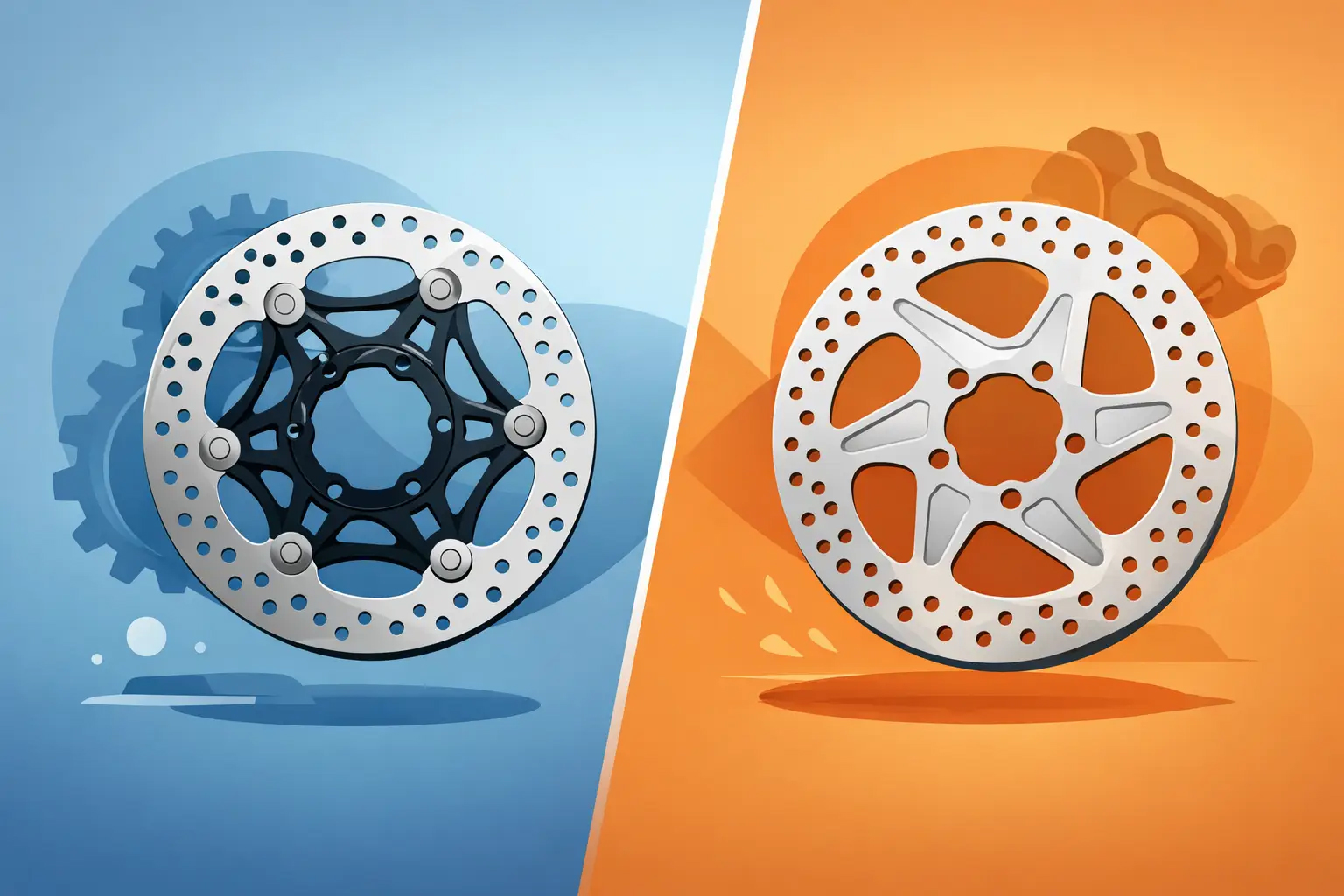
A brake pedal that goes long after a few hard stops is not a minor inconvenience. On a heavy SUV, a high-horsepower street car, or a track-driven coupe, it is the warning that heat has exceeded the system’s ability to remain consistent. The decision between floating rotors versus fixed rotors directly affects how a brake system manages expansion, maintains pad contact, and performs through repeated high-energy stops.
The right answer is not automatically the more expensive rotor. It depends on vehicle weight, intended use, caliper design, wheel clearance, operating temperatures, and the service expectations of the owner or workshop. For professional installers and performance buyers, understanding the engineering difference prevents mismatched components and supports a brake package that performs as intended.
What “Floating” and “Fixed” Actually Mean
A fixed rotor is generally a one-piece brake disc. Its friction ring and mounting hat are cast or machined as one component, so the rotor mounts directly to the wheel hub with no independent movement between those sections. This is the standard arrangement on most factory vehicles because it is cost-effective, durable, quiet, and simple to service.
A floating rotor, often called a two-piece floating disc, separates the friction ring from the center hat. The two sections are connected with drive pins, bobbins, or similar mounting hardware. These connectors transmit braking torque while allowing the iron or carbon ceramic friction ring to expand independently as temperatures rise.
That controlled movement is the point. A rotor is not static under heavy braking. The friction surfaces absorb enormous heat, and their outer diameter grows as temperatures climb. If the ring cannot relieve that thermal expansion, stress can build inside the disc. In severe use, that stress can contribute to distortion, cracking, uneven pad deposits, or pedal feedback that feels like rotor runout.
A common source of confusion is the floating caliper. A floating caliper moves laterally on guide pins, while a floating rotor allows movement between the rotor ring and hat. They are separate design concepts. A brake system can use a fixed multi-piston caliper with a floating rotor, or a floating caliper with a fixed one-piece rotor.
Floating Rotors Versus Fixed Rotors Under Heat
Heat management is where floating rotors show their strongest advantage. During repeated hard braking, the friction ring becomes much hotter than the center hat and wheel hub. A floating connection gives the ring room to expand without forcing the hat to absorb all of that movement.
This reduces thermal stress at the mounting area and helps preserve a more stable friction surface. For track sessions, mountain descents, towing applications, and high-speed road driving, that can mean more consistent pedal feel and less risk of vibration caused by heat-related disc distortion.
Two-piece construction also allows the use of an aluminum hat with an iron or carbon ceramic rotor ring. The aluminum section reduces rotating and unsprung mass compared with a full one-piece iron rotor of equivalent size. Lower unsprung weight helps the suspension react more accurately to road changes, while lower rotational mass can improve steering response and acceleration feel.
Carbon ceramic systems extend this advantage further. Their thermal resistance and low weight make them especially valuable on premium performance vehicles where repeated braking performance, wheel clearance, and chassis balance all matter. But the system must be engineered as a complete package. Rotor diameter, thickness, annulus design, caliper stiffness, pad compound, cooling airflow, and vehicle-specific mounting geometry must work together.
Fixed one-piece rotors remain highly capable within their intended operating range. On daily-driven vehicles that see normal commuting, occasional spirited use, and limited heat cycling, a quality fixed rotor may offer excellent stopping performance with lower purchase and service costs. The limitation appears when operating temperatures repeatedly approach the material’s thermal threshold.
Pedal Feel, Noise, and Real-World Refinement
A floating rotor does not automatically create a harder pedal or shorter stopping distance. Pedal firmness is influenced more directly by caliper rigidity, hydraulic system condition, brake fluid, pad compressibility, hose expansion, and proper bedding. What a floating rotor can do is help preserve consistency when thermal loads would otherwise alter rotor behavior.
This distinction matters in sales and installation conversations. A customer may expect a rotor upgrade alone to transform every part of brake feel. The better approach is to match the rotor design to the vehicle’s actual heat demand and pair it with compatible pads, calipers, and hardware.
Floating assemblies can produce more mechanical noise than fixed rotors. Depending on the bobbin or drive-pin design, drivers may hear a light rattle or clicking sound at low speed, especially on uneven pavement or during direction changes. This is often normal movement within the hardware system, not a defect.
For a dedicated track car, that trade-off is usually acceptable. For a luxury street vehicle, it requires a more careful choice of floating mechanism, hardware tolerances, and pad compound. Premium systems are designed to control unnecessary movement while preserving the thermal expansion benefit. The objective is racing-grade function without turning a refined road car into a source of constant noise.
Service Requirements and Long-Term Cost
Fixed rotors are straightforward to inspect and replace. There are no bobbins or drive pins to monitor, and replacement usually means changing the complete disc. That simplicity is valuable for high-volume workshops and owners who prioritize predictable maintenance.
Floating rotors require a more informed inspection process. The friction ring, hat, mounting hardware, and wear limits each need attention. Depending on the design, the ring may be replaced separately from the hat, which can reduce long-term cost after the initial investment. However, the correct hardware, torque procedure, and service documentation are essential.
Technicians should inspect for excessive axial or radial play, worn mounting components, damaged locking hardware, cracks, heat checking, and uneven friction-ring wear. They should also distinguish normal float from abnormal movement. Replacing parts based only on a noise complaint, without measuring the assembly against the manufacturer’s specification, can create unnecessary expense and fail to address the real cause.
Brake pads deserve equal attention. An aggressive track compound can generate more noise, dust, and disc wear, while a street-oriented compound may not maintain the same friction level at sustained race temperatures. Rotor choice cannot compensate for an unsuitable pad.
Fitment Is an Engineering Requirement, Not a Detail
A floating rotor conversion changes more than the disc itself. Hat offset, rotor diameter, thickness, friction-ring position, wheel mounting face, caliper bracket location, and wheel-spoke clearance must be confirmed for the specific vehicle. This is especially critical on Porsche, Tesla, BMW, Jaguar, Land Rover, Toyota Supra, Nissan GT-R, Defender, and supercar platforms, where factory brake packaging varies widely across trims and model years.
A larger disc can increase thermal capacity and leverage, but only when the caliper is correctly positioned over the full usable friction surface. An incorrect offset can cause pad overhang, poor wear patterns, caliper interference, or compromised braking performance. Wheel clearance must also account for caliper profile, balancing weights, and suspension movement, not just static clearance in the shop.
For distributors and workshops, complete brake kits reduce these risks. A properly engineered system includes matched rotors, hats, calipers, brackets, pads, lines where required, and application-specific hardware. That is a stronger solution than assembling components from unrelated sources and hoping their dimensions align.
Which Rotor Design Fits the Job?
Choose a quality fixed rotor when the vehicle is primarily street-driven, thermal loads are moderate, quiet operation is a priority, and low-complexity service matters most. It is often the practical choice for standard replacement work and mild performance upgrades.
Choose a floating two-piece rotor when the vehicle sees repeated heavy braking, higher curb weight, track use, aggressive road driving, towing, or significant power increases. It is also a strong fit when reducing unsprung mass and protecting performance under sustained heat are central goals.
The highest-performing choice is not simply floating or fixed. It is a brake system engineered around the vehicle’s energy demands and built with consistent materials, machining, and quality control. CCYS applies that discipline through extensive in-house production, IATF 16949 quality standards, and vehicle-specific carbon ceramic brake solutions.
Before specifying a rotor, define the vehicle’s weight, power, tire grip, duty cycle, wheel constraints, and driver expectations. That conversation leads to the brake package that delivers confidence when the next braking zone arrives faster than expected.