

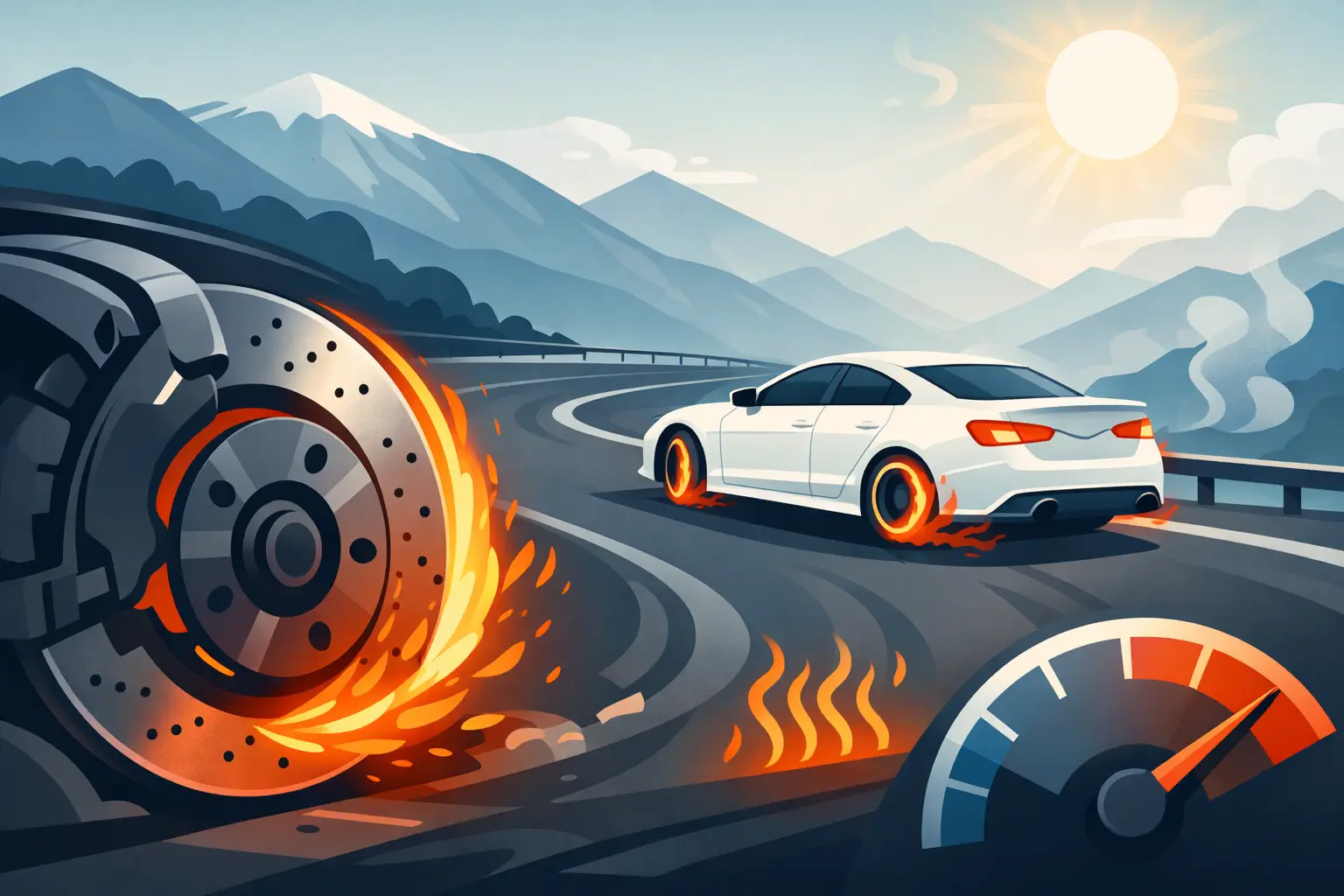
A single hard stop can make almost any brake system feel convincing. The real question arrives several laps later, after repeated high-speed deceleration has pushed rotor, pad, caliper, fluid, and hardware far beyond normal street temperatures. Endurance brake testing is where a braking system proves whether its performance is engineered to last or merely strong enough for a brief first impression.
For performance workshops, distributors, and serious vehicle owners, this distinction matters. Brake fade, a lengthening pedal, uneven friction behavior, or cracking under thermal stress can turn a fast vehicle into an unpredictable one. A properly tested carbon ceramic brake system must retain control as heat cycles accumulate, not simply deliver an impressive peak braking number.
What Endurance Brake Testing Measures
Endurance testing evaluates braking performance across repeated applications over time. Rather than measuring one emergency stop from a controlled speed, the test simulates the sustained punishment created by track sessions, mountain descents, loaded high-speed driving, and demanding road use.
The objective is not only to see whether the vehicle stops. Engineers examine whether it stops with consistent pedal feel, predictable torque, stable balance, and controlled component temperatures. The rotor and pad must work as a friction pair, while the caliper must maintain stiffness and piston control as temperatures rise. The system also depends on correct brake fluid, hose integrity, mounting hardware, and vehicle-specific cooling conditions.
A credible test program tracks temperature at critical areas, including the braking surface, rotor hat or mounting region, pad backing plate, caliper body, and sometimes brake fluid path. It records braking torque, deceleration, pedal force, pedal travel, rotor thickness loss, pad wear, and visible surface condition. These measurements reveal problems that a short road test may never expose.
Why Repeated Heat Cycles Expose Weak Brakes
Heat is the central challenge in any endurance brake test. Every stop converts vehicle speed into thermal energy. When the system cannot absorb and release that energy effectively, temperatures climb until the friction characteristics begin to change.
Pad fade occurs when the pad material loses its intended friction stability at elevated temperatures. The driver presses harder, but braking response weakens. Rotor surface distress can follow, including uneven deposits, hot spotting, thermal checking, or distortion that contributes to vibration. If fluid temperatures become excessive, pedal travel can increase and the pedal may feel soft or inconsistent.
Carbon ceramic rotors are valued because their material construction is exceptionally thermal-resistant and substantially lighter than conventional iron alternatives. Reduced unsprung and rotating mass can support sharper steering response and suspension movement, while the rotor's heat tolerance supports repeated high-energy stops. Those advantages do not remove the need for validation. Rotor design, friction material, caliper architecture, airflow, vehicle weight, tire grip, and driver use all affect the result.
That is why a complete brake kit should be considered as a system. Installing an aggressive pad on an unsuitable rotor, or fitting a large caliper without confirming hydraulic balance and wheel clearance, can create new compromises. Endurance performance comes from matched engineering rather than isolated parts.
A Meaningful Endurance Brake Test Has a Defined Duty Cycle
Testing must reflect how the brake system will be used. A Porsche used for occasional track days, a modified Tesla carrying substantial vehicle mass, and a Nissan GT-R driven in repeated high-speed sessions do not place identical demands on the brakes. Vehicle mass, power output, wheel and tire package, aerodynamic load, and brake cooling all change the thermal equation.
A useful duty cycle specifies the starting speed, target speed, deceleration rate, number of stops, interval between stops, cooling periods, ambient conditions, and load state. It should also define whether braking is performed with controlled mechanical input or by a professional driver following a repeatable target.
For example, a repeated-stop cycle may require a series of decelerations from a high initial speed with only limited recovery time. The system is then allowed to cool before the cycle begins again. This approach makes temperature accumulation visible. It can show whether the brakes stabilize at a manageable operating range or continue climbing toward fade, excessive wear, or material damage.
Track-oriented testing adds another layer. Real circuit sessions introduce corner sequencing, airflow variation, traction changes, elevation, and inconsistent cooling between front and rear axles. Controlled dynamometer work delivers repeatability; vehicle testing confirms how the complete installation performs in actual operating conditions. Neither method replaces the other.
Key Results That Matter to Buyers and Workshops
Peak deceleration attracts attention, but repeatability is more valuable in endurance use. A performance brake system should produce reliable braking torque from the first stop through the final hard stop of the test cycle. Small changes can be normal as temperatures rise, particularly while pads reach their intended operating range. Large drops in response, however, deserve investigation.
Pedal consistency is equally important. Drivers need a firm, confidence-inspiring pedal that responds predictably when braking zones arrive quickly. A changing pedal can point to fluid temperature, hose expansion, caliper movement, pad knock-back, or other system-level issues. The test result should be interpreted with the vehicle's complete hydraulic setup in mind.
Wear rates provide a commercial and technical reality check. Extremely aggressive friction material may generate strong initial bite but accelerate rotor or pad wear, produce more noise, or require a narrower temperature window. A system designed for street and occasional track use should not be judged by the same priorities as a dedicated competition package. The right answer depends on the application, but the trade-offs must be clear before installation.
Post-test inspection is where engineering discipline becomes visible. Rotor surfaces should be evaluated for cracking, deposits, uneven transfer layers, and abnormal wear. Pads should be checked for taper, crumbling edges, glazing, and backing-plate distress. Calipers, seals, fasteners, mounting brackets, and lines require inspection as well. A rotor that survives a heat cycle is not enough if surrounding components show loss of function or premature deterioration.
Carbon Ceramic Testing Requires System-Level Control
Carbon ceramic braking systems demand precision in manufacturing and fitment. Disc geometry, internal structure, mounting interfaces, pad compound, caliper piston layout, and hardware tolerances influence heat management and friction stability. Small inconsistencies can become significant after repeated thermal cycling.
This is one reason vertical manufacturing control matters. When machining, component inspection, assembly, and quality management are disconnected, it becomes harder to trace variation back to its source. CCYS completes 90% of production in-house, giving its engineering and quality teams direct control over the components that determine braking consistency. IATF 16949 and ISO 9001 standards reinforce the process discipline required for safety-critical performance hardware.
For distributors and workshops, documented vehicle-specific fitment is also part of endurance readiness. A brake package must clear the wheel, align correctly with the hub and mounting points, preserve intended caliper position, and work with the vehicle's electronic and hydraulic systems. The strongest rotor material cannot compensate for poor installation geometry or an incomplete kit.
Turning Test Data Into Better Brake Decisions
Endurance test results should guide product selection, not serve as a marketing shortcut. Ask what vehicle was tested, how much it weighed, what tires it used, how the stops were structured, and whether the system was inspected after the thermal cycle. A claim of racing-grade performance has more value when it is supported by defined operating conditions, consistent manufacturing, and components designed to work together.
For high-performance road cars, track builds, premium SUVs, and supercar applications, braking confidence is earned under repeated load. Choose systems built for the heat your vehicle will actually generate, install them with the correct supporting components, and treat every change in pedal feel or braking behavior as a reason to inspect before the next hard session.