

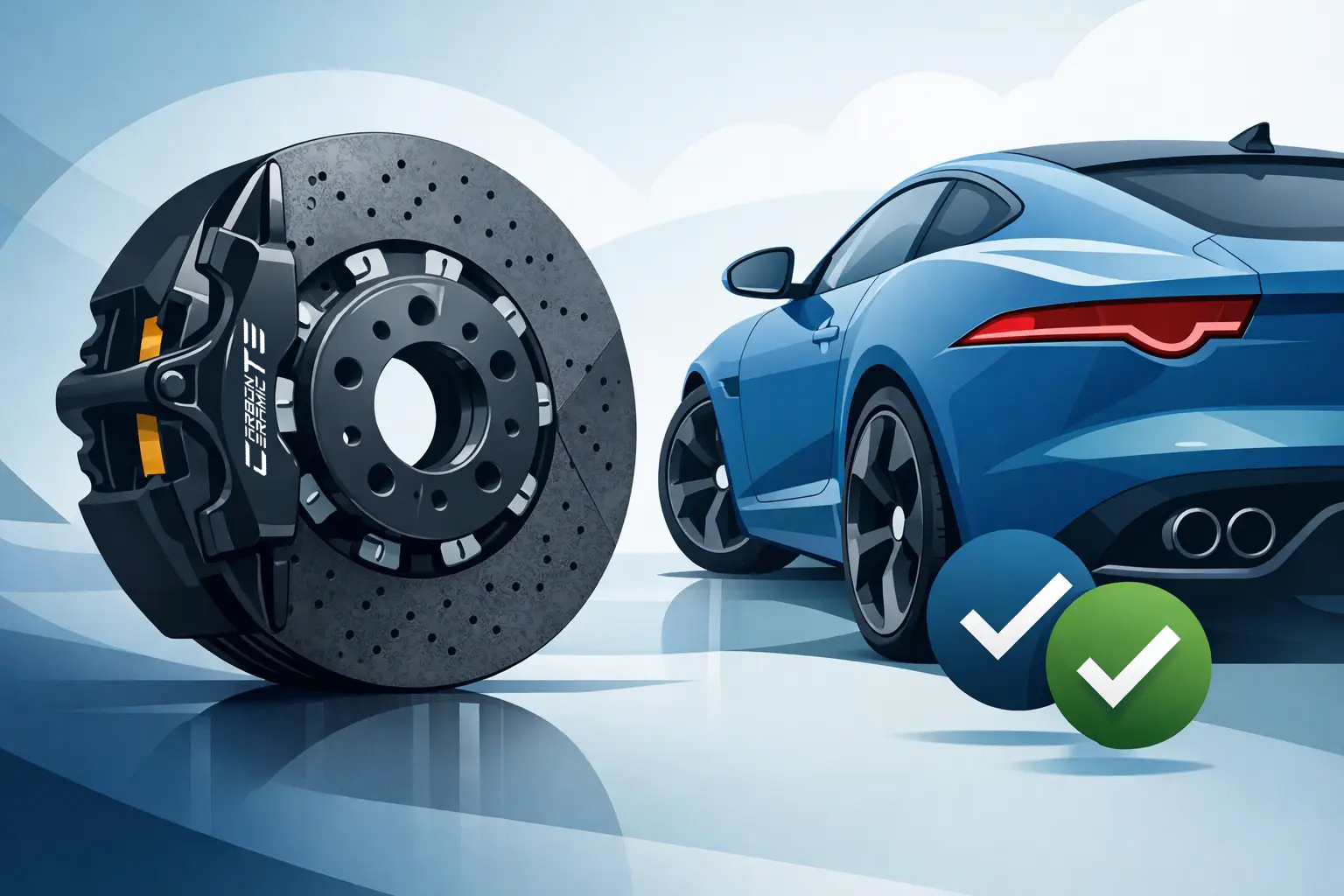
A Jaguar that reaches a braking zone with speed and weight behind it leaves no room for assumptions. Jaguar carbon ceramic fitment is not a matter of selecting the largest rotor that can sit behind the wheel. It is the engineering process of matching rotor diameter, disc offset, caliper geometry, mounting hardware, hub location, wheel clearance, and brake-system behavior as one complete assembly.
For performance workshops and parts distributors, this distinction protects both the vehicle and the customer relationship. A brake kit can look impressive on a product sheet yet create noise, interference, uneven pad wear, incorrect pedal response, or ABS intervention if the application has not been verified at the vehicle level. Carbon ceramic braking delivers its strongest advantage when every component is designed around the Jaguar platform, its intended use, and its wheel package.
Why Jaguar Carbon Ceramic Fitment Is Vehicle-Specific
Jaguar has produced a wide range of performance-oriented platforms, from F-TYPE variants to XE, XF, XJ, and select Jaguar Land Rover applications. Even within one model family, engine configuration, model year, factory brake option, upright design, wheel diameter, and electronic parking brake arrangement can change the requirements.
The first question is not simply, “What Jaguar is it?” The correct question is, “What is the exact chassis, year, trim, factory braking configuration, wheel specification, and intended driving use?” A rear-wheel-drive coupe, an all-wheel-drive sedan, and a supercharged performance model may share a nameplate while requiring different rotor offsets, caliper brackets, or front-to-rear brake balance.
A properly engineered carbon ceramic conversion begins with the fixed points on the vehicle. The hub face, wheel bearing, knuckle mounting ears, suspension travel, and wheel barrel define the available space. The rotor and caliper must then be located precisely within that space, with no compromise to fastener engagement, pad sweep, or wheel rotation.
Rotor size is only one dimension
A larger disc can increase thermal capacity and leverage, but diameter alone does not determine whether a rotor fits. Rotor thickness, overall height, hat offset, center bore, mounting pattern, and friction-ring design all matter. A disc that is only a few millimeters wrong in offset can move the friction surface out of the caliper centerline, causing pad taper, piston imbalance, and reduced component life.
The rotor hat is especially critical on Jaguar applications. It controls where the disc sits relative to the hub and caliper. In a two-piece carbon ceramic system, the hat must also manage thermal expansion between the friction ring and the vehicle mounting interface. Precision machining and correct hardware selection are not cosmetic details. They are part of the system’s safety margin.
Caliper position determines usable braking performance
A monobloc caliper needs more than a bracket that bolts on. Its mounting location must center the caliper over the rotor, align the pad profile with the available friction track, and preserve clearance through steering lock and suspension movement. Piston sizing also needs to be considered with the Jaguar master cylinder, booster behavior, and electronic brake controls.
Installing a higher-piston-count caliper does not automatically produce better brakes. Excessive piston area may create a longer pedal or alter hydraulic balance. Too little area can require more pedal force than intended. The goal is stable, repeatable deceleration with a pedal that gives the driver confidence at highway speeds, on mountain roads, and during repeated track use.
Wheel Clearance Is the Fitment Check That Cannot Be Skipped
Many fitment failures occur after the brake kit has been selected correctly for the hub but before the wheel has been checked. Carbon ceramic rotors are often paired with larger calipers, and caliper clearance depends on wheel barrel shape and spoke profile, not just wheel diameter.
An 18-inch wheel may clear one caliper design and interfere with another. A 20-inch wheel may still fail because its spokes curve inward near the caliper face. Wheel offset, spacer thickness, tire width, and steering angle can introduce additional issues, particularly on lowered cars or vehicles using aftermarket suspension components.
A serious fitment process uses a vehicle-specific wheel template or a physical test fit before final installation. The check should confirm radial clearance above the caliper, axial clearance between spokes and caliper, rotor-to-dust-shield clearance, and unrestricted movement from full steering lock through suspension travel.
Do not solve a clearance problem by grinding a caliper, machining a wheel without engineering approval, or relying on an arbitrary spacer. Spacers can change scrub radius, wheel-bearing load, stud engagement, and fender clearance. They may be appropriate in a documented application, but they are not a substitute for a correctly designed kit.
Matching Carbon Ceramic Components to Jaguar Use
Carbon ceramic brakes are valued because they reduce unsprung and rotating mass while handling severe heat more effectively than conventional iron systems. On a heavy, high-output Jaguar, less unsprung weight can support sharper suspension response, while the thermal-resistant friction ring helps maintain consistency during repeated hard stops.
Those benefits depend on selecting the correct system for the vehicle’s duty cycle. A street-driven F-TYPE that sees occasional spirited use has different priorities than a track-focused build. The street car may prioritize quiet operation, progressive cold response, dust reduction, and long-term rotor protection. The track vehicle may prioritize high-temperature pad behavior, increased airflow, firmer pedal feel, and repeated braking stability.
The pad compound is a key part of this decision. Carbon ceramic discs should be used with pads developed for the rotor material and intended temperature range. An aggressive race pad may deliver strong hot performance while producing unwanted noise or reduced cold bite on the street. Conversely, a street compound may not provide the thermal capability needed for sustained circuit sessions.
Brake fluid, lines, cooling, and maintenance procedures also belong in the conversation. Carbon ceramic discs resist fade-related heat effects, but fluid can still boil and pads can still exceed their operating range. A complete performance braking plan considers the entire path from pedal input to tire contact patch.
Fitment Details a Professional Installer Should Verify
Before a Jaguar carbon ceramic brake system is ordered or installed, the workshop should document the vehicle rather than rely on visual identification. The following checks prevent expensive rework and establish a professional installation standard:
- Confirm the VIN-level model year, trim, drivetrain, and original brake package.
- Measure the factory rotor diameter, thickness, overall height, hub bore, and wheel mounting pattern.
- Identify the front knuckle and rear carrier mounting points, including bolt size, thread condition, and mounting-ear geometry.
- Verify wheel diameter, offset, inner-barrel profile, spoke clearance, tire size, and any existing spacers.
- Check electronic parking brake configuration, brake wear-sensor provisions, brake hose routing, and ABS-related requirements.
- Define whether the vehicle is used for daily driving, high-speed road use, track days, or dedicated competition.
These checks are not administrative work. They determine whether the installation will perform as engineered once the vehicle is moving at speed.
Installation discipline protects carbon ceramic hardware
Carbon ceramic components require clean handling and controlled installation. The hub face must be free of corrosion and debris so rotor runout remains within specification. Mounting bolts need the correct torque procedure, and any required thread treatment must be applied exactly as specified. Caliper bolts, brackets, rotor hardware, and brake lines should never be mixed with unverified substitute parts.
After installation, the system should be inspected for free rotation, correct pad contact, hose clearance, fluid leaks, wheel clearance, and proper brake-pedal response. A controlled bedding procedure is then required to establish a stable transfer layer between pad and disc. Skipping this stage can create vibration, uneven friction behavior, and a poor first impression of an otherwise capable system.
Drivers should also understand that unusual noises after a cold start, during light braking, or in wet conditions can be characteristic of high-performance brake systems. The correct response is not to dismiss every noise as normal. It is to distinguish expected performance-brake behavior from symptoms such as grinding, persistent pull, warning lights, pedal changes, or contact marks that require immediate inspection.
Engineering Control Matters More Than a Generic Conversion
For distributors and workshops, the strongest carbon ceramic offering is not a catalog of loosely related parts. It is a documented system with vehicle-specific engineering, consistent production, available support, and clear installation requirements. That standard becomes more important when the customer expects premium vehicle refinement alongside racing-grade heat resistance.
CCYS supports this approach through carbon ceramic brake systems, monobloc calipers, rotors, pads, wheel hubs, and related chassis components produced with extensive in-house control. With 90% of production completed internally and quality systems aligned with IATF 16949 and ISO 9001 standards, component consistency can be managed from design through machining and final inspection.
The right Jaguar carbon ceramic fitment gives the driver more than visual impact behind the wheel. It gives the workshop a defensible installation, the distributor a system they can specify with confidence, and the vehicle the braking control it needs when the next corner arrives faster than expected. Confirm the application before ordering, verify the wheel before installation, and treat every component as part of one engineered braking system.