

A brake pedal that goes long after repeated hard stops is not a minor inconvenience. It is a warning that heat, stiffness, fluid control, or component matching is no longer working as the driver expects. The best monobloc caliper designs address that problem at the caliper body itself, creating a rigid foundation for consistent clamp force, controlled pad movement, and dependable braking under demanding use.
For performance workshops and serious vehicle owners, a monobloc caliper should never be selected because it has more pistons or fills more space behind the wheel. The right design must match the vehicle’s rotor diameter, disc thickness, hydraulic system, wheel clearance, intended use, and service requirements. A well-engineered caliper is part of a complete braking system, not an isolated visual upgrade.
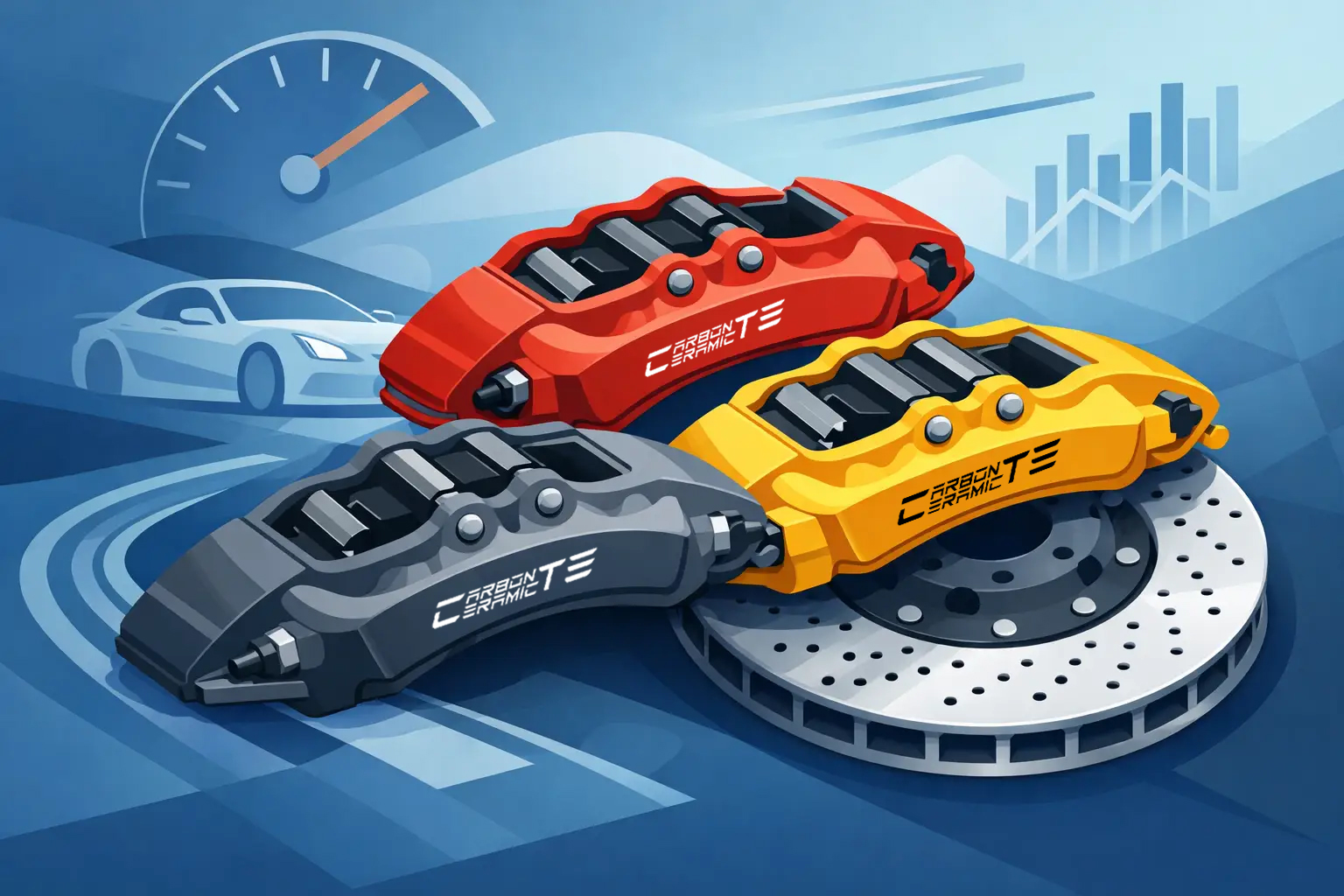
What Makes a Monobloc Caliper Different?
A monobloc caliper is machined from a single forged or billet piece rather than assembled from two bolted halves. This construction removes the central joint found in many multi-piece calipers. The result is typically higher structural stiffness, more controlled deflection under pressure, and fewer sealing surfaces within the main body.
Under heavy braking, every caliper flexes to some degree. Excessive flex can consume pedal travel before full clamp load reaches the brake pads. It can also contribute to uneven pad pressure and a less precise pedal feel. A properly designed monobloc architecture resists this movement, helping the driver receive a firmer, more repeatable response when braking zones become shorter and speeds increase.
That does not mean every one-piece caliper is automatically superior to every two-piece design. Material grade, forging quality, machining accuracy, bridge geometry, piston bores, and hydraulic design all matter. The best monobloc caliper designs use the one-piece format as a starting point for better engineering, not as a marketing label.
The Best Monobloc Caliper Designs Prioritize Stiffness
The bridge is the section of the caliper that spans the outer edge of the brake pads and rotor. It carries major loads during braking, which makes bridge shape and thickness central to caliper performance. A weak bridge can deflect under line pressure, reducing immediate pedal response and making the system feel less controlled when the brakes are hot.
High-quality monobloc calipers use carefully machined bridge geometry to retain stiffness without adding unnecessary mass. This balance matters because brake calipers are unsprung weight. Reducing weight at the wheel can improve suspension response, steering accuracy, and ride control, particularly on performance vehicles with large wheels and low-profile tires.
Forged aluminum is a common choice for high-performance monobloc calipers because it offers an effective strength-to-weight ratio. The manufacturing process must be controlled, however. Consistent material structure, precision machining, and inspection of critical piston and fluid passages are what turn a forged blank into a reliable brake component.
Bridge Design Also Affects Pad Changes
A stiff bridge should not make routine service difficult. Track-oriented calipers often use bridge bolts, retaining pins, or top-loading pad arrangements that allow pad replacement without removing the caliper from the mounting bracket. This can save meaningful time during track-day preparation or workshop service.
The trade-off is application-specific. A road-focused design may prioritize dust protection, quiet operation, and long-term corrosion resistance. A race-oriented caliper may favor fast pad access and reduced mass. The correct answer depends on whether the car spends most of its time commuting, driving mountain roads, making repeated high-speed stops, or running competitive sessions.
Piston Layout Must Match the Pad and Rotor
Six-piston and eight-piston calipers are widely associated with high performance, but piston count alone does not define braking quality. Piston diameter, piston spacing, total hydraulic area, pad shape, and rotor dimensions determine how the system applies force.
A well-designed multi-piston caliper places pressure evenly across a long brake pad. Staggered piston sizes are frequently used to manage the way the pad contacts the rotating disc. This can reduce uneven wear and help prevent pad taper, especially where large pads and high temperatures are involved.
Too much total piston area can create problems if it is not paired correctly with the vehicle’s master cylinder and brake booster. Pedal travel may increase, and front-to-rear brake balance can move away from the vehicle’s intended behavior. Too little piston area can demand higher line pressure for the same clamp force. For that reason, caliper selection should be based on the complete hydraulic system, not a simple piston-count comparison.
Piston Materials Matter at High Temperature
The piston sits between hot brake pads and brake fluid, making it a critical thermal-control component. High-performance designs may use insulated pistons, thermal barrier elements, or materials selected to limit heat transfer into the fluid. Reducing fluid temperature helps preserve pedal consistency and lowers the risk of fade during repeated braking.
Seal design is equally important. Street-driven vehicles often benefit from dust seals that protect piston bores from road contamination. Dedicated competition applications may use seal arrangements optimized for high-temperature service and frequent inspection. Neither approach is universally better. The duty cycle determines the right choice.
Heat Management Is Where Caliper Engineering Proves Itself
Carbon ceramic and high-performance iron rotors can absorb and dissipate substantial energy, but the caliper must work with the rotor rather than become a heat trap. The best monobloc caliper designs provide adequate clearance around the disc, support proper airflow, and use pad shapes with enough volume for the expected thermal load.
Pad volume is often overlooked. A larger pad can distribute heat across more material and may offer improved durability under repeated hard use. Yet a larger pad also requires a caliper and rotor package designed around it. Installing an oversized caliper over an undersized disc does not create a balanced system.
Rotor thickness and effective radius are equally significant. A larger effective radius gives the braking system more leverage. Increased rotor mass can improve heat capacity, while the correct disc thickness supports stable operation under load. The caliper must be engineered for the exact rotor width and swept area. Even a small mismatch can lead to poor pad contact, noise, wear issues, or unsafe operation.
Fitment Is a Performance Requirement, Not a Final Check
Wheel clearance is one of the most common obstacles in big brake conversions. A caliper can clear the wheel diameter but still interfere with spoke shape, barrel profile, wheel weights, or suspension components. This is especially relevant with aftermarket wheels, where nominal diameter alone says very little about internal clearance.
Vehicle-specific mounting brackets, hub offsets, rotor hats, and fastener specifications must position the caliper precisely over the disc. The caliper should be centered on the rotor, the pad should sweep the intended braking surface, and the mounting hardware must maintain alignment under load. These details determine whether a system performs as engineered or merely bolts onto the vehicle.
For premium platforms such as Porsche, Tesla, BMW, Jaguar, Land Rover, Toyota Supra, Nissan GT-R, Defender, and supercars, fitment should also account for electronic brake functions, parking brake arrangements, factory wheel designs, and axle-specific brake bias. A front-only upgrade may change vehicle behavior if it is not planned around the rear system and the car’s control strategy.
Manufacturing Control Separates a Caliper From a Commodity
A caliper may look impressive in a product photo while hiding inconsistent machining, poor bore finish, unsuitable seals, or weak quality control. Professional buyers should ask how the component is produced, inspected, and supported after sale.
CCYS maintains control of roughly 90% of its production in-house, from R&D and precision machining to quality management. That matters because monobloc caliper performance depends on repeatable tolerances at every critical point: piston bores, seal grooves, pad abutments, fluid channels, mounting faces, and bridge dimensions. IATF 16949 and ISO 9001 quality systems add documented process discipline to performance-focused component development.
For distributors and workshops, complete-system availability is equally valuable. A matched package of calipers, carbon ceramic rotors, pads, brackets, lines, hardware, and vehicle-specific support reduces the uncertainty that comes from combining unrelated parts. It also gives the installer a clearer path for service, replacement parts, and customer warranty support.
Choosing the Right Design for the Job
The strongest monobloc caliper is not always the right caliper. A heavy luxury SUV used for fast road driving needs thermal capacity, durability, and dependable street service. A lightweight track car may benefit more from low mass, rapid pad changes, and an aggressive pad profile. An EV may require careful consideration of vehicle weight, regenerative braking behavior, and factory brake-system integration.
Start with the vehicle, not the caliper. Confirm rotor size and thickness, wheel clearance, hydraulic compatibility, desired pad compound, operating temperature, and service expectations. Then select a monobloc design whose stiffness, piston layout, heat management, and fitment were engineered to work together.
When braking confidence is on the line, the right caliper should do more than look like a race part. It should deliver controlled pressure, stable pedal feel, and repeatable stopping force every time the vehicle asks for more.