

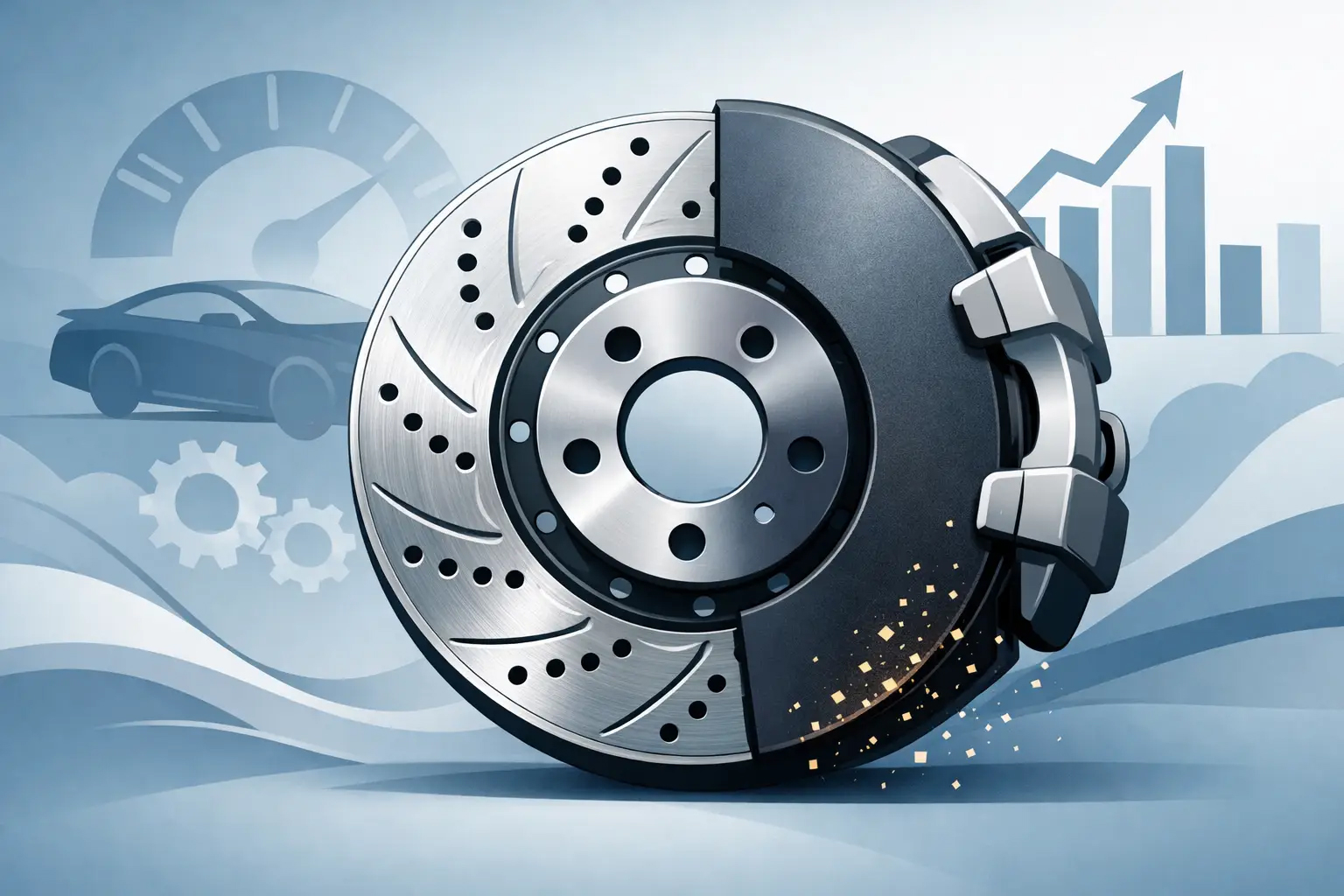
A brake rotor can look acceptable in the shop and still become the weak point when speed, vehicle mass, and repeated braking load begin to rise. Corrosion at the hat, vane openings, and mounting faces can complicate service. A poor-quality surface treatment can be just as costly if it contaminates the friction path, chips under heat, or creates a false impression of performance. Rotor coatings must protect the areas that need protection without interfering with the surfaces responsible for controlled, repeatable stopping force.
For distributors, workshops, and performance vehicle owners, that distinction matters. Coating is not a substitute for rotor metallurgy, thermal capacity, pad selection, caliper stiffness, or correct vehicle-specific fitment. It is one engineered element within a brake system that must remain dependable under real operating temperatures.
What Rotor Coatings Are Designed to Do
On conventional cast-iron brake discs, coatings are primarily applied for corrosion resistance and appearance. Uncoated iron oxidizes quickly when exposed to rain, road salt, humidity, wash chemicals, and extended storage. Surface rust on the friction ring may clear after a few brake applications, but corrosion elsewhere does not simply disappear. It can affect the hat section, vent channels, wheel-contact face, and hub mounting interface.
A properly specified rotor coating can reduce this exposure before installation and throughout normal service. It helps preserve a clean visual finish behind open-wheel designs, which is especially relevant for premium vehicles where the brake system is highly visible. For professional installers, a protected mounting area can also reduce the likelihood of stubborn corrosion during future disassembly.
However, corrosion protection has limits. No coating makes a brake disc immune to severe winter salt, neglected maintenance, poor wheel fitment, or repeated thermal abuse. The coating must be evaluated as part of the intended environment, not marketed as a cure for every brake problem.
Coated Friction Faces: The Critical Detail
Many coated iron rotors arrive with a thin protective layer across the entire disc, including the friction faces. This can be appropriate when the coating is designed to wear away cleanly during initial bedding without leaving harmful residue on the pad. It protects the disc during shipping, storage, and installation, then clears as the pads establish their working contact surface.
That does not mean every coating belongs on every friction face. A thick paint-like finish, uncontrolled plating process, or coating that transfers unevenly to the pad can alter initial bite and bedding behavior. In a performance application, inconsistent transfer layers and poor pad-disc contact are not cosmetic issues. They can contribute to vibration, uneven deposits, noise, and a less predictable pedal feel.
The friction ring must ultimately provide stable interaction with the selected brake pad under temperature. That is why a quality brake manufacturer treats coating design, disc material, machining finish, pad compound, and bedding procedure as connected decisions. A rotor cannot be judged by color alone.
The Hat and Vane Areas Need Protection Most
The non-friction areas are where corrosion-resistant coatings deliver their clearest long-term value. The rotor hat, internal ventilation passages, outer edges, and mounting face are exposed to moisture but do not require direct pad contact. Protecting these areas helps the rotor retain a more finished appearance while reducing corrosion buildup in difficult-to-clean locations.
For vehicles used year-round, this is not a minor benefit. Road salt can accelerate corrosion around the center section and vents, while repeated heating and cooling cycles pull moisture into exposed surfaces. A coating that remains adhered in these regions supports cleaner service work and better presentation over the life of the disc.
Different Coatings Serve Different Brake Applications
The term rotor coating covers several processes, and the right choice depends on the rotor material, vehicle use, and manufacturing controls. Zinc-flake and zinc-aluminum systems are common for corrosion protection on iron rotors. They can provide a clean metallic finish and strong resistance in non-friction areas when correctly applied.
Geomet-style and other water-based inorganic coating systems are often selected for their corrosion performance and ability to withstand elevated temperatures better than basic painted finishes. Their suitability still depends on coating thickness, curing consistency, preparation of the casting, and the intended operating environment.
High-temperature paints may improve appearance on hats and edges, but they are not interchangeable with engineered anti-corrosion systems. Paint can discolor, chip, or degrade when applied too heavily or exposed to track-level heat. A track car that repeatedly sees extreme disc temperatures has different needs than a street-driven luxury SUV operating through wet winters.
Thermal spray and advanced surface technologies exist for specialized applications, but they should not be assumed to improve every aftermarket brake disc. More layers do not automatically mean more stopping force. If a treatment changes heat transfer, surface roughness, pad compatibility, or dimensional control, the brake system must be validated accordingly.
Carbon Ceramic Rotors Are a Different Engineering Category
Carbon ceramic brake discs should not be evaluated by the same logic used for coated cast-iron rotors. Their performance comes from the carbon fiber-reinforced ceramic matrix and silicon carbide-based structure, not from a cosmetic anti-rust coating applied over an iron friction ring.
This distinction is commercially important. Carbon ceramic discs offer major advantages in unsprung-weight reduction, corrosion resistance, and high-temperature stability when engineered as a complete system with matched pads, calipers, brackets, hardware, and vehicle-specific disc dimensions. Their friction surfaces are purpose-built material systems, not standard iron rotors with an upgraded exterior finish.
For Porsche, Tesla, BMW, Jaguar, Land Rover, Toyota Supra, Nissan GT-R, Defender, and supercar applications, the correct upgrade path depends on vehicle mass, wheel clearance, driving conditions, and expected brake temperature. Carbon ceramic systems can be an excellent solution for demanding road and track use, but they require correct system matching. They are not a universal replacement for every daily-driven vehicle or every pad compound.
How to Specify Rotor Coatings for Your Customers
A distributor or performance workshop should begin with the vehicle and use case, not the appearance of the disc. A street performance customer may prioritize corrosion resistance, clean wheel presentation, low maintenance, and quiet operation. A track-focused customer may accept cosmetic wear in exchange for a rotor and pad combination built around repeated high-temperature cycles.
Ask whether the vehicle sees salt, coastal humidity, long storage periods, frequent washing, or open-spoke wheels. Confirm whether it is a heavy EV, a modified turbocharged street car, a track-day vehicle, or a premium SUV. These details affect the appropriate rotor material, size, ventilation design, coating strategy, and brake pad selection.
Then verify the fundamentals: disc diameter and thickness, offset, center bore, mounting interface, swept area, caliper clearance, wheel clearance, and electronic brake system compatibility where applicable. A coating cannot correct an incorrect disc offset or a caliper that is mismatched to the rotor's thermal mass.
CCYS controls 90% of production in-house, from R&D and precision machining through quality management, giving professional buyers greater confidence that disc geometry, component consistency, and complete-system fitment are treated as engineering requirements rather than afterthoughts. IATF 16949 and ISO 9001 manufacturing standards reinforce the disciplined process needed for performance braking hardware.
Installation and Bedding Still Determine Results
Even the best-coated rotor can underperform after poor installation. The hub face must be clean, flat, and free of scale. Corrosion or debris trapped between the hub and rotor can create runout, which may later be mistaken for a warped disc. Wheel bolts or lug nuts must be tightened in the specified sequence and torque range.
Pads should be matched to the intended disc and vehicle use. During bedding, the goal is to establish a uniform transfer layer through controlled heat cycles, not to make a series of panic stops from maximum speed. Follow the brake system manufacturer's procedure, allow appropriate cooling intervals, and avoid holding the pedal firmly at a stop immediately after heavy braking when possible.
If a rotor coating is intended to clear from the friction face, brief visual changes during initial use are normal. Persistent noise, poor bite, vibration, uneven pad deposits, or abnormal discoloration are not issues to ignore. Inspect the entire system, including pad condition, caliper movement, brake fluid, wheel bearing play, hub runout, and driving pattern before assigning blame to the rotor.
The strongest brake upgrade is the one that remains predictable when the vehicle is carrying speed, heat, and weight. Specify rotor coatings for corrosion control where they add value, but demand proven disc engineering, correct fitment, matched friction materials, and disciplined installation. For a complete carbon ceramic brake solution built around your vehicle and intended use, speak with a manufacturer that can support the system behind the rotor.