

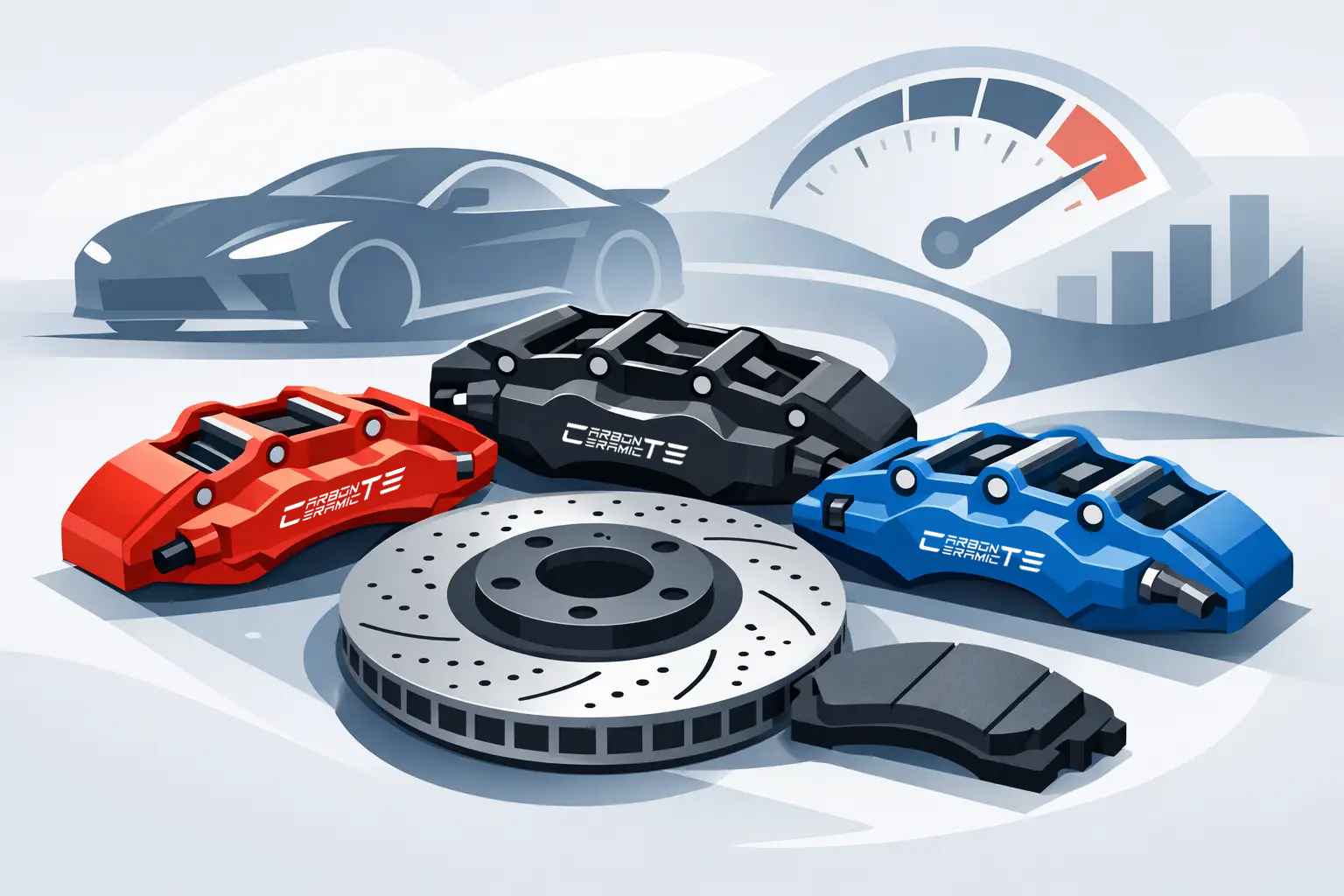
A soft pedal at the end of a fast straight is not a cosmetic problem. It is the moment a driver learns whether the brake system was engineered for repeated load or only for appearance. This aftermarket caliper review focuses on what performance workshops, distributors, and serious drivers should inspect before choosing a caliper upgrade for road, track, or high-output vehicle builds.
A quality aftermarket caliper can improve pedal consistency, thermal control, serviceability, and brake balance. But the word caliper alone can hide a costly mistake: no caliper performs at its best when it is paired with the wrong rotor, pad compound, bracket, hose, or master-cylinder setup. The correct purchase is a matched brake system with documented vehicle fitment, not a collection of impressive-looking parts.
Aftermarket Caliper Review: Judge the Complete System
The first question is not how many pistons a caliper has. It is whether the system has been designed around the vehicle's weight, tire capability, wheel clearance, intended use, and original brake hydraulics. A heavier luxury SUV, a high-speed EV, and a lightweight track coupe create very different demands, even when they use wheels of similar diameter.
A proper kit identifies the rotor diameter and thickness, caliper mounting location, bracket design, pad shape, brake line routing, and wheel-clearance requirement. It should also state the compatible model years and trim levels. Small differences in knuckle geometry, electronic parking-brake configuration, hub offset, or wheel barrel shape can turn an apparently simple conversion into an unsafe fitment issue.
For professional buyers, request the vehicle-specific application data before discussing finish options. The caliper must sit squarely over the rotor, maintain correct radial position, and center the pad sweep across the disc. A machined adapter bracket is a critical structural component, not an accessory. Its material, fasteners, thread engagement, and manufacturing accuracy deserve the same scrutiny as the caliper body.
Stiffness Matters More Than Piston Count
A six-piston or eight-piston caliper may look like an automatic upgrade over an OE sliding caliper. It is not. Piston count changes packaging and clamping-force distribution, but it does not guarantee shorter stops. Tire grip, rotor leverage, brake bias, pad friction, and hydraulic area all influence real braking performance.
What a well-engineered fixed caliper should deliver is rigidity. Under high line pressure, a flexible caliper body can spread slightly, consuming pedal travel and reducing the driver's sense of control. A rigid monobloc caliper, machined from a single forged or high-quality billet body, is designed to resist that deflection. The result can be a firmer, more repeatable pedal when the system is correctly matched.
Examine the bridge section, mounting ears, piston bores, and fluid passages. These are the areas where engineering discipline becomes visible. Light weight is valuable because it reduces unsprung mass, but aggressive material removal without sufficient structural analysis is not performance engineering. The target is a caliper that is light enough for chassis response and strong enough to stay stable during repeated heavy braking.
Piston Sizing and Brake Balance Cannot Be Guessed
Piston area determines how hydraulic pressure becomes clamping force. Increasing total piston area can increase clamp load, but it can also alter pedal travel and shift front-to-rear brake balance. On vehicles equipped with ABS, stability control, brake-by-wire systems, or regenerative braking, those changes must be considered carefully.
Staggered piston sizing is often used in multi-piston calipers to support even pad wear as the disc rotates through the pad. The layout must be installed in the correct leading and trailing orientation. Reversing a caliper side-to-side may create uneven wear, reduce effective pad support, and compromise the intended thermal behavior.
A credible supplier should be able to explain the hydraulic rationale behind a kit. That does not require publishing every design calculation, but it should include clear information about vehicle application, rotor size, caliper configuration, and recommended pad options. If a seller treats any caliper with the same bolt spacing as a universal solution, treat that as a warning sign.
Heat Management Is the Real Performance Test
Street braking is intermittent. Track sessions, mountain descents, towing, heavy EV use, and high-speed driving create sustained thermal load. Under those conditions, the caliper must protect seals, fluid, and pads while allowing heat to move through the system in a controlled way.
Start with the rotor. Larger effective diameter increases mechanical leverage, while thicker discs add thermal mass. Two-piece floating rotors can reduce weight and allow the friction ring to expand more freely as temperatures rise. Carbon ceramic systems bring additional advantages in heat resistance, corrosion resistance, and reduced unsprung weight, but they require compatible pads and properly engineered caliper geometry. They are not a universal substitute for a well-specified iron rotor system.
The caliper's pistons and seals also matter. Quality designs use materials and components selected for elevated temperatures, with dust boots and fluid seals suited to the intended environment. For road-driven vehicles, corrosion resistance and reliable weather sealing may be as important as outright race temperature capability. For dedicated track cars, pad changes, cooling airflow, and fluid maintenance intervals become equally important parts of the specification.
Inspect Manufacturing Proof, Not Just Marketing Claims
Performance buyers should ask where the caliper is made, how it is machined, and what quality controls govern production. Consistency is essential because calipers are safety-critical hydraulic parts. A visually similar component from an unknown supply chain may differ significantly in bore finish, seal quality, mounting precision, anodizing preparation, or material traceability.
Factory control provides a meaningful advantage when it includes design, machining, inspection, and final assembly. CCYS, for example, completes 90% of production in-house and works under IATF 16949 and ISO 9001 quality systems. Those details matter because they support repeatability across batches, applications, and distributor orders, rather than relying on a one-off sample that performs well only in photography.
Ask for practical evidence: dimensional inspection standards, pressure-testing procedures, warranty terms, replacement pad availability, and technical support for fitment questions. A manufacturer that can support caliper rebuild components, brackets, rotors, and pads is generally better positioned to support the vehicle through its service life than a seller offering a caliper alone.
Installation Determines Whether the Upgrade Works
Even an accurately engineered kit can underperform if it is installed casually. The hub face must be clean and within runout limits. Rotors need correct directional orientation where applicable. Brake lines must not contact the wheel, suspension, or steering components through the full range of travel. Fasteners require the specified torque and, where required, the correct thread-locking process.
Fluid selection and bleeding procedure deserve equal attention. High-performance fluid can resist boiling at elevated temperatures, but it cannot correct trapped air, worn hoses, a failing master cylinder, or a caliper installed with the bleed screws below the piston bores. Bed the pads and rotors according to the system recommendation, then inspect for leaks, abnormal noise, uneven transfer film, and rotor discoloration after the first heat cycles.
Workshops should also confirm wheel clearance with a physical template or validated fitment chart. Spoke clearance is only part of the issue. Check the wheel barrel, balancing weights, suspension movement, and steering lock. A few millimeters can decide whether a kit is a clean installation or a recurring contact problem.
Specify the Use Case Before Selecting the Caliper
For a premium street vehicle, prioritize corrosion resistance, low noise, stable cold performance, parking-brake integration, and easy access to service parts. For a track-focused build, prioritize heat capacity, pad availability, rotor cooling, pedal consistency, and predictable wear. For a heavy EV or SUV, give extra attention to vehicle mass, repeated deceleration, wheel load, and the interaction between regenerative and friction braking.
The best caliper is not necessarily the largest one, the brightest one, or the one with the highest piston count. It is the one engineered to work with the vehicle's complete braking system and supported with real fitment data, controlled manufacturing, and service knowledge. Before approving a brake package, match the hardware to the heat, weight, and confidence the driver expects to manage when the next braking zone arrives.