

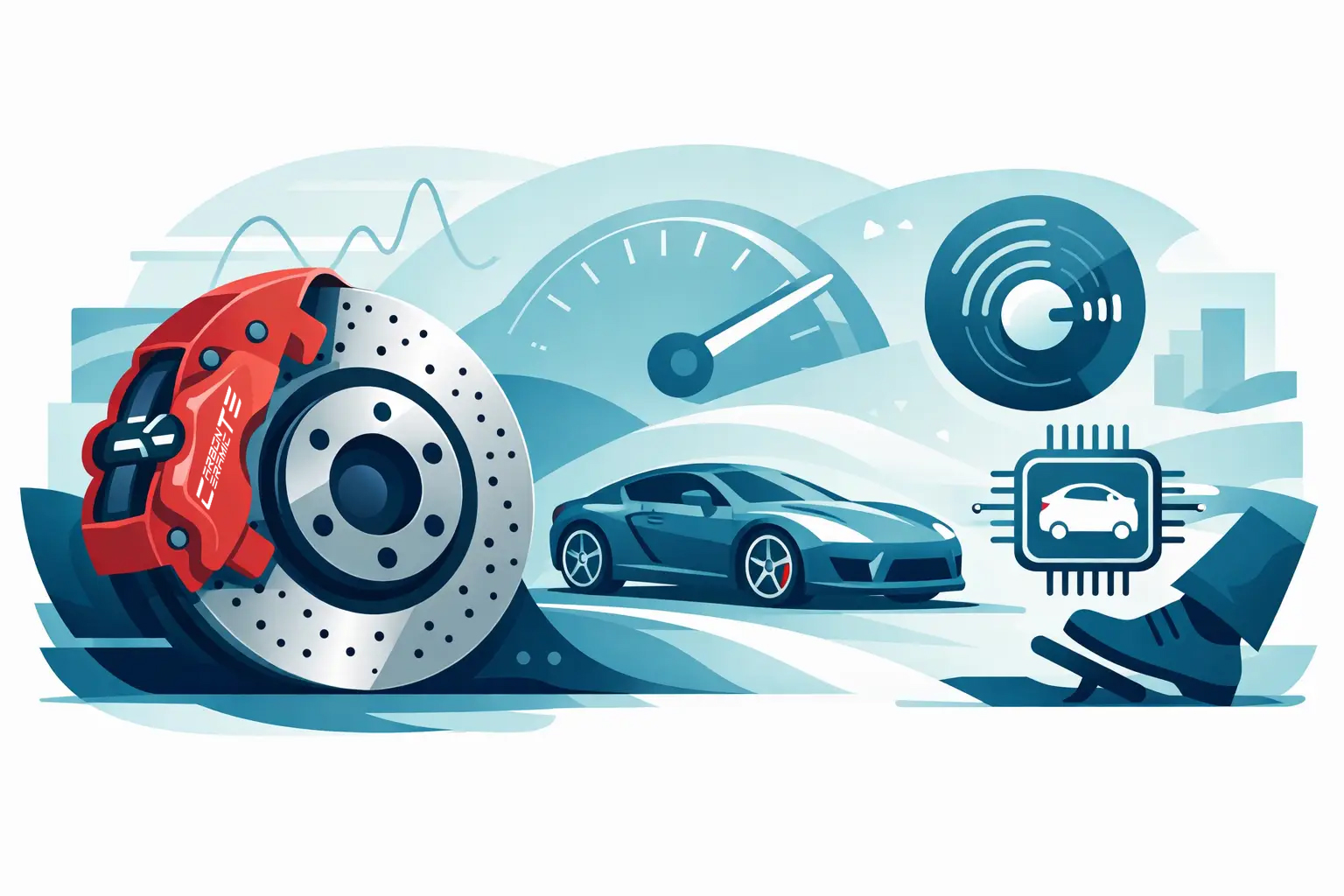
A long brake pedal at highway speed, a fading pedal after three hard laps, or steering-wheel vibration under load changes a performance build immediately. Brake technology trends are moving beyond bigger discs and brighter caliper finishes because modern premium vehicles are faster, heavier, more powerful, and often expected to perform on both the street and the track. The right answer is not one oversized component. It is an engineered system that manages heat, weight, clamping force, pedal feel, electronic controls, and vehicle-specific fitment.
For distributors, workshops, and serious drivers, this shift creates a clear opportunity. The brake products that earn long-term trust will be the ones with traceable materials, controlled manufacturing, correct hardware, and performance that remains consistent when braking demand rises.
Brake Technology Trends That Matter Most
Carbon ceramic systems are becoming a performance benchmark
Carbon ceramic braking is no longer viewed only as an exotic factory option for supercars. It is increasingly specified for high-end aftermarket applications where reducing unsprung weight and controlling extreme heat are real priorities. Compared with conventional iron systems, carbon ceramic rotors can substantially reduce rotating mass, helping suspension response and steering precision while reducing the energy the brake system must manage during repeated deceleration.
Heat resistance remains the larger advantage. Track driving, mountain roads, heavy SUVs, and high-output electric vehicles can generate temperatures that expose the limits of poorly matched rotors and pads. A properly engineered carbon ceramic system is designed to resist heat-related distortion and maintain dependable braking characteristics through repeated high-load events.
That does not mean carbon ceramic is the correct choice for every vehicle. Cost, intended use, wheel fitment, replacement strategy, and pad selection all matter. A daily driver with modest power may be better served by a high-quality iron upgrade. But for Porsche, Tesla, BMW, Nissan GT-R, Toyota Supra, Jaguar, Land Rover, Defender, and supercar applications that see demanding use, carbon ceramic technology can offer a meaningful performance and durability advantage.
Bigger brakes are being replaced by better-matched systems
Rotor diameter still matters. A larger effective radius increases braking torque, and additional mass can provide more thermal capacity. But diameter alone does not define stopping performance. A system with an oversized rotor, poorly positioned caliper, unsuitable pad compound, or inadequate mounting hardware can create noise, uneven wear, poor pedal feel, or interference with wheels and suspension components.
The stronger trend is vehicle-specific system engineering. That means matching rotor thickness and airflow, caliper piston area, pad shape, brake bias, bracket rigidity, wheel clearance, and original electronic systems. It also means recognizing that a heavy EV, a front-engine GT car, and a track-focused coupe transfer load differently under braking. Each needs a different solution.
Complete kits reduce the risk of piecemeal upgrades. When rotors, calipers, pads, brackets, lines, and hardware are designed as one assembly, the workshop spends less time resolving preventable compatibility issues. For resellers, that translates to clearer fitment conversations and fewer avoidable post-sale problems.
Monobloc calipers are raising expectations for stiffness
Caliper design has become a central part of the performance conversation. Monobloc calipers are machined from a single forged or billet structure rather than assembled from two halves. The goal is higher rigidity under hydraulic pressure, more stable pad loading, and a more direct pedal response.
A stiff caliper does not automatically create shorter stopping distances, since tires and surface conditions ultimately limit deceleration. It can, however, improve driver confidence by making brake response more consistent and controllable. That consistency is especially valuable when a driver is modulating threshold braking at speed or dealing with repeated braking zones on track.
Piston sizing and arrangement are equally critical. More pistons are not inherently better. The caliper must deliver balanced pressure across the pad face while preserving the vehicle's intended front-to-rear brake behavior. Engineering discipline matters more than a high piston count printed on a specification sheet.
Pad materials are being selected for use cases, not marketing claims
The brake pad remains the friction component that converts hydraulic force into stopping torque. Current development is moving toward more specific pad choices for street performance, track work, heavy-vehicle use, and mixed driving. The right pad must offer an appropriate friction level across its operating temperature range while controlling fade, noise, dust, rotor wear, and pedal consistency.
A race-oriented compound may work exceptionally well when hot but be loud, dusty, or less responsive at low temperatures. A street-focused compound may offer quiet operation and smooth initial bite yet lose consistency during repeated high-energy braking. There is no universal pad formula.
For carbon ceramic systems, pad selection requires even greater care. The pad and rotor must be engineered to work together. An unsuitable compound can compromise feel, increase wear, or prevent the system from delivering its expected thermal performance. Workshops should ask how the vehicle is driven before recommending a pad, not after the customer returns with complaints about noise or fade.
Electronic Braking Is Now Part of Mechanical Fitment
Modern vehicles rely on ABS, stability control, brake-force distribution, regenerative braking, and brake-by-wire logic. These systems make upgrading more complex, but they also make proper integration more valuable. A mechanical brake conversion must work with the vehicle's sensors, wheel-speed information, hydraulic architecture, and control calibration rather than fight them.
This is particularly relevant for EVs. Regenerative braking can reduce friction-brake use in normal driving, yet vehicle weight and instantaneous torque can place exceptional demand on friction brakes during aggressive driving, emergency stops, or sustained downhill operation. Rotor corrosion and inconsistent pad transfer can also become concerns when friction brakes are used less frequently.
The practical takeaway is straightforward: performance braking for electronically controlled vehicles requires verified fitment and technical support. A kit that physically bolts on is not necessarily a system that performs correctly through every driving condition.
Manufacturing Control Is Becoming a Buying Requirement
As brake hardware becomes more specialized, buyers are asking harder questions about where components are made, how dimensions are checked, and whether replacement parts will remain available. This is a positive change. Braking components are safety-critical parts, not cosmetic accessories.
Vertical manufacturing control supports consistency across rotor machining, caliper production, mounting brackets, hardware, and quality inspection. It also gives a manufacturer more direct control over technical revisions when a new wheel design, vehicle update, or fitment issue appears. Certifications such as IATF 16949 and ISO 9001 provide an additional framework for documented quality systems, though they should support real engineering controls rather than replace them.
CCYS produces 90% of its braking and supporting chassis components in-house, allowing closer control over precision machining, development, and quality management. For professional buyers, that manufacturing depth matters because a complete braking system is only as dependable as its smallest bracket, seal, fastener, or machining tolerance.
Weight Reduction Is Being Evaluated as a Chassis Upgrade
The push toward lighter braking components is not simply about acceleration. Rotors, calipers, hubs, and wheels contribute to unsprung and rotating mass, which influence how accurately the tire follows uneven pavement. Reducing weight at the wheel can support sharper steering response and more composed suspension movement.
Still, low weight must not come at the expense of thermal capacity or structural rigidity. An extremely light component that cannot tolerate repeated heat cycles is not a performance solution. The best systems balance mass reduction with material stability, airflow, mounting strength, and service life.
This is why brake upgrades increasingly overlap with chassis planning. Control arms, stabilizer links, ball joints, bushings, wheel hubs, and alignment settings all affect how effectively a vehicle uses its braking potential. More stopping force is valuable, but it cannot compensate for unstable geometry, worn joints, or tires with insufficient grip.
What Workshops and Distributors Should Prioritize
The strongest brake technology trends point toward fewer generic promises and more application-specific decisions. Before quoting a kit, establish the vehicle platform, wheel size, intended driving conditions, power level, tire package, and the customer's expectations for noise, dust, service intervals, and track use. Those details determine whether the best recommendation is a carbon ceramic system, a larger iron system, a pad and rotor upgrade, or a broader chassis-and-brake package.
Documentation should carry equal weight. Professional buyers need clear fitment data, installation guidance, warranty terms, replacement-part availability, and technical support when questions arise. The goal is not to sell the largest brake kit. It is to deliver repeatable braking confidence without creating unnecessary compromises.
When the next hard stop arrives, the customer will not be thinking about trends. They will be relying on pedal response, thermal stability, and the engineering decisions behind every component. Choose braking hardware built for that moment, and give the vehicle a system worthy of its performance.