

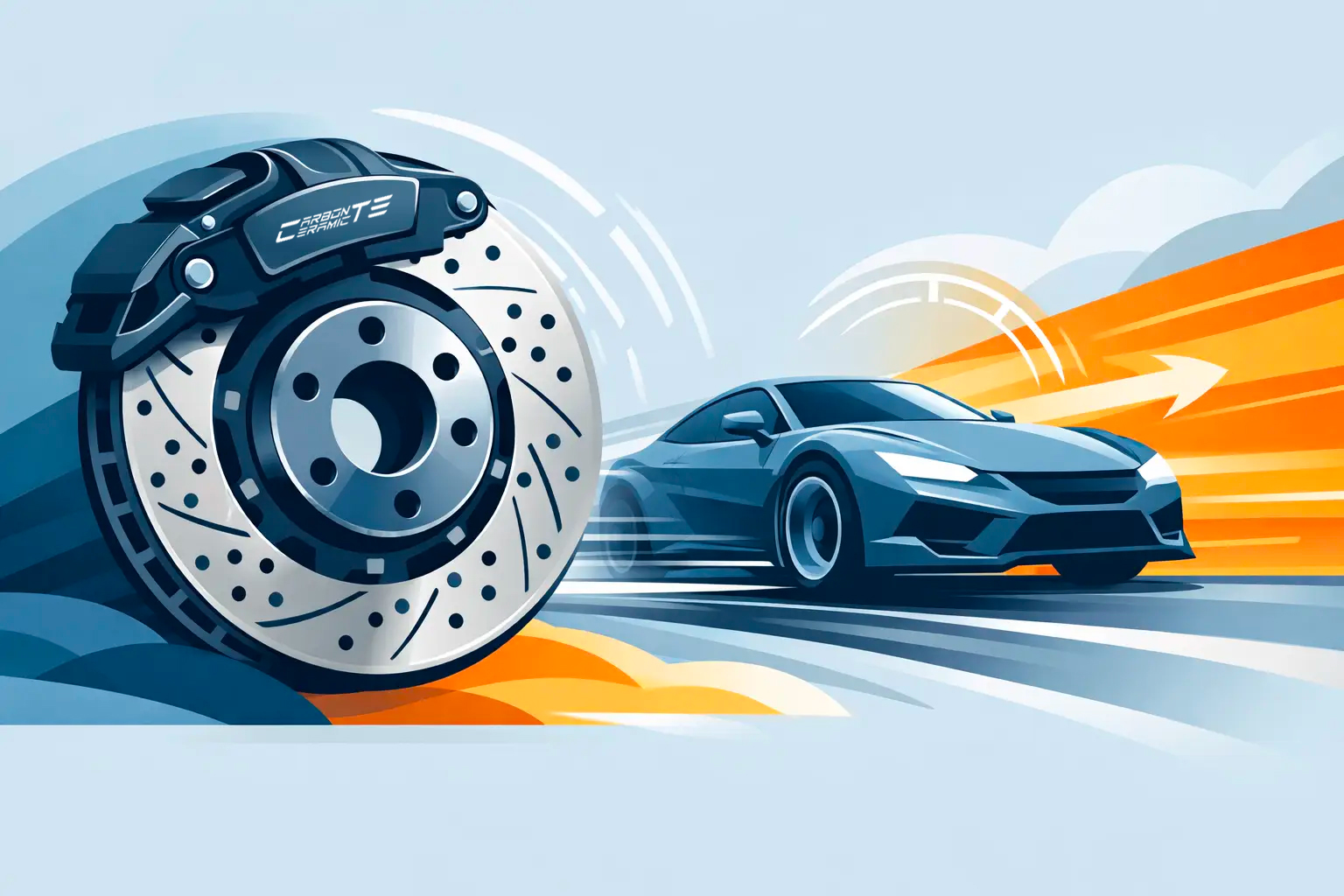
A heavy brake system can make a fast vehicle feel slower, less precise, and less confident when the road gets demanding. The problem is not only total vehicle weight. Brake lightweighting targets mass at the wheel - where every pound affects suspension movement, steering response, ride control, and the driver’s ability to trust the car under repeated hard braking.
For performance workshops, distributors, and owners of premium vehicles, lightweight braking is not a cosmetic specification. It is a system-level decision. A properly engineered carbon ceramic brake kit can reduce unsprung and rotating mass while delivering the thermal resistance needed for aggressive street driving, mountain roads, track sessions, and high-speed stopping events.
Why Brake Weight Matters More at the Wheel
Vehicle weight always matters, but weight at the wheel carries a larger performance penalty than the same weight placed inside the cabin. Brake rotors, calipers, hubs, wheels, and tires are all part of the unsprung mass - the mass the suspension must control over every bump, compression, and surface change.
When unsprung mass is reduced, the suspension can react more effectively. The tire has a better opportunity to stay in contact with the road, which supports mechanical grip and more consistent chassis behavior. That matters on a Porsche driven hard through uneven corners, a BMW used for track-day sessions, a Tesla carrying substantial battery weight, or a Nissan GT-R braking from high speed.
Rotating mass is another factor. A brake disc does not simply add weight; it spins with the wheel. Reducing rotor mass can help the vehicle respond more eagerly to acceleration and deceleration inputs. The real-world result depends on tire selection, wheel weight, suspension calibration, vehicle mass, and driver use, but the direction is clear: unnecessary rotating weight works against responsiveness.
Brake Lightweighting Is Not Just About Smaller Parts
The wrong approach to lightweight braking is removing material without respecting heat capacity, stiffness, pad contact, and vehicle-specific load. A lighter disc that cannot manage repeated thermal cycles is not a performance upgrade. A caliper that flexes under pressure can compromise pedal consistency. A kit with poor rotor offset or incorrect mounting geometry can create fitment issues that erase any claimed benefit.
Effective brake lightweighting depends on engineering the full assembly. Rotor size and thickness must suit the vehicle’s weight, power, wheel clearance, intended use, and axle balance. Caliper piston sizing must work with the hydraulic system. Mounting brackets, hats, hardware, pads, and brake lines must all support repeatable braking behavior.
That is why complete systems are generally preferable to piecemeal component swaps for demanding builds. A vehicle-specific kit gives installers a defined package rather than a collection of parts that may not share the same thermal, hydraulic, or dimensional assumptions.
Carbon Ceramic Rotors Change the Weight Equation
Carbon ceramic brake discs are central to modern lightweight braking because they can offer significant mass reduction compared with conventional iron rotors of a similar application. This can reduce unsprung mass at all four corners while maintaining exceptional resistance to heat under repeated high-load braking.
The advantages extend beyond the scale. Carbon ceramic material is engineered for high-temperature operation, helping resist the heat buildup that contributes to fade, vibration, surface damage, and inconsistent pedal behavior in severe use. For vehicles that repeatedly brake hard from speed, thermal control is a safety and performance requirement, not an optional feature.
Carbon ceramic systems also offer long service potential when correctly matched to the vehicle and operating conditions. However, they are not automatically the best answer for every car. A daily-driven vehicle that never sees heavy braking may not fully use the material’s capability. The cost of the system, replacement planning, climate, driving style, and intended service life should all be considered before specifying a kit.
The Caliper’s Role in a Lightweight Brake System
Rotors get most of the attention, but calipers are equally important. A monobloc caliper can combine low weight with high structural stiffness, helping maintain controlled piston movement and consistent clamping force under pressure.
A rigid caliper body supports a firmer, more predictable pedal feel because less energy is lost to component deflection. The benefits become more apparent when braking loads rise: repeated corner entries, downhill sections, high-speed highway runs, or heavy vehicles carrying significant momentum.
Caliper design must also support practical service. Pad replacement access, piston seal design, fluid management, dust boot configuration, and hardware quality all affect long-term ownership. Performance buyers should look beyond a caliper’s appearance and verify its construction, piston layout, mounting method, and compatibility with the intended rotor and wheel package.
Where the Gains Are Most Noticeable
Brake lightweighting produces the strongest return when a vehicle is already capable of generating meaningful brake load. High-performance coupes, sports sedans, electric performance vehicles, SUVs, and track-focused builds are natural candidates because they combine power, speed, and repeated stopping demand.
On a heavy luxury SUV or Defender platform, the benefit is often confidence under load. Reducing wheel-end mass while adding greater thermal headroom can help the vehicle feel more composed during repeated braking cycles. On a lighter sports car, the driver may notice sharper turn-in, improved suspension response, and a more immediate connection to the road.
For Tesla, Porsche, BMW, Jaguar, Land Rover, Toyota Supra, and supercar applications, fitment is not a minor detail. Wheel clearance, electronic parking-brake integration, brake bias, sensor compatibility, and factory wheel design can all affect the correct kit specification. The best product is the one engineered for the exact platform and its real operating conditions.
What Workshops and Distributors Should Verify
A brake upgrade should arrive with more than attractive claims about weight savings. Professional buyers need evidence that the manufacturer controls the engineering and production process. Ask how rotor materials are developed, where calipers are machined, how brackets are checked, and whether quality systems are documented.
Look closely at the kit’s scope. A complete package should clearly define discs, calipers, brackets, lines, pads, hats, hardware, and any required accessories. It should also identify wheel-clearance requirements and vehicle applications. This prevents costly installation delays and gives dealers confidence when supporting their customers.
Manufacturing control is especially relevant in carbon ceramic braking, where consistency in material processing, machining, assembly, and inspection affects durability and performance. CCYS maintains 90% of production in-house, combining R&D, precision machining, and quality management under direct factory control. IATF 16949 and ISO 9001 certification add further assurance for partners who need repeatable product quality rather than uncertain component sourcing.
Match the System to the Job
The lightest possible brake package is not always the right package. A street-driven luxury vehicle may prioritize quiet operation, cold performance, service life, and clean wheel appearance. A track-oriented build may place greater emphasis on thermal stability, pad selection, pedal consistency, and high-temperature durability. A distributor may need broad fitment coverage and dependable replacement support across multiple vehicle lines.
The right specification begins with honest use-case information: vehicle model, wheel size, horsepower level, tire package, expected braking loads, and road or track use. From there, rotor dimensions, caliper configuration, pad compound, and supporting chassis components can be selected as one system.
A brake system should make the driver feel composed when speed rises and braking zones arrive quickly. Choose lightweight components that have the structure, thermal capacity, vehicle-specific fitment, and manufacturing discipline to earn that confidence every time the pedal is pressed.