

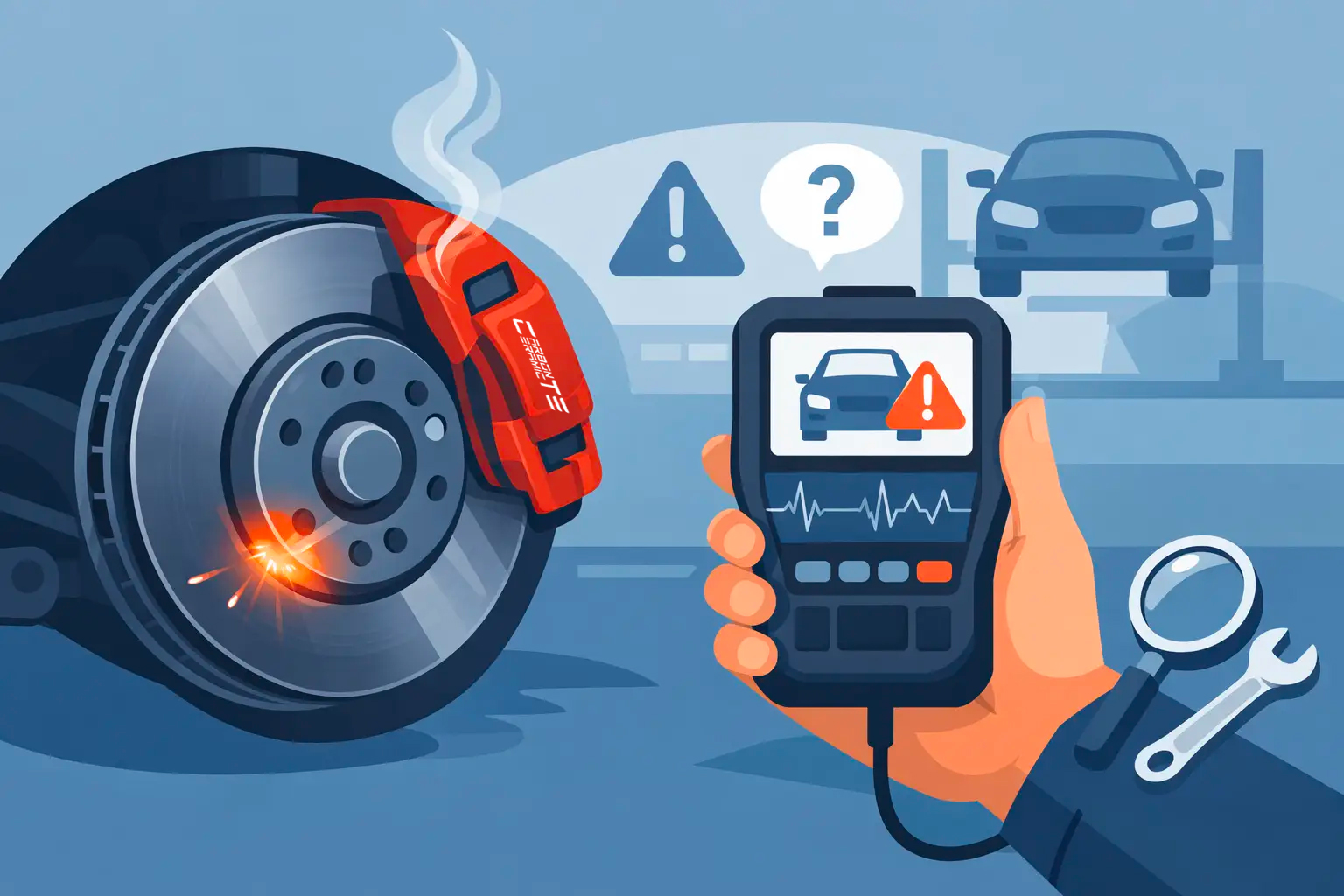
A dragging brake can turn a confident high-speed stop into a costly failure without much warning. The wheel runs hot, the vehicle may pull under braking or coast poorly, and the smell of overheated friction material follows even a short drive. Understanding why brakes drag matters because the first damaged component is rarely the last. Excess heat can compromise pads, rotors, seals, wheel bearings, brake fluid, and, in severe cases, the tire itself.
For performance workshops and owners of premium vehicles, brake drag is not a condition to dismiss as normal bedding, track residue, or a minor alignment issue. A correctly engineered brake system releases enough clearance after pedal application for the rotor to rotate freely. There may be light pad contact in some designs, but there should not be persistent clamping force, abnormal heat, or a wheel that resists rotation.
Why Brakes Drag: The Mechanical Principle
A disc brake applies force when hydraulic pressure moves caliper pistons outward, pressing pads against the rotor. When the driver releases the pedal, pressure must return through the hydraulic circuit and the piston seals must relax slightly. That controlled seal movement, along with pad hardware and caliper design, creates the running clearance needed to prevent excessive friction.
Brake drag occurs when one part of that release process fails. The cause can be hydraulic pressure trapped in the system, mechanical binding at the caliper or pads, rotor distortion, incorrect component fitment, or heat damage that changes how the assembly behaves. The location and pattern of overheating provide the first useful clues.
If one front wheel is dramatically hotter than the other, focus on that corner first. If both front brakes drag after several pedal applications, investigate the master cylinder, booster adjustment, brake fluid condition, or a shared hydraulic restriction. If the problem appears only after hard track use, thermal overload and component compatibility deserve closer attention.
The Most Common Causes of Brake Drag
Seized or Restricted Caliper Movement
On floating-caliper systems, the caliper must slide smoothly on guide pins or sleeves. Corrosion, damaged boots, incorrect grease, or swollen pin bushings can prevent it from centering over the rotor. The inboard pad may apply normally, but the caliper cannot retract or move back into position, leaving the outboard pad in contact.
A fixed multi-piston caliper eliminates sliding pins, but it introduces another inspection point: each piston must move evenly. A contaminated bore, damaged piston seal, or corrosion behind the seal can hold one or more pistons outward. This often produces tapered pad wear, localized rotor discoloration, and an uneven temperature pattern across the caliper body.
Do not assume that a performance caliper is immune to this issue. Racing-grade hardware operates at higher temperatures and may see more frequent pad changes, heat cycles, and exposure to brake dust. Clean assembly practices, correct service intervals, and proper piston inspection remain essential.
Trapped Hydraulic Pressure
A brake can also drag when the caliper is mechanically healthy but pressure cannot return to the master cylinder. An internally deteriorated flexible brake hose is a familiar cause. The inner liner can collapse and act like a check valve: pressure reaches the caliper when the pedal is applied, but returns slowly or not at all when the pedal is released.
A blocked compensating port in the master cylinder can create a similar result, especially if the system has contaminated fluid or the pedal pushrod has insufficient free play. As braking heat raises fluid temperature, the fluid expands. If it cannot return to the reservoir, pressure rises and applies the brakes harder. The driver may notice a vehicle that rolls normally when cold but begins to slow, pull, or smell hot after a few miles.
This distinction is critical during diagnosis. With the affected brake dragging, carefully opening the bleeder screw can be informative. If fluid releases under pressure and the wheel immediately frees, the fault is likely upstream in the hydraulic circuit. This procedure requires proper safety controls because hot brake components and fluid can cause injury.
Pads Binding in the Bracket
Pads need to slide freely in their abutment points. Rust buildup under stainless hardware, damaged shims, excess coating on pad ears, or a bracket distorted by improper tightening can stop that movement. The pad does not retract because it is physically trapped in the applied position.
This is common after rushed brake service. Filing pad ears without correcting the source of corrosion is not a durable repair, and applying heavy grease to friction-adjacent surfaces attracts debris. The correct approach is to restore clean, square abutment surfaces, replace compromised hardware, verify pad fit, and use only the specified lubricant in the specified locations.
Vehicle-specific fitment also matters. A pad shape that appears close enough can have different ear geometry, backing-plate thickness, chamfers, or sensor provisions. On high-performance applications, small dimensional errors can become major thermal problems at speed.
Rotor Runout, Thickness Variation, and Heat Damage
A rotor that runs out excessively can push pistons back as it rotates, then force the pads into repeated contact. More often, runout and disc thickness variation create pedal pulsation and uneven pad transfer rather than constant drag, but the conditions can overlap when hardware is already marginal.
Severe overheating changes the equation. Blue or purple rotor coloring, cracked friction surfaces, crumbling pad edges, and a sharp burnt odor indicate temperatures beyond normal duty. At that point, piston seals may have hardened, dust boots may be damaged, fluid may have degraded, and the rotor may no longer deliver predictable friction.
Carbon ceramic systems bring major advantages in low unsprung weight, corrosion resistance, and high thermal capacity, but they are not a shortcut around diagnosis. Carbon ceramic rotors require compatible pads, caliper geometry, bedding procedures, and temperature management. A dragging pad can create concentrated heat and surface damage even when the disc material withstands temperatures that would distress a conventional iron rotor.
Parking Brake and Electronic Actuator Faults
A rear brake that drags may be caused by the parking brake rather than the service brake. Cable-operated systems can seize or fail to return. Drum-in-hat parking brakes can bind through corroded hardware or incorrectly adjusted shoes. Electronic parking brake actuators may also hold residual clamping force if there is a fault, incomplete service-mode procedure, or incorrect installation.
Before replacing rear calipers, verify that the parking brake mechanism fully releases. Disconnecting or backing off the cable, following the vehicle-specific electronic service procedure, and checking lever return can prevent an unnecessary caliper replacement.
A Disciplined Brake Drag Diagnosis
Start with the customer’s exact complaint. Does the vehicle pull only after a hard stop? Does the issue develop after a track session, after a pad change, or after the car sits for weeks? Does it affect one wheel or an entire axle? These details narrow the test plan before parts are removed.
After a controlled road test, compare rotor and wheel temperatures across the axle using a suitable infrared thermometer or thermal camera. Avoid touching components directly. Then raise the vehicle safely and check wheel rotation, pad wear, rotor condition, hose routing, caliper movement, and parking brake release. Compare the affected corner against the opposite side rather than evaluating it in isolation.
For a suspected hydraulic restriction, test the system while the brake is actively dragging. For a suspected mechanical issue, remove the caliper and confirm that pads move freely in their guides and pistons retract correctly using the manufacturer-approved method. Check fluid age and boiling point where appropriate, especially on vehicles used for repeated heavy braking.
Do not mask drag by fitting a more aggressive pad compound. Higher-friction material may improve bite, but it cannot correct trapped pressure, a seized piston, or incorrect hardware. It can also accelerate heat accumulation when the root cause remains.
Repairing the Cause, Then Restoring Performance
A correct repair replaces damaged parts and addresses the failure mechanism. A seized guide pin calls for proper hardware service or replacement, not just fresh grease. A restricted hose should be replaced, followed by fluid service and a full system bleed. Heat-damaged pads and rotors should be evaluated as a set, because new pads installed against compromised disc surfaces may bed unevenly and repeat the complaint.
For upgraded brake systems, match the entire package: rotor, caliper, mounting bracket, pad compound, lines, fluid, and vehicle-specific hardware. This is where complete, engineered kits offer a meaningful advantage over piecemeal modifications. CCYS applies in-house control across its carbon ceramic braking systems to support consistent fitment, thermal performance, and component compatibility for demanding road and track applications.
After repair, bed the pads according to the system specification, recheck wheel rotation and fluid level, torque all hardware correctly, and inspect again after the initial heat cycle. A brake that releases cleanly in the workshop but drags after temperature builds has not been fully repaired.
When a wheel is running hot, treat it as a safety and engineering problem, not a nuisance. Stop driving long enough to identify the source, protect the surrounding components, and return the vehicle to the precise brake release its performance was built to deliver.