

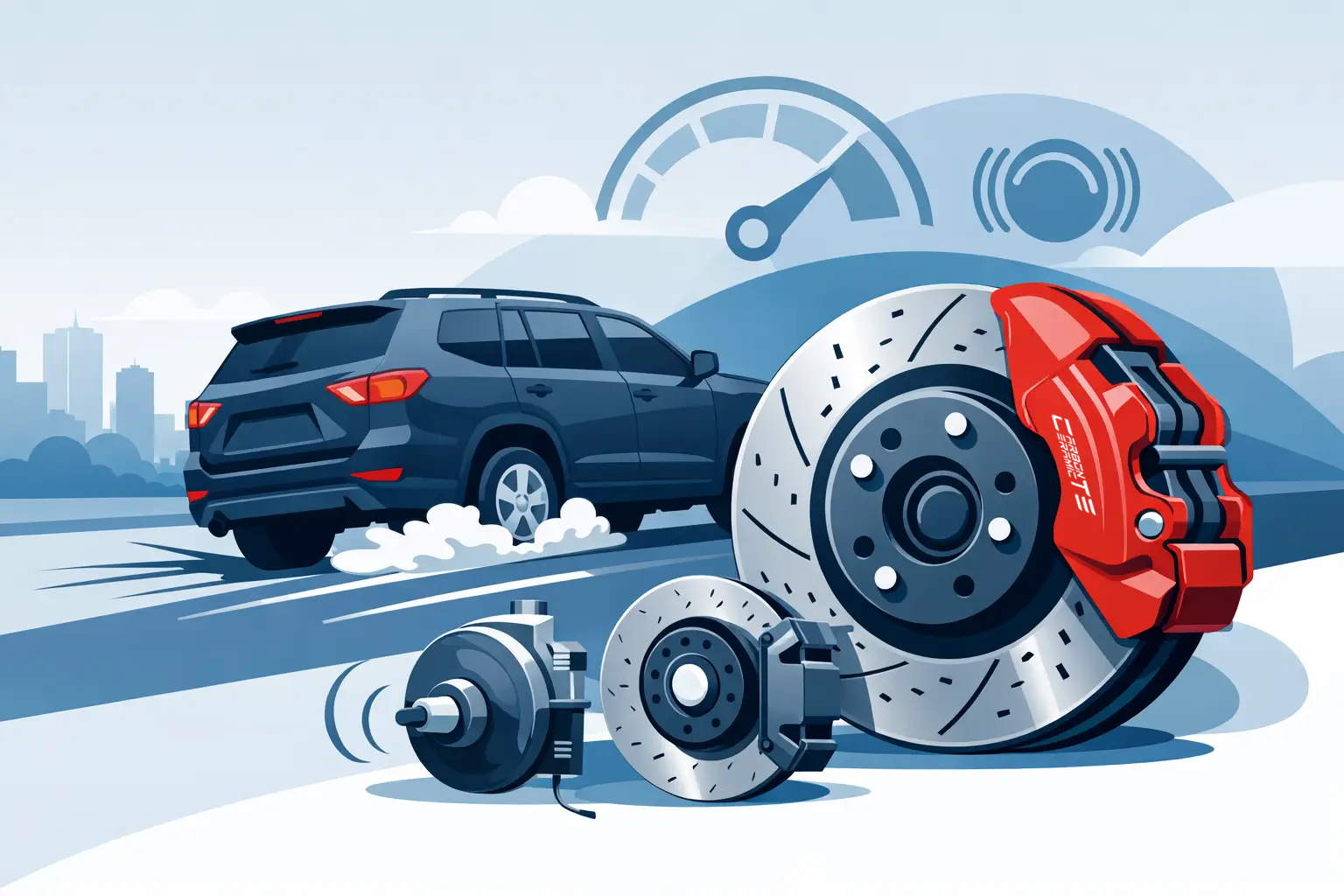
A fully loaded performance SUV can gain speed with startling ease. The harder moment comes when traffic stops, a downhill corner tightens, or repeated high-speed runs load the brake pedal with heat. Heavy SUV braking is not simply a matter of fitting larger rotors. It is a vehicle-system challenge involving mass, thermal control, hydraulic balance, tire grip, and components engineered to work together.
For performance workshops, distributors, and owners of premium SUVs, the right answer is not the most aggressive-looking caliper. It is a vehicle-specific brake system that remains predictable when the vehicle is carrying its full weight and asking for repeated, controlled deceleration.
Why Heavy SUV Braking Creates Extreme Loads
An SUV's mass changes the braking equation immediately. Kinetic energy rises with vehicle mass and rises even faster with speed. That energy does not disappear when the driver presses the pedal. It must be converted into heat through the pads, rotors, calipers, brake fluid, wheels, and surrounding airflow.
A heavy SUV also transfers substantial load to the front axle under deceleration. The front brakes therefore do more than their share of the work, while the rear system must still contribute correctly to keep the vehicle stable. If the system is not matched to the chassis, a brake upgrade can create an inconsistent pedal, premature ABS intervention, uneven pad wear, or an unsettled feel during trail braking.
This is why a single hard stop is not the only test that matters. A brake package may feel strong during a cold, isolated stop yet lose consistency after mountain driving, track sessions, towing, or repeated highway deceleration. The real requirement is repeatable stopping force after the components are heat-soaked.
Bigger Rotors Help, but They Are Not the Whole System
Increasing rotor diameter can improve brake torque because the caliper applies force farther from the wheel center. A larger effective radius gives the braking system more leverage. More rotor mass and surface area can also help absorb and release heat.
But rotor size alone does not define a high-performance result. Rotor thickness, internal vane design, disc material, pad compound, caliper rigidity, piston sizing, brake line condition, and master-cylinder compatibility all affect the final behavior at the pedal. So do wheel clearance and the airflow available behind the wheel.
A poorly matched large rotor can add weight without solving heat management. An oversized caliper with incorrect piston area can alter pedal travel or hydraulic bias. A pad selected only for peak friction may be noisy, harsh on rotors, or less controllable at lower operating temperatures. Engineering excellence comes from balancing these variables, not treating them as separate catalog items.
The Caliper Must Stay Rigid Under Pressure
Under heavy braking, caliper flex reduces the driver's direct connection to the brake system. Pedal input first goes into deflecting hardware rather than clamping the pad consistently against the disc. A properly engineered monobloc caliper is designed to resist that deformation while distributing pressure evenly across the pad.
Piston configuration matters as well. Multiple pistons can support even pad loading across a large friction surface, but the piston sizes must be selected for the specific rotor, vehicle weight, and hydraulic system. More pistons are not automatically better. Correct clamping force and pressure distribution are what produce stable, repeatable performance.
Pads Determine Feel as Much as Stopping Force
The brake pad is the working friction interface, and its behavior changes dramatically with temperature. A street-focused SUV needs progressive response from cold conditions through normal road use. A vehicle used for fast canyon driving, towing, or track activity needs a compound that resists fade and maintains friction as temperatures rise.
There is always a trade-off. More aggressive race-oriented pads may create more noise, dust, and cold-bite compromises. For premium road vehicles, the target is often strong initial response with a broad, stable friction range rather than an abrupt on-off feel. The right pad selection must match how the SUV is actually driven.
Thermal Resistance Is the Difference Between One Stop and Ten
Brake fade is a confidence problem before it becomes a performance problem. As rotor and pad temperatures rise beyond their effective range, the pedal may require more force, stopping distances can increase, and the driver loses the predictability needed to place a large vehicle precisely.
Thermal management begins with rotor design. A performance disc needs material stability, effective internal ventilation, and sufficient thermal capacity for the vehicle application. It also needs to resist distortion and cracking under repeated thermal cycles. Carbon ceramic rotors are particularly valuable where lower weight, high thermal resistance, and repeated high-energy braking are priorities.
Compared with a conventional heavy iron setup, a well-engineered carbon ceramic system can significantly reduce rotating and unsprung mass. That reduction supports more responsive suspension movement and can sharpen steering and ride control over uneven pavement. On a tall, heavy SUV, reducing mass at the wheel is not a cosmetic benefit. It affects how the vehicle reacts during braking, turn-in, and rapid direction changes.
Carbon ceramic technology is not a universal shortcut. Initial investment is higher, and system design must account for pad compatibility, operating conditions, and exact vehicle fitment. For a vehicle that spends its life in light urban traffic, the owner must decide whether the added thermal headroom and weight savings justify the cost. For high-output luxury SUVs, performance builds, frequent mountain use, towing, or repeated high-speed braking, the case becomes much stronger.
Vehicle-Specific Fitment Protects Safety and Performance
A brake system should never be selected by rotor diameter or wheel size alone. The installer must confirm hub interface, offset, mounting hardware, wheel-spoke clearance, brake line routing, parking brake requirements, electronic brake functions, and front-to-rear system balance.
This is particularly relevant across platforms such as Porsche, Tesla, BMW, Jaguar, Land Rover, Defender, and other high-performance SUVs. Even vehicles in the same model family can have different wheel packages, axle hardware, electronic calibrations, and factory brake configurations. A complete kit designed for the application reduces the risk of compromises that appear after installation.
The same principle applies to supporting chassis components. Worn control arms, stabilizer links, ball joints, tie-rod ends, rack ends, or rubber bushings can make a high-performance brake kit feel less precise than it should. Under hard braking, excessive suspension movement can change alignment and reduce driver confidence. Braking performance and chassis condition are connected at the tire contact patch.
Do Not Ignore Tires, Fluid, and Installation Discipline
No brake kit can create grip that the tires do not have. Tire condition, compound, pressure, and load rating set the available traction, while ABS and stability systems manage braking near that limit. The brake system must deliver controlled torque that allows these systems to work effectively rather than overwhelming the chassis.
High-temperature brake fluid, correct bleeding procedures, clean hub surfaces, accurate torque values, and proper pad bedding are equally important. A premium braking package installed without disciplined preparation can suffer from pedal inconsistency, disc runout, vibration, or uneven friction transfer. The hardware deserves an installation process of the same standard.
What Professional Buyers Should Ask Before Specifying a Kit
Before recommending a solution, a distributor or workshop should establish the SUV's actual use case: daily driving, high-speed road use, mountain descents, towing, track activity, or a combination. Vehicle weight, power output, wheel diameter, current brake behavior, and future chassis modifications should all be part of the discussion.
Then evaluate the brake system as a complete engineered package. Confirm the rotor construction, caliper design, piston configuration, pad options, mounting brackets, lines, accessories, and application-specific clearances. Ask who controls production, what quality systems are in place, and whether the manufacturer can provide technical support when a fitment question arises.
CCYS approaches this requirement with carbon ceramic brake kits, rotors, pads, monobloc calipers, hubs, and supporting chassis components developed for demanding vehicle applications. With 90% of production completed in-house and quality management supported by IATF 16949 and ISO 9001 certification, the focus is on consistent execution rather than assembling an assortment of unrelated parts.
For heavy SUV braking, confidence comes from knowing that the pedal will deliver the same controlled response on the final downhill stop as it did on the first. Specify the system around the vehicle, the load, and the heat it must manage, then give the driver braking hardware worthy of the SUV's performance.