

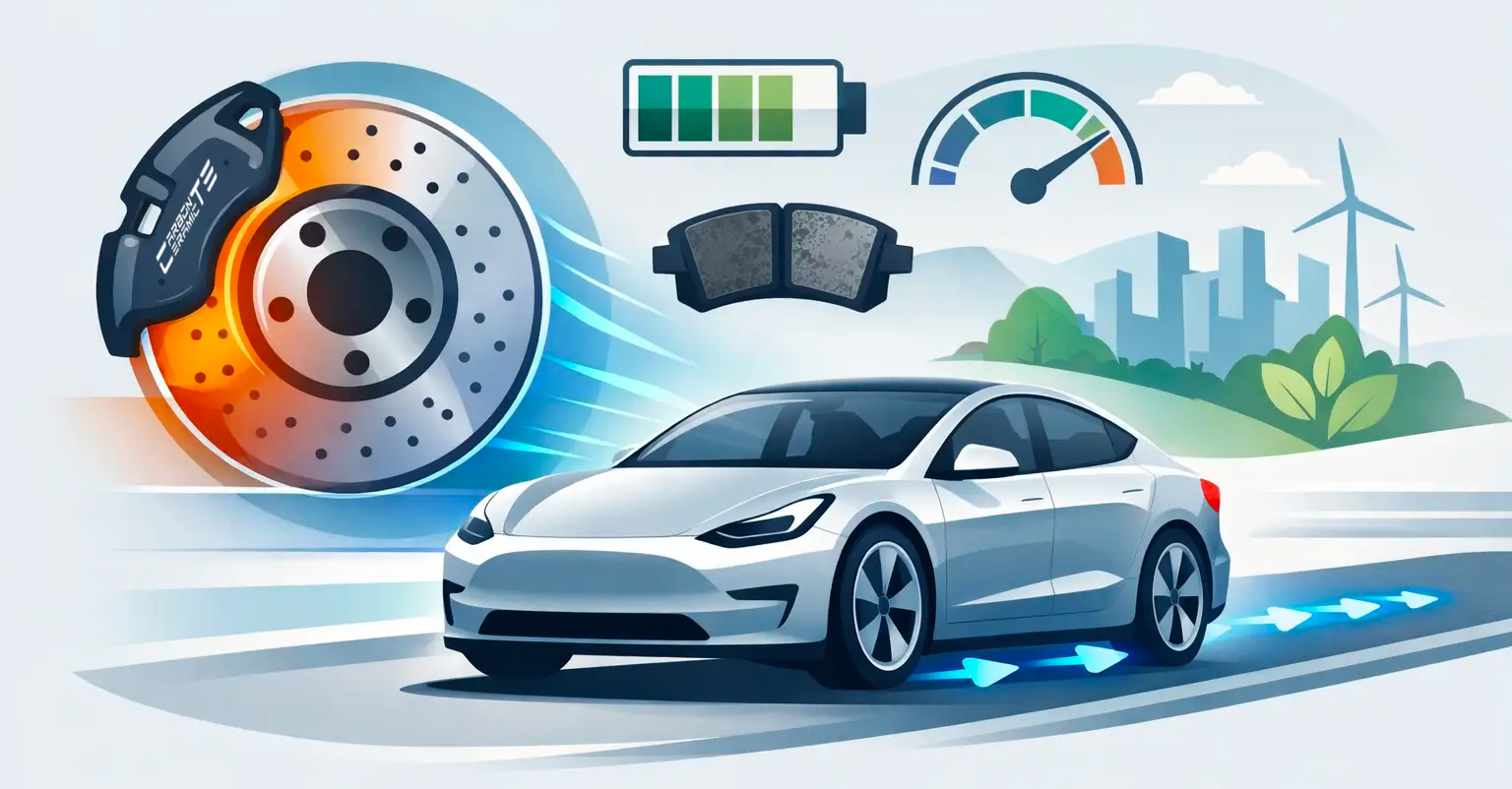
A heavy EV carries serious momentum. When a Tesla driver asks whether regenerative braking preserves pads and rotors, the real question is more demanding: what happens when the car must stop hard, repeatedly, and with no room for fade? A Tesla regenerative braking wear study must look beyond normal commuting mileage. It must separate the low-friction-brake life of daily driving from the thermal and mechanical punishment created by mountain roads, high-speed driving, track sessions, corrosion exposure, and emergency stops.
What a Tesla regenerative braking wear study should measure
Regenerative braking changes the duty cycle of a brake system. Instead of immediately converting vehicle speed into heat through pads and rotors, the drive motors operate as generators during deceleration. They return energy to the battery while producing braking torque at the axle or axles supported by the powertrain.
This reduces how often the hydraulic friction brakes are asked to perform routine deceleration. In urban traffic, gradual approaches to intersections, and predictable freeway exits, that can substantially reduce pad material transfer and rotor abrasion. For many Tesla owners, the result is unusually low visible pad wear over long road mileage.
That observation is valid, but it is not the entire wear study. Brake wear is not measured only in millimeters of pad thickness. Rotor condition, corrosion, surface finish, caliper movement, fluid condition, heat cycles, and the ability to produce repeatable stopping force all matter. A brake system can show minimal friction-material wear yet still require inspection or service.
A useful study should track pad thickness and rotor thickness, but it should also record rotor runout, disc surface corrosion, pad glazing, slide-pin or caliper condition where applicable, brake-fluid moisture, and stopping consistency under elevated temperatures. For performance workshops, it should include vehicle load, tire specification, wheel fitment, ambient temperature, driving profile, and whether regenerative braking was limited by battery state, temperature, or traction control intervention.
Why regenerative braking does not eliminate brake demand
Regeneration is powerful, but it is conditional. The vehicle cannot always recover the same amount of energy. A fully charged battery has limited room to accept additional energy. A cold battery may restrict regenerative capability until it reaches an appropriate operating range. Low traction, aggressive deceleration requests, and certain stability-control events can also alter how much braking torque is delivered electrically.
The friction system remains the final authority when the driver needs maximum deceleration. That includes panic stops, repeated downhill braking, high-speed road use, and track driving. At that point, Tesla weight, speed, tire grip, and brake temperature become decisive.
This distinction matters for buyers who assume low normal-use wear means any brake system is adequate for performance use. It does not. A Model S, Model X, Model 3 Performance, or Model Y Performance may spend much of its life slowing electrically, then demand a large amount of thermal capacity from the friction brakes in a short window. The pad and rotor system must be ready for that transition without a long pedal, uneven response, vibration, smoke, or fade.
Vehicle mass changes the equation
Electric vehicles deliver immediate torque and typically carry substantial battery mass. The energy that must be managed during a stop rises sharply with speed. A moderate stop from city speeds is one thing. Repeated braking from highway or track speeds is another, especially with passengers, cargo, larger wheels, or sticky performance tires.
Regeneration recaptures part of that energy when conditions allow. It does not erase the fundamental thermal load placed on the brake system during high-demand use. A friction brake upgrade should therefore be selected according to the hardest credible use case, not the easiest commute.
The hidden wear risk: brakes that work too infrequently
Low pad wear can create a different maintenance issue. Friction brakes that are rarely used may see corrosion on rotor faces, especially in wet, salted, or coastal environments. Surface rust can be normal after parking, but persistent corrosion, uneven pad contact, and seized hardware are not performance advantages.
This is particularly relevant for vehicles driven mostly with strong one-pedal braking. The rotors may not receive enough regular friction work to keep surfaces uniformly clean and conditioned. Light brake application can also leave a different wear pattern than repeated full-pressure stops.
The practical response is inspection, not guesswork. During routine tire rotations or scheduled service, check rotor surfaces on both sides, pad movement, caliper hardware, dust boots, and brake fluid. Drivers should also use the friction brakes deliberately and safely from time to time, following vehicle guidance and road conditions, rather than allowing the system to sit unused for extended periods.
For a workshop, the inspection must include inner-pad and inner-rotor condition. Looking through a wheel at the outer rotor face does not verify the complete system. Uneven corrosion or dragging can develop out of sight.
How driving mode changes the results
No single Tesla wear figure applies to every owner. A commuter in warm, dry conditions using predictable deceleration may see extremely slow pad consumption. A driver in a snow-belt state may have more corrosion-related service needs despite low mileage. An enthusiast using a Performance model on canyon roads may reach friction-brake temperature limits long before pads are close to worn out.
Track use is its own category. Regeneration can contribute to deceleration, but sustained laps place repeated high-energy demands on the friction system. Battery temperature, state of charge, power limits, and software behavior can affect the consistency of regenerative contribution. The brake system needs sufficient thermal mass, caliper stiffness, pad compound stability, and fluid temperature resistance to remain predictable when electrical braking is reduced or unavailable.
That is why an EV brake evaluation should include cold response, normal street response, repeated high-load stops, and post-heat inspection. A pad that is quiet and clean for commuting may not be appropriate for repeated high-temperature braking. Conversely, an aggressive track-oriented compound can introduce noise, dust, reduced cold comfort, or faster rotor wear in a daily-driven vehicle.
Reading wear data without making the wrong upgrade decision
When reviewing a Tesla regenerative braking wear study, avoid treating long pad life as a standalone verdict. Ask what the vehicle was used for, how regenerative braking was configured, whether the brakes were inspected for corrosion, and whether the test included demanding friction-brake events.
For standard road use, the priority may be reliable fitment, corrosion resistance, smooth operation, and a pad compound that performs confidently from cold. For spirited road driving, more thermal capacity and a firmer, more consistent pedal become more relevant. For track-oriented or heavily modified vehicles, the decision should account for rotor diameter, disc construction, caliper piston sizing, pad area, brake cooling, wheel clearance, tire capability, and brake-fluid specification as one matched system.
Replacing only one component can move the weakness elsewhere. A high-friction pad on an undersized thermal package may generate heat faster than the system can control it. Larger brakes without proper wheel fitment verification create an avoidable installation problem. Carbon ceramic systems can reduce unsprung and rotating mass while offering high thermal resistance, but they must be engineered around vehicle-specific caliper geometry, rotor mounting, pads, hardware, and intended use.
What performance buyers should demand from a brake kit
A brake kit for a Tesla should not be evaluated by appearance alone. The supplier should provide confirmed vehicle fitment, clear wheel-clearance requirements, complete mounting hardware, replacement-part availability, and technical support. The manufacturer’s production control also matters because caliper machining, rotor construction, bracket accuracy, and material consistency directly affect pedal feel, durability, and safety.
For distributors and performance shops, documented quality systems and a complete package reduce installation uncertainty. For owners, the goal is more direct: confidence that the car will deliver repeatable stopping force when regeneration is no longer carrying the workload.
CCYS approaches this requirement with vehicle-specific carbon ceramic brake systems, racing-grade thermal resistance, and manufacturing control across 90% of production. IATF 16949 and ISO 9001 quality standards support the same principle that a serious Tesla brake study reveals: low routine wear is valuable, but dependable braking under maximum demand is non-negotiable.
The right next step is to inspect the braking system for the way the vehicle is actually driven, then specify pads, rotors, calipers, and fluid capacity for the moment when battery recovery ends and friction braking must do all the work.