

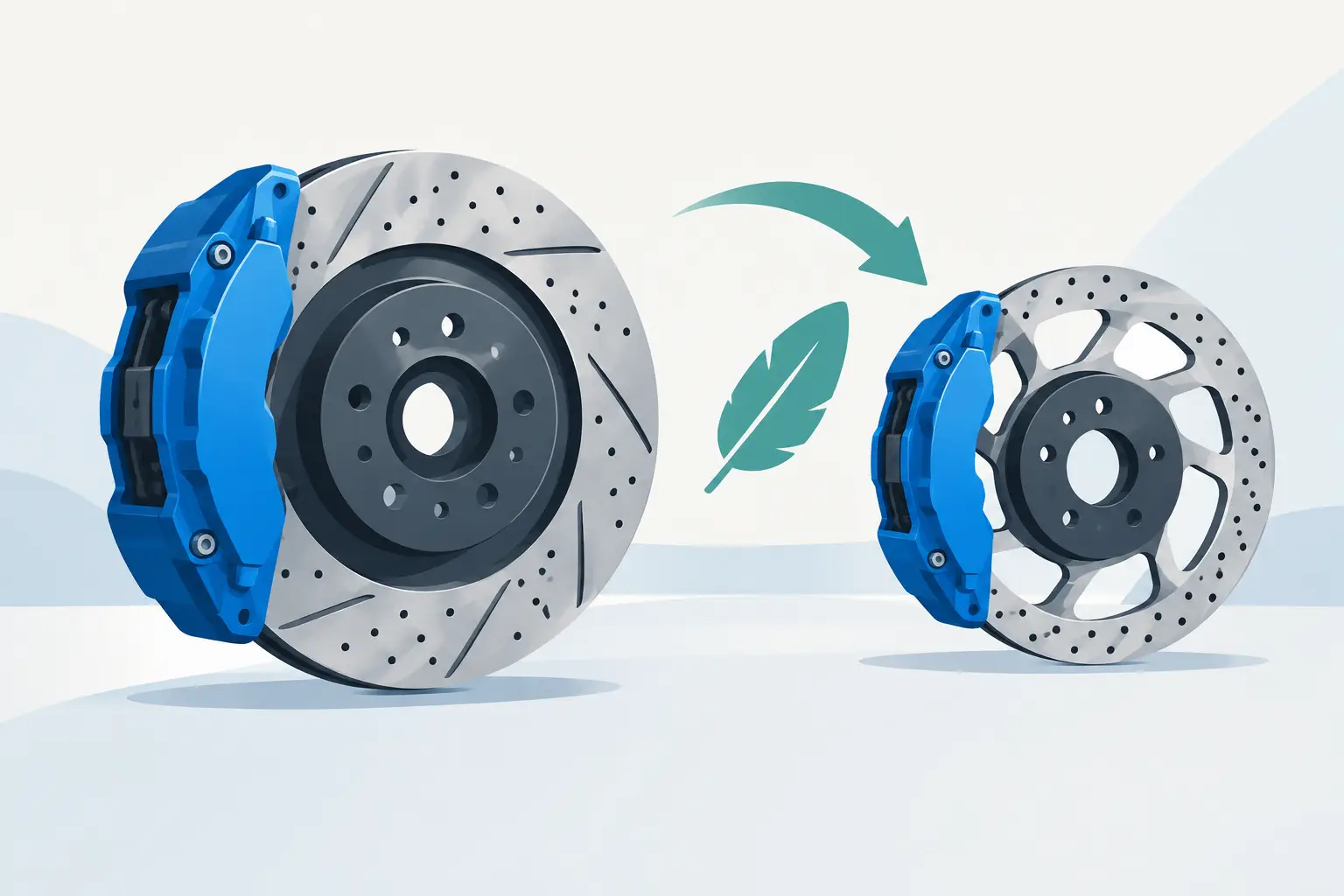
A heavy braking system can make a performance vehicle feel slower to react exactly when the driver needs precision most. When you reduce brake system weight correctly, the gain is not limited to the scale. Lower unsprung mass can sharpen steering response, help the suspension follow uneven pavement, and reduce the rotating inertia the drivetrain must accelerate and decelerate. The condition is non-negotiable: braking force, thermal capacity, pedal feel, and vehicle-specific fitment must remain intact.
For performance workshops, distributors, and serious vehicle owners, the question is not whether lighter brakes are desirable. It is which components can be made lighter without turning a safety-critical system into a compromise.
Why Brake Weight Has a Bigger Effect Than Expected
Brake components sit at the wheel end, where their mass has an outsized influence on vehicle behavior. Rotors, calipers, brackets, pads, and hubs contribute to unsprung weight, meaning weight not fully supported by the springs. The more unsprung mass a vehicle carries, the harder it is for the suspension to keep each tire planted as the road surface changes.
Reducing weight at the wheel can improve compliance over broken pavement, curb transitions, and track surface irregularities. That does not automatically transform every street car into a race car, but on heavy premium EVs, supercars, SUVs, and track-focused builds, the difference can be meaningful. Less rotating mass also reduces the energy needed to spin the brake disc and wheel assembly up to speed.
The engineering objective is balance. A lightweight disc that cannot absorb repeated high-energy stops will overheat. A smaller caliper that lacks stiffness can produce inconsistent pedal response. The correct solution removes unnecessary mass while preserving clamp force, heat management, and structural rigidity.
Start With the Rotor: The Largest Opportunity
The brake rotor is often the most effective place to reduce brake system weight. Conventional cast-iron rotors are durable and cost-effective, but they are heavy. Large-diameter iron discs used on high-performance vehicles can add substantial mass at each corner, particularly when combined with multi-piston calipers and large wheels.
Carbon ceramic brake discs offer a major weight advantage over comparable iron rotors. Their carbon fiber-reinforced ceramic construction can substantially reduce mass while delivering exceptional thermal resistance. This matters during repeated high-speed braking, downhill driving, towing applications, and track sessions, where heat buildup can push an iron system toward fade, cracking, or uneven material transfer.
Weight savings alone should not be the sales pitch. A carbon ceramic rotor must be engineered as part of a complete system. Its diameter, thickness, friction ring design, mounting method, pad compound, caliper piston area, and cooling path all influence real stopping performance. A rotor that looks impressive behind a wheel but lacks correct thermal and friction matching is not a performance upgrade.
For a vehicle-specific carbon ceramic kit, verify that the disc geometry preserves proper wheel clearance, rotor offset, ABS compatibility, and brake balance. This is especially important on Porsche, Tesla, BMW, Jaguar, Land Rover, Toyota Supra, Nissan GT-R, Defender, and supercar platforms, where electronic controls and factory wheel packaging leave little room for approximation.
Thermal Resistance Is Part of Weight Reduction
Lighter does not mean thinner at any cost. A properly developed carbon ceramic rotor can handle high temperatures without the rapid dimensional change associated with overloaded conventional rotors. Stable thermal behavior supports predictable pedal feel and reduces the likelihood of brake fade under sustained use.
That advantage depends on application. Street-driven vehicles that rarely see high brake temperatures may not use the full capability of a carbon ceramic system. For drivers who regularly encounter repeated heavy braking, however, the combination of low mass and thermal endurance is where the upgrade earns its value.
Choose Calipers for Stiffness, Not Just Appearance
A large painted caliper can fill a wheel, but visual impact is not a braking strategy. The caliper should be assessed for material, bridge stiffness, piston configuration, weight, seal design, and compatibility with the selected rotor and pad.
Monobloc calipers are a strong option for reducing mass while maintaining rigidity. Machined from a single forged or billet structure, they eliminate the joint line found in two-piece caliper bodies. The result can be a lighter, more rigid assembly with more consistent behavior under high hydraulic pressure.
Stiffness matters because caliper flex can lengthen or soften pedal response. In a performance braking system, the driver needs clear feedback at the threshold of tire grip. A properly engineered multi-piston monobloc caliper distributes clamp load across the pad and supports controlled, repeatable braking without adding unnecessary wheel-end mass.
Piston count should not be treated as a simple bigger-is-better specification. More pistons can help optimize pad pressure distribution, but piston diameters must be matched to the master cylinder, booster behavior, and front-to-rear brake balance. An incorrectly matched caliper may create excessive pedal travel, over-brake one axle, or interfere with the stability-control system.
Do Not Ignore Hardware, Hubs, and Brackets
The rotor and caliper deliver the biggest visible savings, but supporting components deserve equal engineering attention. Caliper brackets must position the caliper precisely over the friction ring and withstand repeated braking loads without deflection. Lightweight material is only useful when its strength, machining accuracy, and corrosion protection meet the demands of the application.
Wheel hubs are another opportunity, particularly in performance builds where the original component is oversized, worn, or unsuitable for the intended rotor assembly. A lightweight hub can reduce rotating mass, but it must maintain bearing interfaces, stud geometry, flange strength, and runout control. A few pounds saved is not worth a vibration problem or compromised wheel retention.
Fasteners, rotor hats, and floating hardware also require careful selection. Two-piece rotor designs can use an aluminum hat to lower mass while allowing the friction ring to manage heat. The connection between these parts must accommodate thermal expansion without producing noise, looseness, or fatigue failure.
Keep the System Matched From Pedal to Tire
The fastest route to an expensive brake problem is mixing parts based only on weight or catalog specifications. Brakes work as a system. The pad compound affects cold bite, heat tolerance, noise, dust, and disc wear. The rotor affects thermal storage and friction consistency. The caliper determines clamp load and pedal feel. Brake lines, fluid, master-cylinder sizing, and electronic control calibration influence the final result.
For road and track customers, a complete kit usually offers a safer and more predictable route than assembling unrelated components. A complete system should include the correctly matched carbon ceramic discs, calipers, pads, brackets, lines, and installation hardware for the intended vehicle platform.
Wheel clearance must be confirmed before ordering. Spoke shape, barrel diameter, offset, and wheel weights can interfere with a larger caliper even when the nominal wheel diameter appears sufficient. Professional workshops should use a supplied clearance template where available and verify both static clearance and suspension movement.
Weight Reduction Has Trade-Offs
Carbon ceramic systems are premium components, and their initial cost is higher than many iron-based upgrades. Replacement planning also matters. Not every pad compound is compatible with every carbon ceramic disc, and careless installation can damage expensive components.
Cold-weather behavior, street noise, and low-temperature bite depend on the pad and disc combination. A race-oriented pad may be excellent at high temperatures but unpleasant on a daily-driven luxury vehicle. Conversely, a street-focused compound may sacrifice some absolute track endurance for quiet, controlled operation during normal driving.
Vehicle use should guide the specification. A Tesla or Land Rover carrying significant curb weight needs thermal capacity and axle balance appropriate to its mass. A Nissan GT-R or Porsche used for track driving needs repeated-stop stability and confidence at high speed. A show-oriented build may prioritize wheel presentation, but it still requires certified materials, accurate fitment, and brake performance that matches the vehicle's capability.
Manufacturing Control Protects Performance
Lightweight braking components demand precise machining and consistent material control. Rotor runout, caliper bore finish, piston sealing, bracket alignment, and disc-to-hat assembly all influence performance and service life. These are not areas where visual inspection alone is enough.
CCYS controls 90% of its production in-house, from R&D and precision machining through quality management. Supported by IATF 16949 and ISO 9001 manufacturing standards, this level of control helps maintain the repeatability required for vehicle-specific carbon ceramic braking systems. For distributors and workshops, it also supports a more reliable supply of matched components, technical guidance, and warranty-backed products.
The practical decision is simple: reduce weight where it improves the vehicle, but never separate lightweight design from thermal capacity, stiffness, and fitment accuracy. Select a system built for the vehicle's actual mass, power level, wheel package, and driving conditions. When every component is engineered to work together, lower brake weight becomes more than a specification - it becomes sharper control when the braking zone arrives.